
By Murat Yıldız
Bosphorus News operates under roughly 26 pages of editorial rules. I wrote or helped shape many of them. They still apply here.
Facts remain facts. Quotations remain quotations. A Turkish legal claim does not become international law because I am Turkish. A Greek argument does not become nonsense because I disagree with it.
What changes is distance.
I am a Turkish journalist writing about a relationship I have followed for decades. The judgments are mine.
Türkiye and Greece have real disputes. Continental shelf delimitation is one. Territorial waters are another. Airspace, military deployments on islands, Cyprus and the Eastern Mediterranean each carry their own legal histories and security risks. Governments negotiate them. Armed forces plan around them. An accident can become a crisis.
My objection begins when the dispute itself becomes a profession.
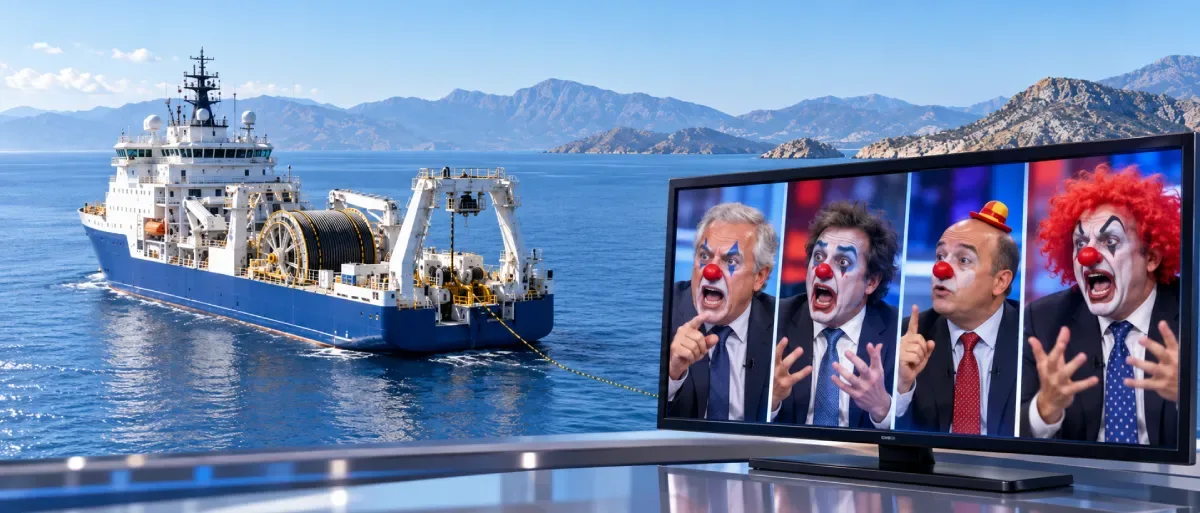
Possibility is sold as the likely outcome. A military scenario becomes a forecast. A survey vessel is cast as the opening scene of the next confrontation. An exercise becomes evidence that war is approaching. A map is promoted from argument to destiny.
Fear attracts an audience. An audience can bring airtime, status, influence and money.
I am not alleging that a particular person is paid to manufacture a Turkish threat. I am describing an economy in which the most alarming interpretation of a real problem can also be the most rewarding one.
The Great Sea Interconnector is a good place to begin because the dispute beneath it is serious enough without embellishment.
A Cable, Two Verbs and the Real Dispute
The Great Sea Interconnector (GSI) is intended to connect the electricity grids of Greece and the Republic of Cyprus, with Israel part of the longer-term design. The dispute concerns seabed work along a route crossing waters where Greece and Türkiye maintain incompatible continental-shelf claims.
Athens and Paris have been working on a formula for renewed surveys east of Kasos and Karpathos.
Nexans would notify Ankara.
It would seek authorization from Athens.
Two verbs carrying very different political weight.
The Greek-French position is that notification does not amount to a request for Turkish approval. Ankara attaches greater jurisdictional significance to being formally notified before work proceeds in an area it considers part of its continental shelf.
Anyone declaring victory or surrender before a survey vessel moves is getting ahead of the facts.
The legal argument is often compressed into a more convenient television question: does Türkiye have the right to approve the cable?
Article 79 of the United Nations Convention on the Law of the Sea (UNCLOS) gives states the right to lay submarine cables and pipelines on the continental shelf. It limits the coastal state's ability to impede those activities while preserving specified rights. The provision requiring coastal-state consent over the course applies specifically to pipelines.
Greece therefore has a serious legal argument against a general Turkish permission requirement for a submarine cable.
Article 79 still does not delimit an undelimited continental shelf or erase overlapping jurisdictional claims.
Türkiye is not a party to UNCLOS. Parts of the convention also reflect customary international law, so non-membership does not make every provision irrelevant to Ankara. Nor does invoking UNCLOS settle every Greek-Turkish argument by itself.
Remove the television language and the disagreement becomes clearer.
Athens is answering a question about permission.
Ankara is arguing about notification, jurisdiction, coordination and state practice.
I described this earlier as parallel monologues. Türkiye and Greece can speak continuously while answering different questions.
The cable has almost turned that metaphor into infrastructure.
The same gap appeared in the debate over who would notify Türkiye before renewed GSI surveys. Türkiye's position has centered on prior contact before work in waters where Ankara claims sovereign rights and jurisdiction. Greece insists that notification cannot be converted into a Turkish permission process.
Athens can say no Turkish authorization was sought. Ankara can say its objection entered the formal record.
Neither sentence requires the other side to surrender its position.
Retired Rear Admiral Ali Deniz Kutluğ has explained the Turkish concern to me in another legal vocabulary.
Continental-shelf rights, he notes, arise ipso facto and ab initio. Article 77 of UNCLOS states the principle more directly: those rights do not depend on occupation or an express proclamation.
That establishes the existence of continental-shelf rights. It does not establish where the Greek-Turkish boundary lies.
Kutluğ's concern is about conduct. If a state repeatedly operates in an undelimited area on the assumption that its jurisdiction is uncontested, that conduct may later enter the political or legal record.
A cable does not create a boundary. A survey vessel does not delimit a continental shelf.
But states care about practice because practice leaves a record.
The Seville Map helps explain Ankara's sensitivity.
The European Commission has said that the European Union has no competence to establish or delimit national maritime zones and that the so-called Seville Charter, produced by an external party, has no legal significance.
Yet the map acquired a political life far beyond its legal status.
Some Turkish commentators still speak as though Greece persuaded Brussels to adopt it as official European maritime law.
It did not.
The map did not create law. It acquired a political afterlife.
That history helps explain why Ankara worries that technical practice around GSI could later be narrated as something more than technical practice. One can understand the concern without accepting every Turkish legal argument.
Greek Member of the European Parliament Nikolas Farantouris offered a useful example when he described waters around Kasos as "European waters".
GSI is a European project.
The legal status of the waters through which it passes is another question.
Political Capital
Politicians belong in a different category from commentators.
Nikos Dendias is Greece's defense minister. He is overseeing a genuine military modernization program that includes Agenda 2030 and the Achilles Shield defense architecture.
Greece has every right to strengthen its armed forces.
At Defence Exhibition Athens (DEFEA) in May, Dendias rejected "ad hoc anti-Turkish coalitions," said Greek policy was not "turco-centric" and cautioned against reading everything through a Turkish lens.
At other moments, he has explicitly described Türkiye as a threat and invoked that threat when explaining the need for stronger deterrence.
Both positions can coexist. A defense minister can regard Türkiye as a serious military contingency without making Ankara the organizing principle of every Greek foreign-policy decision.
The political usefulness of the Türkiye file remains plain.
It can move to the foreground when defense spending needs explanation. It can recede when Greece presents itself as a wider European and Mediterranean actor. It returns easily when domestic politics give the threat renewed value.
Military modernization creates capability. It can create political capital too.
Adonis Georgiadis shows how portable the subject has become.
He is Greece's health minister, yet Türkiye repeatedly enters interventions far removed from health policy. That recurring pattern in his public rhetoric, including particularly provocative anti-Türkiye remarks, matters because the subject performs a political function well beyond his portfolio.
In September, while discussing the danger of political instability after an election, Georgiadis invoked Türkiye and Greece's historical vulnerability during periods of weak government. The government spokesman declined to endorse an alarmist reading and warned against creating public panic.
The striking part is how easily Türkiye entered a debate over domestic political stability.
Everybody understands the emotional currency.
The Fear Market
Politics has its incentives. The media economy has others.
A Greek may believe Türkiye is dangerous. A former officer may argue that Greece needs more weapons. A journalist may distrust Erdoğan. An analyst may conclude that Türkiye represents Greece's principal long-term security concern.
Someone may dislike Türkiye and still argue honestly.
The issue is method.
A professional knows the difference between evidence of a possibility, evidence that makes an outcome plausible and evidence strong enough to support a conclusion.
Problems begin when those categories are collapsed.
A scenario becomes a prediction. A prediction becomes certainty. A technical dispute becomes surrender. Even calm can be offered as evidence that something worse is being prepared.
At that point the audience is no longer being helped to assess risk. It is being trained to expect disaster.
The names I repeatedly encounter in this media environment include Michalis Ignatiou, Stavros Lygeros, Manolis Kotakis, Pantelis Savvidis, Savvas Kalenteridis, Giannis Theodoratos, Aris Portosalte, Alexia Tasouli, Manos Niflis, Dimitris Oikonomou, Akis Pavlopoulos, Fanis Papathanasiou, Nikos Manesis and Nikos Evangelatos.
They are not interchangeable. They include analysts, columnists and presenters, and some host arguments they do not personally endorse.
Their inclusion here does not mean every article, question or television appearance by each of them belongs in the same category.
I am describing a media environment they inhabit, feed or amplify, one in which Turkish danger has become a remarkably durable product in Greek public life.
Fear has commercial value.
It produces viewers, ratings, clicks and reach. Reach can become influence, invitations, access, professional standing and money.
Three recent examples explain why I think the problem deserves a harder name.
Giannis Theodoratos appeared in September under a headline warning that "the hourglass is running" and that the "autumn of the Blue Homeland" was coming. His analysis placed Greek deterrence against a renewed Turkish challenge at the center of the discussion.
These are legitimate subjects.
The method becomes questionable when almost every path leads to the next confrontation.
If visible tension proves danger and calm can also be interpreted as preparation for danger, reality has little chance of disproving the thesis.
Savvas Kalenteridis works in the same environment with a different style.
In September he argued that Türkiye had concluded Greece would keep retreating and wanted "half the Aegean without firing a shot."
It is an effective sentence.
It compresses disputes over territorial waters, continental shelf, airspace, islands, treaties, navigation and deterrence into one image.
Something belongs to you. Someone is taking half of it. Your government may be allowing it.
The legal file disappears. The emotional conclusion survives.
Kalenteridis has also argued elsewhere that Türkiye should neither be underestimated nor exaggerated and that strategy should rest on data rather than propaganda.
I agree with him there.
The real test is whether that discipline survives when the subject returns to television.
Michalis Ignatiou's treatment of GSI offers another example.
In August, he expressed alarm at reports that the French company involved in the project might need Turkish permission, tied the issue directly to Greek sovereignty and attacked anticipated critics of his position.
Now return to the wording actually under discussion.
Notification to Ankara.
Authorization from Athens.
Collapse both into "permission" and the reader gets a story of capitulation.
Keep the verbs separate and the harder questions remain.
Who has jurisdiction? What legal meaning does notification carry? What does the conduct of each state put on the record?
Expertise should help an audience work through those questions.
Fear is easier to package.
Permanent warning has another professional advantage.
If a crisis eventually occurs, the commentator can say: I warned you.
If nothing happens, there will be another maritime warning, another aviation notice, another exercise, another survey vessel, another ministerial statement.
Another autumn.
The prediction expires.
The prophet remains.
I have a word for the deliberate collapse of possibility, probability and certainty when the person doing it knows the difference.
Not error. Not nationalism. Not pessimism.
Charlatanism.
The States Refuse the Script
There is a problem with the permanent-emergency narrative.
The states themselves often refuse to behave as though war is around the corner.
Recep Tayyip Erdoğan has used harsh language toward Greece. A Turkish journalist has no reason to sanitize that record.
The "one night we may suddenly come" rhetoric existed. Athens objected to it.
I have read some of Erdoğan's harder rhetoric toward Greece as domestic political consumption. That is my interpretation, not a claim about his private motives.
His public record contains another register too.
On September 24, Erdoğan said that Türkiye is not Greece's enemy. He described the countries as neighbors and North Atlantic Treaty Organization (NATO) allies and said their relationship was too important to turn into election material.
Prime Minister Kyriakos Mitsotakis has spoken about rebuilding trust, keeping channels open and preventing unwanted crises while maintaining Greece's legal positions.
Foreign Minister Giorgos Gerapetritis has described the relationship as functional despite serious differences and argued that diplomacy has value precisely because disagreements remain.
Then came Aglaia Balta.
On October 1, as Greece assumed the rotating presidency of the United Nations Security Council, Greece's permanent representative was asked why Greek-Turkish disputes should not be discussed there.
Her response was almost disarming.
"Why discuss?"
She said Greece had good relations with Türkiye and referred reporters to Erdoğan's General Assembly speech.
Nothing had been solved.
The continental shelf remained undelimited. Territorial waters remained disputed. Cyprus remained divided. GSI remained contested. Greek and Turkish armed forces continued preparing for contingencies.
States do not need a settlement before they manage a dispute.
A military can prepare for war while a government tries to prevent it. A foreign ministry can protest in the morning and keep talking in the afternoon.
Commentators carry none of the consequences borne by governments.
A commentator who predicts confrontation and gets it wrong can return the following week.
A government that treats every prediction as certainty can get people killed.
Give Greek Diplomacy Its Due
A Turkish writer making this argument should also say something Turkish commentary too often avoids.
Greek diplomacy has often been good at its job.
Across governments of different political colors, Athens has maintained considerable continuity in its regional relationships.
As Türkiye's relationship with Israel deteriorated, Greece expanded its ties with Israel. After Ankara's relationship with Cairo collapsed following Mohamed Morsi's removal, Greece and the Republic of Cyprus deepened relations with Egypt. Athens also expanded strategic ties with the United Arab Emirates and Saudi Arabia during periods when Türkiye's own relations with those governments were strained.
Those relationships were not created simply because Türkiye had problems with the same capitals. Every government involved had interests of its own, and Greece had something to offer.
Still, Ankara created openings.
Athens saw them and used them.
That deserves credit.
A foreign ministry is supposed to recognize diplomatic space and occupy it.
Acknowledging Greek competence does not require accepting Greece's maritime claims. It requires looking across the Aegean without lying to yourself.
That competence also makes permanent panic around Türkiye harder to justify.
Mitsotakis and Gerapetritis can defend Greek positions without acting as though every morning is the eve of war.
Their room is constrained by defense politics, party competition, public opinion, the media and Cyprus.
I have argued before that decisions by the Republic of Cyprus government can narrow Athens's room in managing Türkiye.
The Republic of Cyprus does not dictate Greek foreign policy.
Greek-Turkish relations simply do not exist in a bilateral vacuum.
Journalism should make those pressures easier to understand, not add another alarm.
Türkiye Has Its Own Version
The same scrutiny belongs on my side of the Aegean.
Türkiye has real maritime interests. Its continental-shelf arguments deserve serious legal examination.
The geography of the Aegean is unusual. The effect to be given in maritime delimitation to islands lying very close to the Anatolian mainland is a genuine legal question.
I have argued that for years, along with something less popular: Türkiye can weaken a serious case through the language used to defend it.
In "Legitimate Claims, Faulty Framing: The Strategic Cost of Blue Homeland", I criticized the concept while preserving what I regard as Türkiye's legitimate underlying maritime rights.
My argument was simple:
The strongest Turkish case is not built by making the map louder. It is built by making the legal argument harder to dismiss.
I still believe that.
My problem with Blue Homeland is not Türkiye's continental shelf. It is the conversion of a state interest into an identity.
A doctrine becomes a slogan. The slogan becomes a loyalty test. Particular people begin behaving as though the country's maritime rights belong to them.
They do not.
Türkiye did not acquire maritime interests because somebody gave them a name.
No retired admiral owns Türkiye's continental shelf.
No academic owns the Aegean.
No television commentator owns the national interest.
Nobody gets to issue certificates of patriotism to everyone else.
This part is personal.
Among journalists and academics I know, the difficulty of criticizing Blue Homeland while still defending Türkiye's underlying maritime claims has almost become a private joke.
You can defend those rights, challenge Greek positions and argue forcefully for Turkish interests. Question the doctrine, its packaging or the personalities who have built public authority around it, and the atmosphere changes quickly.
I did question it.
Some circles closely identified with Blue Homeland gained visibility and status through promoting it. Some blocked me on social media after my criticism.
The Turkish state did not silence me. I was not persecuted. A social-media block is not martyrdom.
The reflex interests me.
A national concept had become fused with personal identity. Criticize the formulation and some people hear criticism of themselves. Criticize them and the criticism can be recoded as hostility toward Türkiye.
It is a convenient arrangement, and it produces the same economy of tension I see across the Aegean.
Some people gain from alarm. The reward may be airtime, followers, invitations, status, political access, influence or money.
Others pay for challenging it through exclusion, labeling, closed professional circles or suspicion about loyalty.
I have no interest in presenting myself as a victim.
I am interested in the incentive.
The person who tells the public that danger is greater, closer and more certain can be rewarded.
The person saying, "The problem is real, but your diagnosis is wrong," often occupies the harder position.
I cannot expose a Greek fear market and then applaud its Turkish equivalent because it carries my flag.
Professional Honesty
I have no problem with a Greek who dislikes Türkiye.
I mean that literally.
A Greek nationalist has the right to his nationalism within democratic and legal boundaries. A conservative has a right to his worldview. A leftist has a right to his. Someone may believe almost every Turkish argument in the Aegean is wrong.
Make the case.
Show the evidence.
Defend it.
My objection begins when professional authority is used to turn prejudice, exaggeration or speculation into fact.
Journalists know that possibility is not certainty. Analysts know that a scenario is not a forecast. Academics know that a map is not law. Officers plan for outcomes because the future is uncertain. Politicians know deterrence does not make conflict inevitable.
If you know the difference and erase it because fear attracts a bigger audience, the problem is no longer your politics.
It is your professional honesty.
Socrates
Which brings me to Socrates.
For me, Socrates remains the greatest Hellene.
Athens accused him of corrupting the young and of impiety and condemned him to death in 399 BCE.
The irony has outlived his judges.
The man Athens executed for corrupting its youth became one of the foundations of the intellectual civilization through which Athens still speaks to humanity.
There is another way to corrupt public life.
Teach people to stop asking questions.
Teach them that doubt is weakness and criticism disloyalty. Hide uncertainty. Turn every dispute into hostility and every military scenario into tomorrow's war. Reward the loudest patriot instead of the most accurate one.
Make fear more valuable than truth.
Socrates paid for his questions with his life. Those who teach people not to ask questions often pay no price at all.
Some are rewarded with another television appearance.
Socrates asked Athens to examine itself.
More than 2,400 years later, that remains the harder form of patriotism.
Türkiye and Greece will continue to disagree.
Their armed forces will prepare. Their diplomats will negotiate. Their ships will keep sailing the same sea.
Long after today's panels disappear.
Long after today's reputations are gone.
States endure.
Television fame does not.
And the Aegean will still be there when today's charlatans are forgotten.