
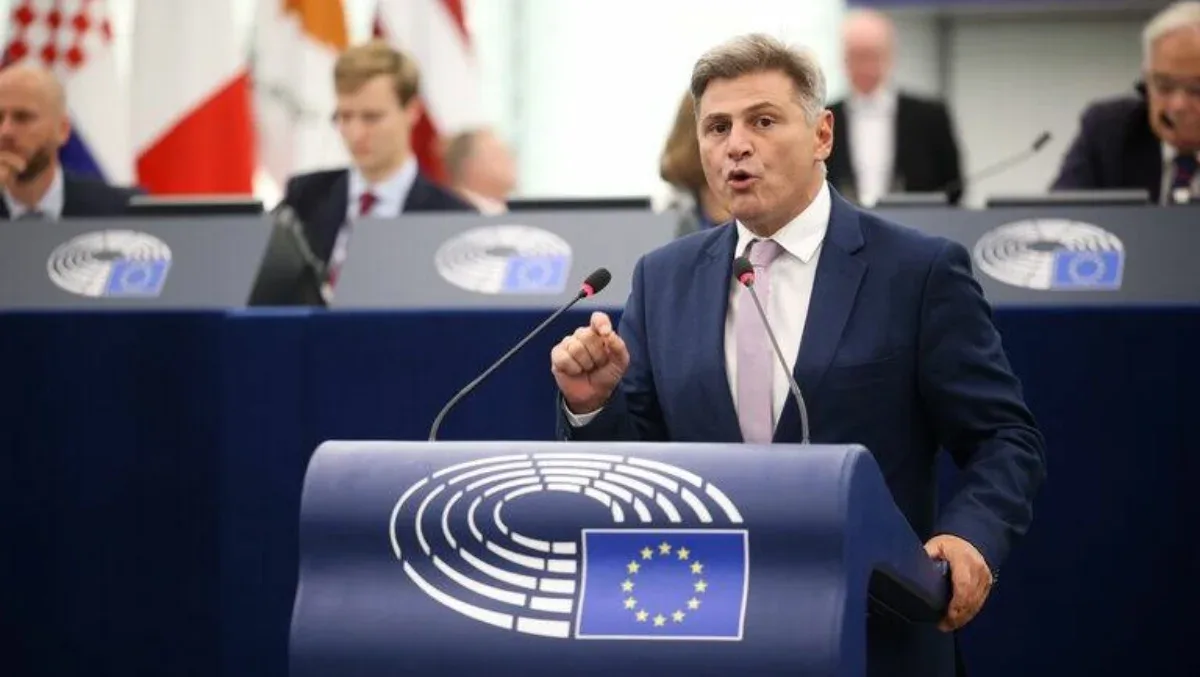
By Murat Yıldız
On September 4, Nikolas Farantouris, a Greek Member of the European Parliament who sits with the Socialists and Democrats group, posted on X from Kasos. "Around me are not merely Greek waters. These are European waters," he wrote. Later in the same post, he said a third country was using military power to obstruct a European project "on European territory and in European waters" and condemned revisionism against European member states in both the north and the south.
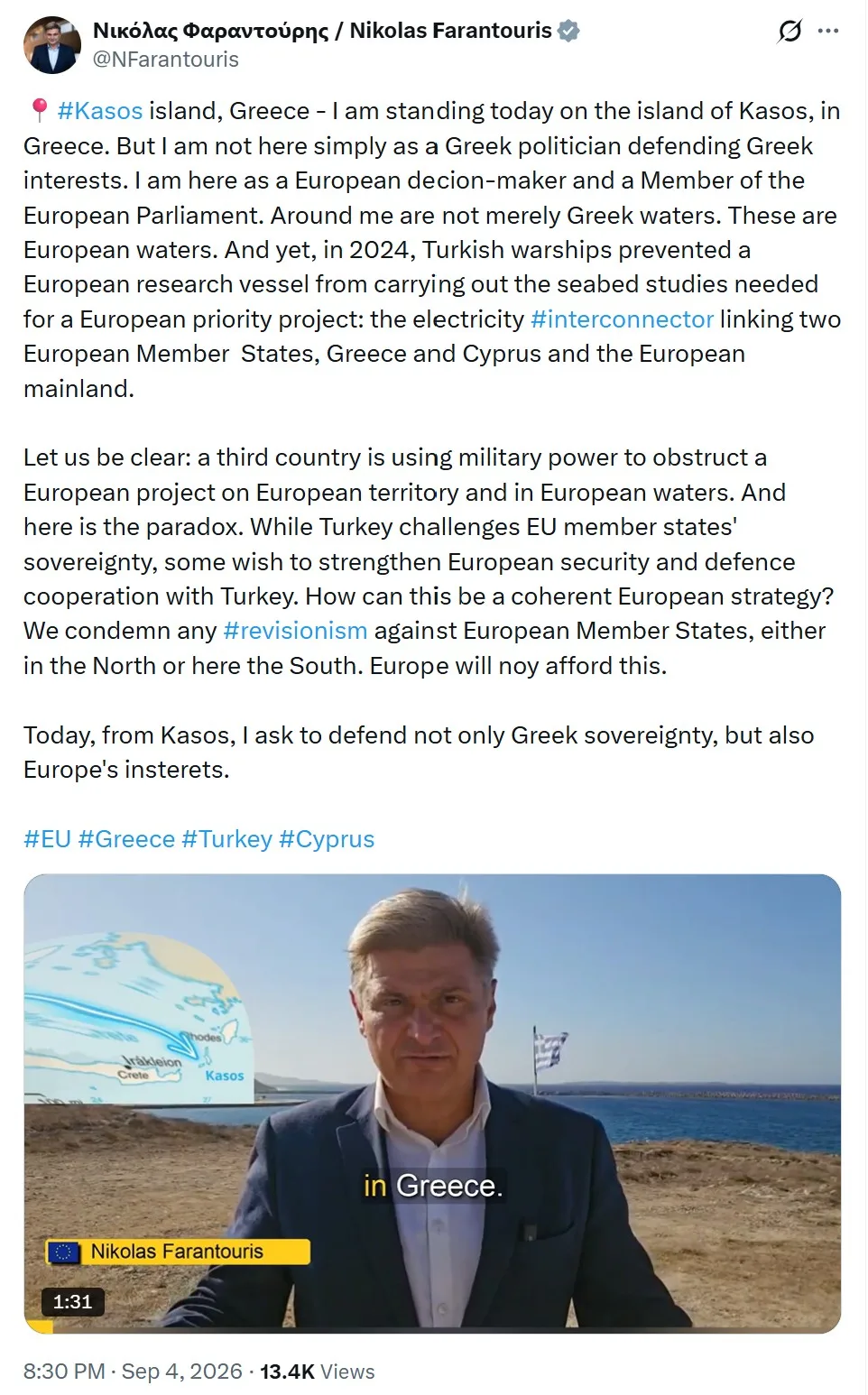
One word caught my attention. "European."
I went back through Farantouris's record. The core elements were already there. Maritime positions advanced by Greece and the Republic of Cyprus were being presented as European rights. Disputes with Türkiye were appearing in EU security, defense, industrial and trade files.
Farantouris comes to this language with an extensive background in EU law. He is a professor of EU law and policies at the University of Piraeus, holds a DPhil in EU law from Oxford, was awarded a European Jean Monnet Chair in 2011 and served as Greece's Public Gas Corporation DEPA's general counsel and a board member.
He was elected in 2024 on the SYRIZA list and sat with The Left in the European Parliament. SYRIZA removed him from its European Parliament delegation and then expelled him from the party in January 2026. He sat as an independent until late April, when he left The Left and joined PASOK-KINAL, moving to the Socialists and Democrats group.
Kasos itself is Greek territory. Offshore, the dispute concerns maritime jurisdiction and overlapping continental shelf and exclusive economic zone claims, not sovereignty over the island. Farantouris puts undisputed Greek territory beside waters where Greece and Türkiye contest jurisdiction.
His post also sits uneasily with Athens' account of the 2024 survey. Farantouris now describes Türkiye as having blocked the work. Foreign Minister George Gerapetritis said it was completed "100% according to plan."
From Greek Rights to European Rights
On January 6, 2025, Farantouris submitted written question E-000015/2025, titled "European maritime strategy and the prospect of the creation of an EU EEZ."
He described maritime rights held by EU member states as "European rights," identified Türkiye as a "revisionist" power challenging them in the Eastern Mediterranean and asked whether the Commission would consider a "European EEZ" based on the Seville Map.
The Commission replied on February 28. Under the United Nations Convention on the Law of the Sea, coastal states establish and delimit their maritime zones. "The EU has no competence regarding the establishment/proclamation and delimitation of maritime zones."
It also described what it called the "Seville Charter" as a regional map created by an external party that "holds no legal significance."
Farantouris had asked Brussels to treat member-state maritime rights as European rights and to consider an EU-level maritime zone. The Commission said the EU could defend its interests and those of its members against breaches of international law. It did not accept that the Union itself could establish or delimit those zones.
The Seville Map Returns Through EU Policy
On April 2, Farantouris brought the Seville Map into the European Oceans Pact debate. He called for a legally binding and mandatory pact and urged Commissioner Costas Kadis to start building on the map.
Kadis was the commissioner who had answered Farantouris on behalf of the Commission in February, stating that the map had no legal significance and that the EU lacked competence to establish or delimit maritime zones.
Five weeks before the April intervention, the Court of Justice of the European Union ruled in Case C-128/24 that Greece had failed to draw up and communicate its maritime spatial plan by the March 31, 2021 deadline. EU law requires such plans to organise competing maritime uses, including energy, shipping and environmental protection. The Commission's case record says Greece acknowledged the failure in its response to the reasoned opinion.
Nothing in the record proves that Farantouris was trying to sidestep the Commission's February answer. What is clear is that Brussels had denied the Seville Map legal significance and Farantouris continued to use it in another EU policy debate.
Across those records, maritime positions advanced by Greece and the Republic of Cyprus acquire a European identity.
The GSI Story Gets Narrower
Farantouris's description of the problems surrounding the Great Sea Interconnector (GSI) changed over the following year.
In written question E-003419/2025 on September 4, 2025, he described the planned electricity link between Greece and the Republic of Cyprus as serving EU energy integration, diversification and security of supply. He accused Türkiye of attempting to obstruct it through threats of force and claims he described as illegal.
The document also named another source of delay. Farantouris cited disputes involving the Greek and Republic of Cyprus governments and the project operator over their obligations and the project's economic viability. He said those disagreements were causing "additional delays."
By August 27, 2026, his emphasis was different. Writing about Turkish maritime parks, NAVTEX notices and Greek-Turkish relations, Farantouris placed the earlier obstruction of cable laying within what he described as Türkiye's gradual creation of faits accomplis at sea.
He dismissed the explanations for the cable's three-year delay as pretexts, listing weather, updated technical and economic studies and possible participation by additional companies. The disputes between authorities in Greece and the Republic of Cyprus that he had explicitly recorded in September 2025 no longer appeared in his account.
On August 5, an agreement was signed for French infrastructure investor Meridiam to become GSI's majority shareholder. The project already had EU financial backing.
European money still does not draw a maritime boundary.
Farantouris Breaks With Athens' 2024 Account
The 2024 Kasos record is harder to reconcile with Farantouris's current account.
In July 2024, the Italian-flagged Ievoli Relume was conducting seabed surveys south of Kasos and Karpathos for the interconnector. Türkiye deployed warships after the vessel moved through an area where Ankara asserts continental shelf rights and Greece rejects the Turkish claim.
Türkiye's Defense Ministry later said Turkish forces had thwarted the July survey activity in what Türkiye regards as its continental shelf.
Athens said otherwise.
On September 7, 2024, Gerapetritis said in an official Foreign Ministry interview that the Turkish ships had withdrawn after 24 hours, no Turkish right had been accepted, no permission had been requested and the research had been completed "100% according to plan."
Four days later, he repeated the point. The company itself, he said, had confirmed that the survey was completed fully according to plan. Claims that it had not been completed were "false."
Two years later, Farantouris returned to the episode from Kasos and described Türkiye as having blocked the surveys.
On the outcome of the 2024 episode, Farantouris's current description matches Ankara's stated account more closely than Gerapetritis's public account.
From the Northern Flank to the South
Months before the Kasos post, Farantouris had asked Brussels to extend its eastern-border security policy southward.
On February 24, 2026, he submitted written question E-000767/2026 after the Commission introduced a strategy for EU regions bordering Russia, Belarus and Ukraine.
Executive Vice-President Raffaele Fitto had described those frontiers as "not only national borders" but "European borders." Farantouris asked why Greece and the Republic of Cyprus were not explicitly covered and whether the Commission recognised what he called "the Turkish threat" as a destabilising factor for European security at the eastern border.
Kasos is an interstate maritime jurisdiction dispute involving a research vessel and naval deployments, not a Russia-Belarus hybrid-threat case. Farantouris did not equate Türkiye with Russia. He asked Brussels to extend the eastern-border security category to Greece and the Republic of Cyprus, with Türkiye named as the threat.
In an April 2025 article following an inter-parliamentary security and defense conference in Warsaw, Farantouris called for a collective guarantee of the Union's external borders and operational arrangements for the mutual-assistance clause under Article 42(7) of the Treaty on European Union. He also argued against EU defense and security cooperation with Türkiye while, in his account, Ankara failed to respect member-state borders, international treaties and the law of the sea.
Defense Access
The Security Action for Europe (SAFE) instrument later supplied a legal test for that political position.
Article 17 allows entities from certain third countries to participate under specified conditions. For Türkiye, those conditions include an international agreement under Article 218 of the Treaty on the Functioning of the European Union.
In its August 11, 2025 answer to E-002181/2025, the Commission said the EU had concluded no such agreement with Türkiye and Turkish companies were therefore not authorised to participate in SAFE common procurements.
SAFE did not permanently exclude Türkiye. It set conditions that had not been met. Farantouris's argument goes further by making Türkiye's disputes with Greece and the Republic of Cyprus relevant to whether access should be opened at all.
Customs Union as Leverage
On March 5, 2026, Farantouris used written question E-000926/2026 to challenge the treatment of Turkish products under the proposed Industrial Accelerator Act.
He argued that the EU-Türkiye Customs Union did not amount to participation in the single market or equivalent access to European industrial regimes. He then warned against integrating production from a non-EU country which, in his words, "threatens the sovereignty and security of Member States."
The Commission's April 24 answer left the existing legal structure untouched. The proposal did not amend the EU-Türkiye Customs Union. For specified Union-origin requirements, content originating in countries with which the EU has a customs union, including Türkiye, can be deemed equivalent to Union origin.
On September 2, Farantouris said he had filed another question asking the Commission to connect alleged illegal activity by Turkish fishing vessels with discussions over deepening and modernising the EU-Türkiye Customs Union.
Fishing rules, industrial-origin requirements, defense procurement and maritime delimitation are separate legal files. Farantouris repeatedly asks EU institutions to make conduct in Greek-Turkish disputes relevant to Türkiye's access in those other fields.
Where Brussels Stops
A separate April 1 Commission answer to Greek MEP Emmanouil Kefalogiannis, E-000411/2026, matters because it describes the continental shelf and exclusive economic zone dispute between Greece and Türkiye as "unresolved."
Kaja Kallas, answering on behalf of the Commission, also called on Türkiye to respect member states' sovereignty over their territorial sea and airspace and their sovereign rights, including rights over natural resources.
Kallas returned to that distinction on July 30 in her answer to Farantouris, E-002335/2026. Again, sovereignty over territorial sea and airspace was treated separately from sovereign rights under international law.
Territorial sovereignty, sovereign rights over a continental shelf or EEZ and the delimitation of overlapping maritime claims are different legal categories.
Brussels has repeatedly backed Greece and the Republic of Cyprus on sovereignty, sovereign rights and strategic infrastructure. Its legal answers preserve those distinctions. They do not turn political solidarity into EU maritime jurisdiction. The February 2025 response had already said the Union cannot establish or delimit maritime zones and that the Seville Map has no legal significance.
Farantouris's record goes beyond a sequence of anti-Türkiye statements. Greek and Republic of Cyprus positions repeatedly enter his EU vocabulary as European rights, European borders and European security interests. Disputes with Türkiye then surface in arguments over defense, industrial policy and Customs Union access.
The Commission's answers set the institutional limit. Political solidarity and support for strategic infrastructure do not create EU maritime jurisdiction or settle an unresolved delimitation.