
By Bosphorus News Defense Desk
Greek Defense Minister Nikos Dendias has detailed the systems Athens intends to use to close the military technology gap he acknowledged earlier this week, without referring directly to Türkiye while tying the operational framework to the Aegean, Evros and Cyprus.
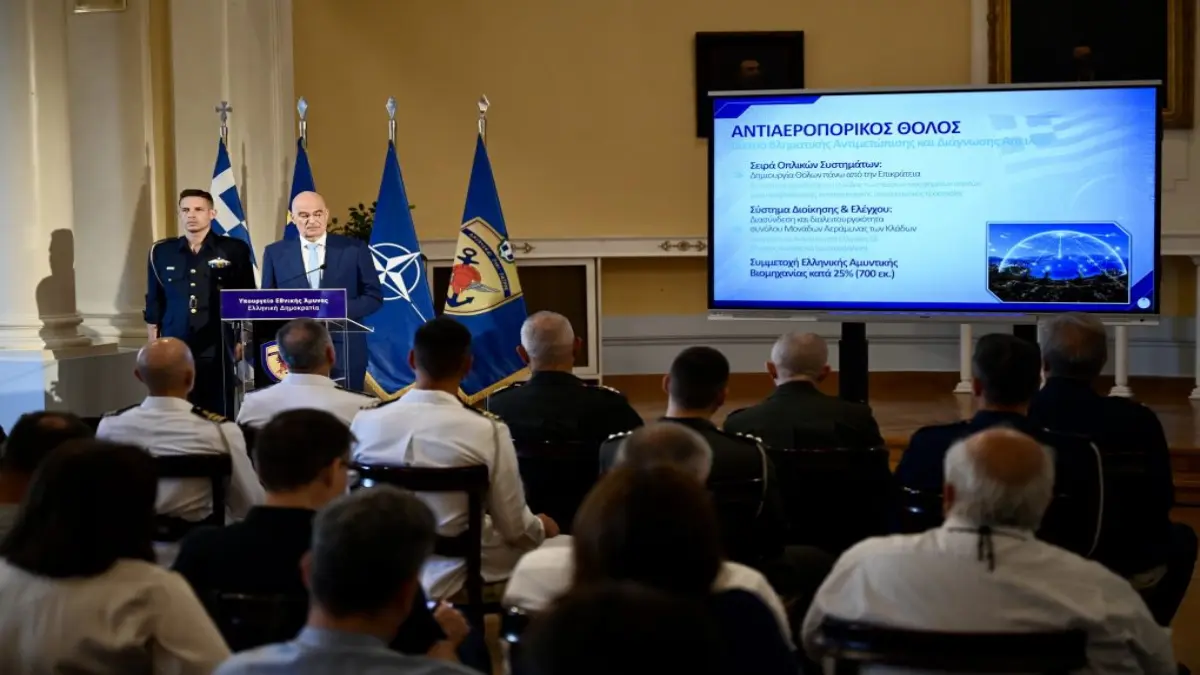
Dendias presented the programs on July 23 after Greece's Government Council for National Security, known as KYSEA, approved a new group of defense procurements under the country's long-term modernization plan.
The package is centered on Achilles Shield, a nationwide air, ballistic missile and counter-drone network expected to cost slightly more than €3 billion and become fully operational within 35 months.
The system will combine overlapping defensive layers with a single command-and-control architecture capable of receiving information from sensors across the armed forces, processing and prioritizing the data, and recommending targeting and response options.
Dendias described the transition as a move from the older C4I model to C5ISRT, bringing command, control, computing, communications and cyber functions together with intelligence, surveillance, reconnaissance and targeting.
The package gives operational form to the gap Dendias identified in an earlier speech, when he said Greece had fallen behind while an unnamed threat advanced in military technology.
He did not identify Türkiye as that threat then, and he did not mention Türkiye during the latest briefing. The operational geography he described, however, remained centered on areas that shape Greek planning toward Ankara.
Aegean, Evros and Cyprus enter the network
Ten additional V-BAT unmanned aircraft will support networked surveillance across the Aegean and the Evros region, Dendias said. Greece already operates four V-BAT systems, and the new aircraft could later be equipped with weapons.
The approved package also includes another Heron 1 unmanned aircraft, electromagnetic counter-drone systems and Greek participation in a small-satellite constellation capable of providing high-resolution imagery under national control.
A separate decision to acquire three C-390 Millennium aircraft introduces both faster airlift and aerial refueling capacity.
Dendias said the C-390s, which fly at roughly twice the speed of Greece's current transport aircraft, could significantly shorten transport missions to Cyprus or allow twice as many trips over the same period.
The aircraft will also be able to refuel Greece's Rafale and Mirage fighters in flight. Dendias said this could extend their endurance until limited primarily by the pilot's physical stamina rather than the aircraft's fuel supply.
The first C-390 is expected to arrive in 2027 under an interstate agreement with Portugal. The aircraft will also be capable of serving as mobile hospitals, while their airframes and engines are expected to be maintained in Greece.
Dendias did not present the acquisition as a response to Türkiye. His choice of Cyprus as the principal example of its transport value, combined with the tanker capability, nevertheless gives the procurement a clear Eastern Mediterranean operational dimension.
Source-code control and Greek industrial participation
Dendias said Greece would not normally acquire systems without access to their source code, particularly in command-and-control programs.
He argued that operating a C5ISRT network without the ability to alter its architecture would leave the country dependent even on its closest allies.
He also presented a minimum 25% Greek industrial share as a standing condition for new defense programs. For the €3 billion-plus air-defense order, he said domestic participation would exceed €700 million, with Israeli companies expected to establish production capacity in Greece and work with local firms.
The policy is designed to turn procurement into domestic production, maintenance and export capacity, although the division of high-value software, intellectual property and systems integration has not yet been disclosed.
Phasing out the S-300 era
Asked whether the new architecture would replace Russian-origin systems, Dendias said the system under discussion was the S-300.
He said it was not obsolete but had already been superseded by a newer system in its country of origin. Although it remains in Greek service, he described it as an "outgoing" part of the arsenal.
The remark points to Athens' planned transition away from the S-300 as Greece shifts toward an integrated network built around Western and Israeli technology, domestic production and sovereign command-and-control access.
Other approved programs include underwater vehicles for special operations, upgraded anti-submarine systems for Greece's four MEKO frigates and laser-guided Hellfire missiles for Apache helicopters.
Athens is also funding postgraduate training in the United States, particularly at the Massachusetts Institute of Technology, as part of an effort to build personnel capable of transferring new technical knowledge into the armed forces.
Dendias said a second phase of Greece's revised force structure and the next 2027–2037 armaments plan would be presented in September.
The latest package turns his earlier warning about Greece's technological position into a defined recovery program. Türkiye remained unnamed, but Dendias tied key elements of the plan to the Aegean, the Evros border region, Cyprus and the wider Eastern Mediterranean through networked surveillance, faster airlift, aerial refueling and integrated air and missile defense.
Sources: Greek Ministry of National Defense, Bosphorus News reporting and review.