
By Bosphorus News Defense Desk
Greek Defense Minister Nikos Dendias said Greece had fallen behind in military technology while an unnamed threat moved far ahead, linking the gap to Athens' accelerated integration of unmanned systems.
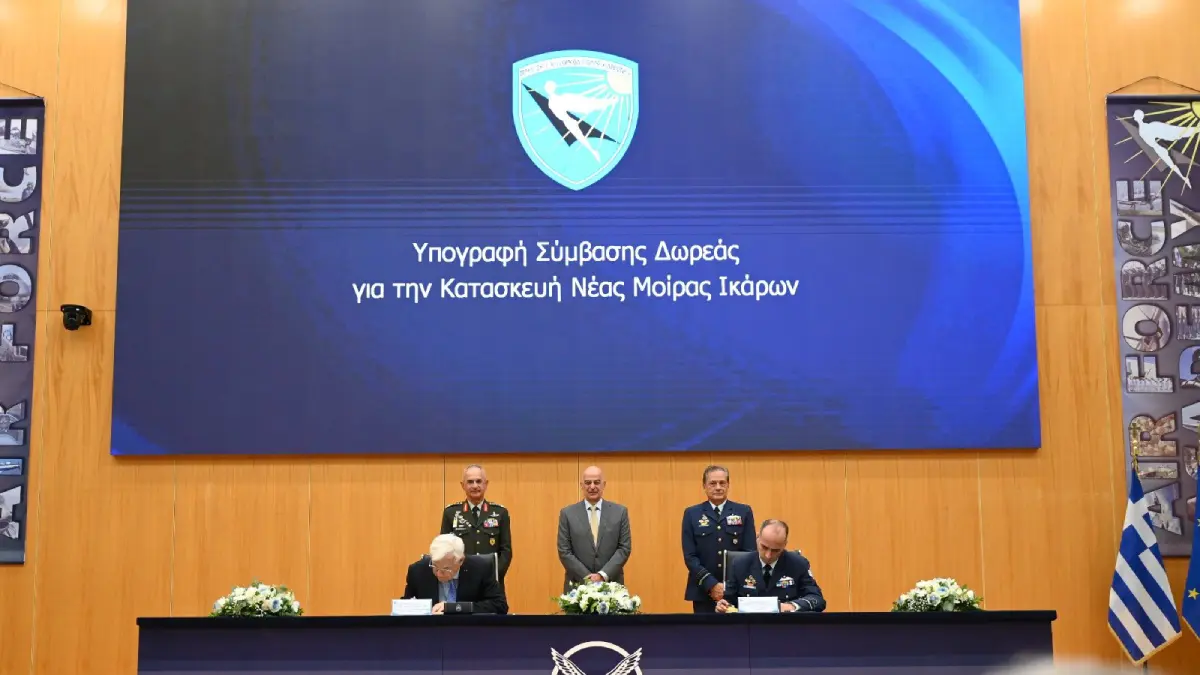
Dendias made the remarks at a ceremony for new facilities serving the Hellenic Air Force Academy's 5th Squadron. The event focused on military housing, personnel conditions and privately funded infrastructure, but the minister used it to underline the urgency of Greece's defence overhaul.
"If we do not integrate the new technologies, we will not be able to fulfil our mission," Dendias said. "And we will integrate them at tremendous speed, because we had fallen behind, because the threat had moved far ahead of us."
He did not identify the threat.
The remarks followed references to unmanned systems and Greece's expanding drone and counter-drone training structure. Dendias said the armed forces had to absorb technologies that had not been integrated at the required pace.
He said Athens aimed by 2030 to field the most modern and powerful armed forces in Greek history and, in his words, Europe's most modern armed forces.
An unnamed threat in a familiar setting
Dendias did not say that Türkiye was the threat he believed had moved ahead. The speech was not confined to the Aegean or relations with Ankara.
His earlier statements show, however, where Türkiye sits in Greek defense planning.
During a May visit to Agathonisi, a small eastern Aegean island close to the Turkish coast, Dendias warned against what he called "revisionist ambitions" and claims based on "non-existent rights." The remarks came as Türkiye worked on a maritime jurisdiction bill and Athens scrutinised Ankara's Blue Homeland doctrine.
From Agathonisi, Dendias tied island presence, military infrastructure and maritime rights to the same strategic argument. His latest remarks followed a similar pattern, using a military infrastructure ceremony to frame a broader defence posture.
The Agathonisi speech does not prove that Türkiye was the sole subject of his latest warning. It places the unnamed threat inside a Greek defence debate in which Türkiye remains the main conventional reference.

Achilles Shield as the response
Athens is not trying to close the gap simply by buying more aircraft, ships and missile batteries. Its stated objective is to connect sensors, weapons, unmanned systems and command structures within a single operational architecture.
Achilles Shield is the centrepiece. The five-layer concept covers anti-missile, anti-aircraft, anti-drone, anti-ship and anti-submarine defence.
Bosphorus News previously examined how the programme is built around island-based coverage across the Aegean, combining distributed sensors, layered interception and AI-enabled command and control to complicate mass attacks and raise their cost.
The approach moves away from matching Türkiye platform for platform. Greece instead wants to disperse defensive nodes, reduce reliance on a small number of fixed sites and shorten the interval between detection and response.
The model is particularly relevant against drones, where defenders can be forced to fire costly interceptors at much cheaper targets. The planned command layer is intended to classify incoming threats and recommend the appropriate response, preserving high-value missiles for higher-priority targets.
Greece's parliamentary armaments committee approved a defense package worth nearly €5 billion in March, including roughly €3 billion for Achilles Shield.
The wider package includes upgrading 38 F-16 Block 50 aircraft to the Viper configuration, preparing infrastructure for future F-35 fighters, supporting the C-27J transport fleet and modernising four MEKO-class frigates.
The 2030 plan extends beyond drones, bringing aircraft, naval platforms, missile defence, radar coverage, data links and command-and-control reform into the same modernisation drive.
Electronic warfare widens the gap
Türkiye's unmanned aviation sector is the most visible part of the technological comparison, but Athens is also watching capabilities designed to shape the electronic environment around aircraft, missiles and unmanned systems.
Türkiye's HAVA SOJ standoff electronic warfare aircraft has appeared in a more mature test configuration. The aircraft is designed to detect and analyse hostile emissions and interfere with radar and communications systems from outside heavily defended airspace.
The programme remains in testing and integration and should not be treated as fully operational. Its development nevertheless exposes a central vulnerability in networked defense: radars and interceptors depend on communications, sensor fusion and a functioning decision chain, all of which can be disrupted through electronic attack.
Athens now has to integrate systems from different suppliers, train personnel for new roles and maintain distributed coverage across the Aegean. Drone and counter-drone training must also move beyond specialist units and exercises into routine force-wide practice.
Dendias's admission frames the overhaul as an effort to recover ground that Athens believes has already been lost.
Sources: Greek Ministry of National Defense, Bosphorus News reporting and review