
By Bosphorus News Geopolitics Desk
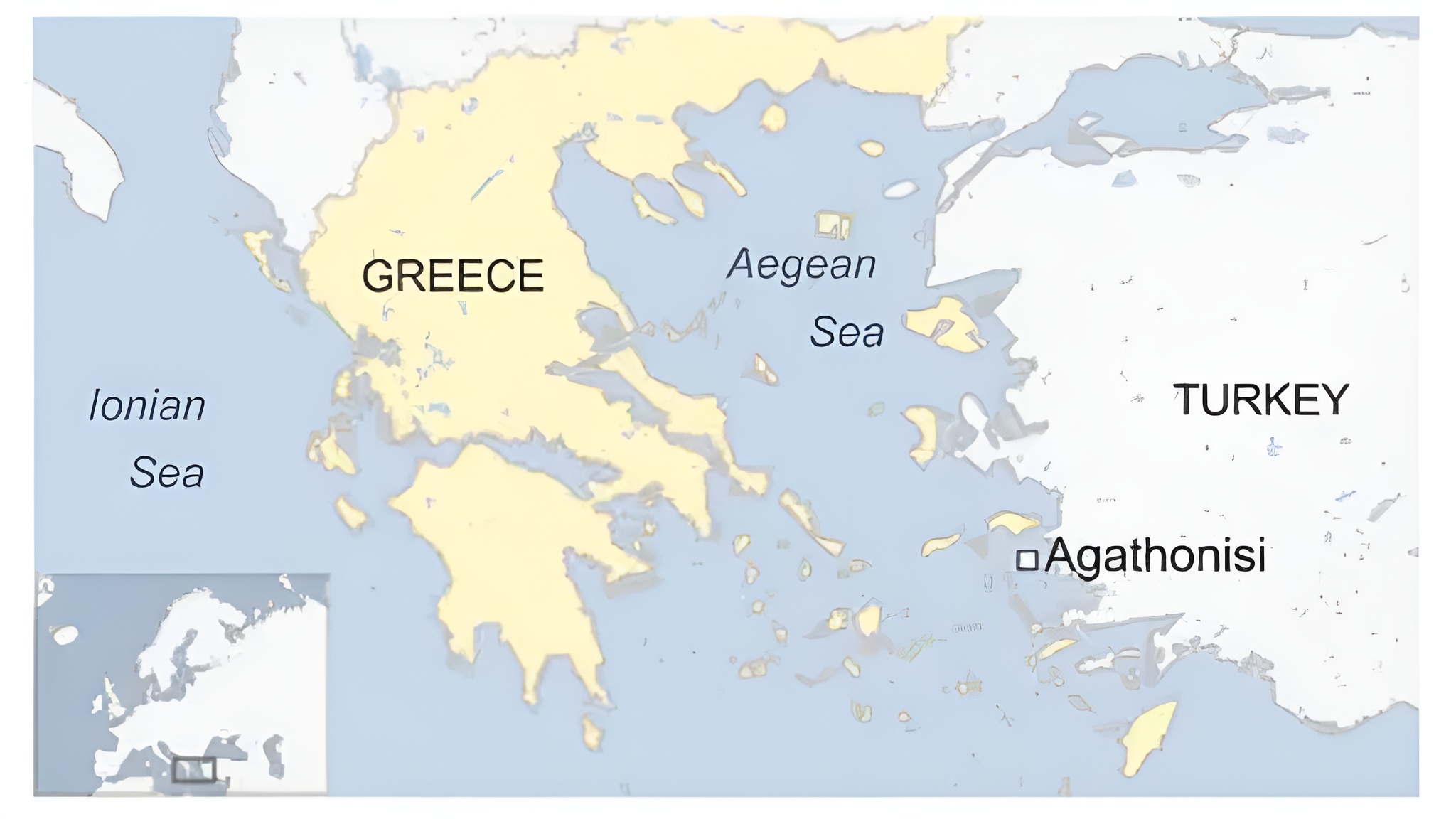
Greek Defence Minister Nikos Dendias used a visit to Agathonisi, a small eastern Aegean island roughly five miles from the Turkish coast, to warn against what he called "revisionist ambitions," turning a military housing ceremony into a pointed message over the Aegean as Ankara's maritime jurisdiction bill pushes the Blue Homeland debate into a sharper legal phase.
Dendias was on Agathonisi on May 14 for the inauguration of new military housing units, part of a broader Greek programme that gives priority to the eastern Aegean islands and Evros. The island has fewer than 200 residents and sits in one of the most sensitive parts of the Aegean, where military presence, island sovereignty and maritime rights are bound to the long-running Türkiye-Greece dispute.
He did not deliver the message from a ministry podium in Athens. He delivered it from Agathonisi, where military infrastructure, population retention and maritime sovereignty are part of the same strategic language. The setting carried its own message: Greece was linking island presence, military permanence and maritime rights in one of the most contested theatres of the Aegean.
The choice of location also fits a wider Greek defence pattern. Athens has been strengthening its eastern Aegean posture through infrastructure, deployments and long-range firepower debates, including the PULS rocket system map controversy that placed Greek strike ranges inside the regional security argument.
Dendias said Greeks were facing "revisionist ambitions" that had intensified through claims of "non-existent rights" and unilateral planning that violated international legality. He said those initiatives also ran against the United Nations Convention on the Law of the Sea, basic common sense and the principles of good neighbourly relations.
He added that all Greek islands enjoy the maritime rights provided under the United Nations Convention on the Law of the Sea, "no more, no less." The line went directly to one of the core legal disputes between Athens and Ankara: Greece's position that islands carry full maritime rights, and Türkiye's long-standing objection to the way Greek island claims could restrict Turkish access and jurisdiction in the Aegean and Eastern Mediterranean.
Ankara did not issue a direct response to the Agathonisi remarks. The Turkish official context came from the Ministry of National Defence, which confirmed the same week that work was continuing on a maritime jurisdiction bill designed to define responsibilities in Türkiye's maritime jurisdiction areas and address gaps in domestic legislation, moving the Blue Homeland dispute into a more formal legal phase.
Greek reporting has tied the draft bill to the Blue Homeland doctrine, reading it as a possible attempt to move Türkiye's maritime claims into a clearer domestic legal framework. Türkiye presents the work as a legal and administrative step linked to maritime jurisdiction, responsibilities and domestic legal gaps. Athens sees a broader risk that Ankara is preparing to give its maritime doctrine a stronger statutory basis.
The Agathonisi speech did not stand alone. It followed a week of renewed Greek attention to Türkiye's maritime moves, the Aegean cable route dispute, island security and the possible codification of Blue Homeland claims in Turkish domestic law.
Dendias's message also came during a broader Greek defence push. Athens has been moving ahead with the Achilles Shield air defence architecture, a multi-layered system tied to missile, air, drone, naval and island defence, while the Greek defence minister has used recent speeches to frame deterrence in sharper operational terms.
During the same week, Dendias also pressed Ukraine over an unmanned sea vessel found near Lefkada, saying he was still waiting for explanations promised by Ukraine's Defence Minister Mykhailo Fedorov. He described the matter as extremely serious because the craft carried explosives and endangered maritime navigation safety. Greek authorities have said findings will be passed to the coast guard and then to the judiciary.
The Lefkada case gave the Agathonisi remarks a wider maritime security context. Greece was dealing not only with Türkiye's legal moves in the Aegean, but also with a live security incident involving an explosive-laden unmanned vessel in Greek waters. Dendias used both issues to underline a harder maritime line.
The Agathonisi visit showed why this dispute is no longer confined to diplomatic language. Dendias was speaking from a small eastern Aegean island where Greece is investing in military housing, personnel retention and permanent presence. Ankara, at the same time, is working on a maritime jurisdiction bill that Greek officials and media read through the Blue Homeland lens. That overlap gives the moment its weight: one side is reinforcing the islands as lived and defended Greek space, while the other is preparing to give its maritime claims a clearer domestic legal frame. Between Agathonisi and Ankara's draft law, the Aegean argument is becoming less episodic and more institutional, carried by buildings, statutes, military planning and the geography each side chooses to put on display.
***Sources: Greek Ministry of National Defence; Turkish Ministry of National Defence; To Vima; Kathimerini; AMNA; Associated Press.