
By Bosphorus News Geopolitics Desk
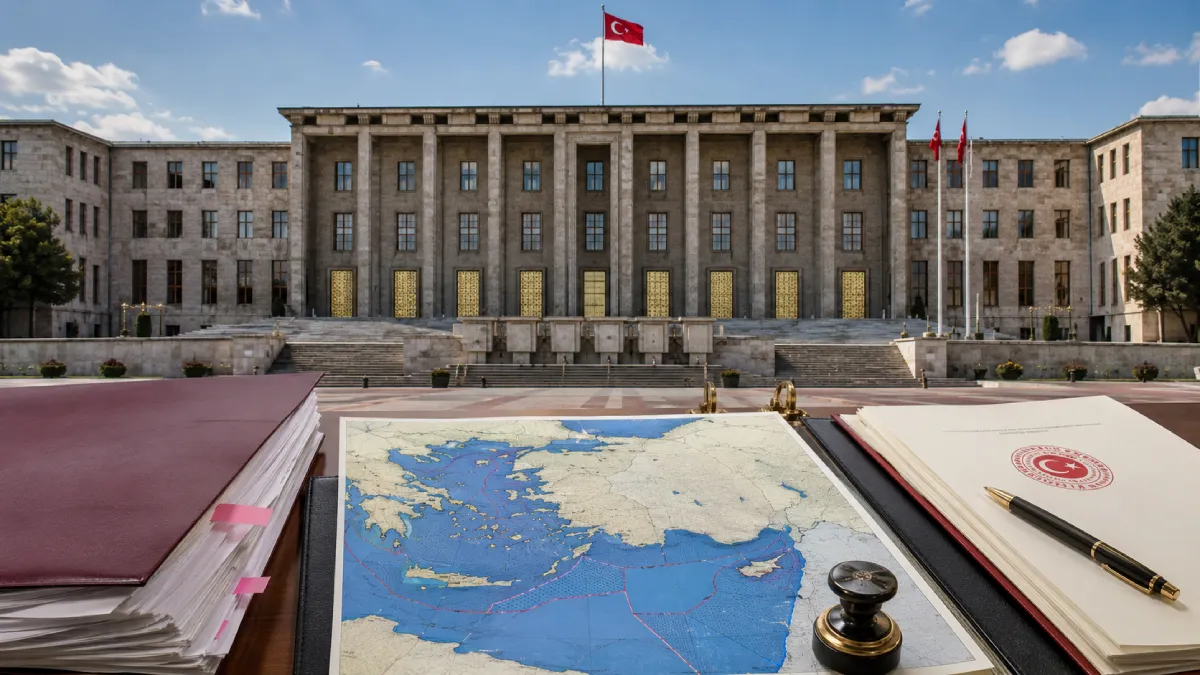
Türkiye moved its Blue Homeland doctrine closer to domestic law on May 12, after Ankara University's maritime law center said it had prepared a draft framework that could affect foreign economic, scientific and environmental activity in waters Ankara regards as its own.
The draft has not reached parliament as a formal bill. Ankara University's National Center for the Sea and Maritime Law, known by its Turkish acronym DEHUKAM, announced that it had prepared a draft law on Turkish maritime jurisdiction areas at a news conference attended by Çağrı Erhan, deputy chair of Türkiye's Presidency Security and Foreign Policy Council.
Erhan said he expected the draft to become an official proposal and then law "in a short period." That leaves the final legislative text, parliamentary timetable and implementation rules open, but moves the issue beyond a rumoured policy file and into a visible legal track.
The measure appears to bring four contested issues into a single domestic frame: the maritime effect of islands, Türkiye's six-nautical-mile position in the Aegean, Turkish approval for activity in maritime areas Ankara claims, and the legal logic of the 2019 Türkiye-Libya maritime memorandum.
The island question sits at the centre of the dispute. Greek media described the draft as reflecting Ankara's long-standing argument that islands should not generate maritime zones in a way that cuts off Türkiye's mainland projection in the Aegean and Eastern Mediterranean. Greece rejects that position and maintains that islands have maritime entitlements under international law.
The six-nautical-mile issue gives the draft a sharper Aegean edge. Türkiye's territorial waters remain at six nautical miles in the Aegean, while its territorial waters in the Black Sea and Mediterranean extend to 12 nautical miles. Ankara has treated any Greek extension of territorial waters in the Aegean beyond six nautical miles as a casus belli since 1995, arguing that such a move would sharply restrict Türkiye's access in the Aegean.
The approval mechanism could become the draft's most operational element. Turkish coverage of the DEHUKAM meeting said the proposed framework would regulate activities in maritime areas Ankara regards as falling under Turkish jurisdiction, including economic, scientific and environmental activity. The full scope of that authority has not been published in the form of a final bill.
The draft could also allow the president to declare "special status" maritime areas. That provision matters because marine protection, fishing controls, scientific research, offshore surveys and infrastructure work increasingly operate through regulatory designations rather than open military confrontation.
Athens has not issued a formal public response that Bosphorus News could locate at the time of writing. Greek media, however, reported that officials are monitoring the draft and view it as a domestic measure with no standing under international law. Kathimerini said Athens is following the legislation closely, while To Vima framed it as an attempt to formalize Ankara's contested sea-zone claims.
The draft follows a year of map-driven friction. Greece's maritime spatial planning initiative in 2025 drew Turkish objections, with Ankara arguing that some mapped areas overlapped with Türkiye's maritime jurisdiction claims. The dispute widened again in April 2026, when Türkiye's Ministry of Foreign Affairs rejected Greek fishing restrictions and maps that it said relied on "non-existent and fictitious maritime boundaries."
That official Turkish statement now looks less like an isolated protest and more like part of a legal sequence. Greece used maritime planning, marine parks and fishing restrictions to extend technical regulation into contested waters. Türkiye is now preparing a domestic legal instrument of its own.
The practical effect could be to move disputes from maps and diplomatic notes toward permits, enforcement claims and legal contestation. Research vessels, environmental designations, offshore surveys and energy infrastructure could become more exposed to competing legal frameworks if Ankara gives its maritime positions a clearer domestic-law channel.
The Eastern Mediterranean dimension is immediate. Maritime jurisdiction now shapes electricity interconnectors, offshore surveys, environmental zoning and energy infrastructure. Projects such as the Great Sea Interconnector, the planned Greece-Cyprus-Israel electricity cable, depend on legal assumptions that Ankara contests when it believes they bypass Turkish or Turkish Cypriot rights.
The timing is sensitive for that project. The cable is already facing financing and geopolitical pressure, with Cyprus warning that additional funding may be needed if costs rise. A harder legal frame around maritime jurisdiction would add another layer of risk to a project designed to connect Cyprus to the European electricity grid through Greece, with a later Israel link.
Ankara is likely to place Turkish Cypriot rights inside the same argument. Türkiye has long maintained that Eastern Mediterranean energy projects cannot be treated as legitimate if they ignore Turkish Cypriot claims around Cyprus. The draft gives Ankara another route to connect maritime jurisdiction, energy planning and the Cyprus file.
The Türkiye-Libya maritime memorandum remains a separate pressure point. Greek media have reported that the draft may incorporate or reinforce the logic of the 2019 memorandum, which Athens and the European Union have rejected. Ankara continues to treat the agreement as a valid part of its Eastern Mediterranean legal position.
The European Union track is already opening. Greek lawmakers have asked the bloc how it would respond if Turkish legislation were deemed to challenge Greek or Cypriot sovereign rights, placing the draft inside Brussels' wider debates over defence financing, energy security and Mediterranean infrastructure.
The North Atlantic Treaty Organization summit expected in Ankara gives the timing a wider diplomatic edge. Türkiye will host allies at a moment when its role in European security has become harder to separate from disputes with Greece and Cyprus.
Ankara contributes to the North Atlantic Treaty Organization's Black Sea posture, the Western Balkans, Baltic deterrence and southern flank planning, while remaining central to debates over defence production, regional access and military mobility. That wider role gives Ankara more room to argue that its maritime concerns cannot be separated from the security architecture allies rely on around Türkiye.
Türkiye views the Eastern Mediterranean through that security lens. Greece's expanding defence and energy coordination with non-North Atlantic Treaty Organization actors such as Israel, Cyprus and Egypt has reinforced Ankara's argument that its maritime concerns are part of a wider regional architecture forming around Turkish access, Turkish Cypriot rights and Eastern Mediterranean energy routes.
Fidan made that point at the Antalya Diplomacy Forum on April 19, arguing that the military alignment between Israel, Greece and the Greek Cypriot administration had a clear threat priority: "that is Türkiye."
France adds a further European military layer through its defence cooperation with Greece and Cyprus, giving the Eastern Mediterranean dispute a wider security frame beyond the Ankara-Athens legal file. India remains a more distant factor, but its defence and connectivity links with Greece and Cyprus, including the India-Middle East-Europe Economic Corridor, add another non-North Atlantic Treaty Organization layer Ankara is watching.
The timing places Türkiye's maritime law push beside its wider regional diplomacy. On the same day the DEHUKAM draft entered public view, Foreign Minister Hakan Fidan warned in Doha that the Strait of Hormuz should not be used as a weapon. Ankara is pressing safe passage abroad while trying to formalize its own maritime claims closer to home.
That parallel gives the draft a sharper political setting. Türkiye is asking for restraint and open passage at a global chokepoint while telling its neighbours that maritime maps, environmental zones and energy corridors closer to home cannot be drawn as if Turkish and Turkish Cypriot objections are a technical inconvenience. The legal text may still change before it reaches parliament, but the direction is already visible: Ankara wants the Blue Homeland file to move from doctrine and protest into the machinery of domestic law, where future disputes over surveys, cables, parks and permits would be harder to treat as temporary diplomatic friction.