
By Murat Yıldız
Türkiye's National Security Council on August 6 warned that the strategic deadlock in the Russia-Ukraine war could not be overcome by turning neighboring regions, particularly the Black Sea and the Caspian Sea, into areas of conflict. The statement came after months of attacks on commercial shipping, Turkish casualties and Ukrainian operations that had carried the war into the Caspian.
A Bosphorus News review of publicly available statements by Türkiye's Presidency, Foreign Ministry, Defense Ministry and senior officials found no earlier official Turkish reference linking the Caspian Sea to the Russia-Ukraine war before the August 6 communiqué.
Türkiye responded to the war in 2022 through Montreux, direct diplomacy and the first Istanbul negotiations. It later helped produce limited agreements on grain shipments and prisoner exchanges. By late 2025, attacks on ships, ports and energy infrastructure were forcing Ankara to deal with another problem alongside mediation: keeping the war away from commercial routes and Türkiye's own maritime interests.
Moscow and Kyiv have repeatedly accepted Türkiye as a venue for talks. Agreement over what should happen at the table has been much harder to find.
The first weeks
Türkiye set out its legal position on February 24, 2022. The Foreign Ministry called Russia's military operation against Ukraine unacceptable and a serious violation of international law, while reaffirming support for Ukraine's political unity, sovereignty and territorial integrity.
Ankara nevertheless kept its channels with both governments open. It applied the Montreux Convention and restricted warship passage through the Turkish Straits under its wartime provisions, limiting the opportunities for the naval dimension of the conflict to expand through the Bosphorus and Dardanelles.
Diplomacy followed almost immediately.
Russian Foreign Minister Sergey Lavrov and Ukrainian Foreign Minister Dmytro Kuleba met in Antalya on March 10. Russian and Ukrainian negotiating teams then gathered in Istanbul on March 29, when the war was barely a month old.
The Istanbul talks failed to stop the fighting, though their legacy never disappeared. Moscow continued to cite the documents exchanged in 2022 as a possible basis for a settlement. Ukrainian officials later argued that battlefield conditions and the security environment had changed too much for the same terms to be revived, while maintaining that any settlement would require credible guarantees for Ukraine's sovereignty and security.
The same division appeared over a ceasefire. Türkiye pressed for an early halt to hostilities and negotiations. Moscow tied the end of military operations to its political and security demands.
Ankara had more success when the objective was narrower.
The Black Sea Grain Initiative, agreed in Istanbul in July 2022 with the involvement of the United Nations, allowed Ukrainian agricultural exports to move through the Black Sea while the war continued. Türkiye also helped facilitate prisoner exchanges between Russia and Ukraine.
The arrangement did not require the two governments to agree on how the war should end. It required them to accept rules for one part of it.
That space narrowed in July 2023 when Russia withdrew from the grain initiative. Erdoğan tried to revive the mechanism, including during a meeting with Putin in Sochi that September, but Moscow said restrictions affecting Russian agricultural exports had to be addressed before it would return. Ukraine increasingly relied on alternative shipping routes.
Türkiye could still bring Russians and Ukrainians into the same room. It could not decide which step had to come first.
Istanbul stays open
The disagreement was visible during Ukrainian President Volodymyr Zelenskyy's visit to Istanbul in March 2024.
Erdoğan offered to host a peace summit that would include Russia. Zelenskyy said Russian representatives should not attend the first summit, arguing that Ukraine and its partners should first establish a common plan before presenting it to Moscow.
Kyiv later became more open to Russian participation in a subsequent summit. Ankara's preference remained clear: a process intended to end the war would eventually have to include Moscow.
Russia continued to regard Türkiye as an acceptable negotiating venue. In October 2024, Putin said he would examine proposals Erdoğan had raised on Black Sea shipping and said Moscow had never refused discussions of that kind.
The Istanbul channel reopened fully in 2025.
Putin proposed renewed direct talks in Istanbul "without any preconditions." Russian and Ukrainian delegations met in Türkiye in May, June and July. The talks produced prisoner exchanges and preserved direct contact, but the main dispute over how a ceasefire should begin remained unresolved.
Moscow continued to refer to the 2022 Istanbul discussions and what it described as the root causes of the war. Kyiv demanded a full and unconditional ceasefire before negotiations could move into a meaningful political phase.
Neither government rejected Istanbul. They arrived there with different ideas about what the negotiations were supposed to achieve first.
The war moves into Türkiye's maritime space
The character of Ankara's involvement began changing late in 2025.
On November 28, the tankers Kairos and Virat were attacked inside Türkiye's exclusive economic zone in the Black Sea. The Turkish Foreign Ministry said the incidents posed serious risks to navigation, life, property and environmental safety and warned against the war spreading across the sea.
Ukrainian security sources later claimed responsibility for the attacks, saying naval drones had targeted vessels linked to Russia's sanctioned oil trade.
Days later, MIDVOLGA-2 reported an attack around 80 nautical miles from the Turkish coast before heading toward Sinop. Kyiv denied involvement.
Ankara did not treat every attack on shipping as evidence against the same side. That became increasingly difficult to maintain politically as incidents accumulated and Moscow and Kyiv pressed Türkiye to accept competing versions of the maritime war.
In December, Ankara moved from general warnings to a specific proposal.
During Erdoğan's meeting with Putin in Ashgabat on December 12, the Turkish president raised a limited ceasefire covering energy facilities and ports. Turkish statements also called for an arrangement protecting navigation and suspending attacks on energy and port infrastructure.
Zelenskyy had publicly backed the proposal the previous day. He said Erdoğan had discussed it with him and that Ukraine would support the idea and was ready to take part in talks.
The Kremlin did not publicly accept the arrangement. Two days before the Erdoğan-Putin meeting, spokesman Dmitry Peskov had summarized Moscow's approach to a possible energy ceasefire in four words: Russia was working for "peace, not a ceasefire." Moscow wanted a signed and durable settlement rather than an interim halt in selected sectors.
Russian strikes on Ukrainian ports later on December 12 damaged three Turkish-owned vessels. There is no evidence linking the timing of the attacks to Erdoğan's proposal, but the incident showed how exposed Turkish commercial interests had already become.
Returning from his talks with Putin, Erdoğan said the Black Sea should not be treated as a battleground and called for safe navigation for all sides.
By the end of 2025, maritime security was no longer background to Türkiye's diplomacy with Moscow and Kyiv. It had become part of the same file.
Ships, crews and Turkish interests
The pressure continued in 2026.
On January 28, the National Security Council warned against developments that could damage stability in the Black Sea.
On March 26, the Turkish-operated tanker Altura was struck inside Türkiye's exclusive economic zone near the Bosphorus while carrying Russian crude. Its crew was Turkish.
The Foreign Ministry went further than in its earlier maritime warnings, saying Türkiye reserved the right to take necessary measures under international law to protect its economic interests.
On April 8, the National Security Council warned against attacks spreading into the Black Sea and threatening energy security.
The Turkish-owned cargo ship ANT was struck on May 28 while sailing from Ukraine toward Türkiye. Two Turkish citizens were injured. Ukrainian authorities blamed Russian drones. Ankara did not identify an attacker and instead warned of uncontrolled escalation, called for the protection of civilian navigation and said it was prepared to contribute to measures developed by countries of the region.
Three tankers off Türkiye's northern coast were also hit that day. No side publicly claimed responsibility for those attacks.
Moscow was developing its own account. Russian Foreign Ministry spokeswoman Maria Zakharova accused Ukrainian forces of staging what she called "bandit-style raids" with unmanned boats and drones and then attributing the attacks to Russia.
On June 5, the Turkish-flagged fishing vessel DURU 67 was attacked off Crimea and sank. Five Turkish fishermen were injured and one later died. Turkish authorities did not name the attacker.
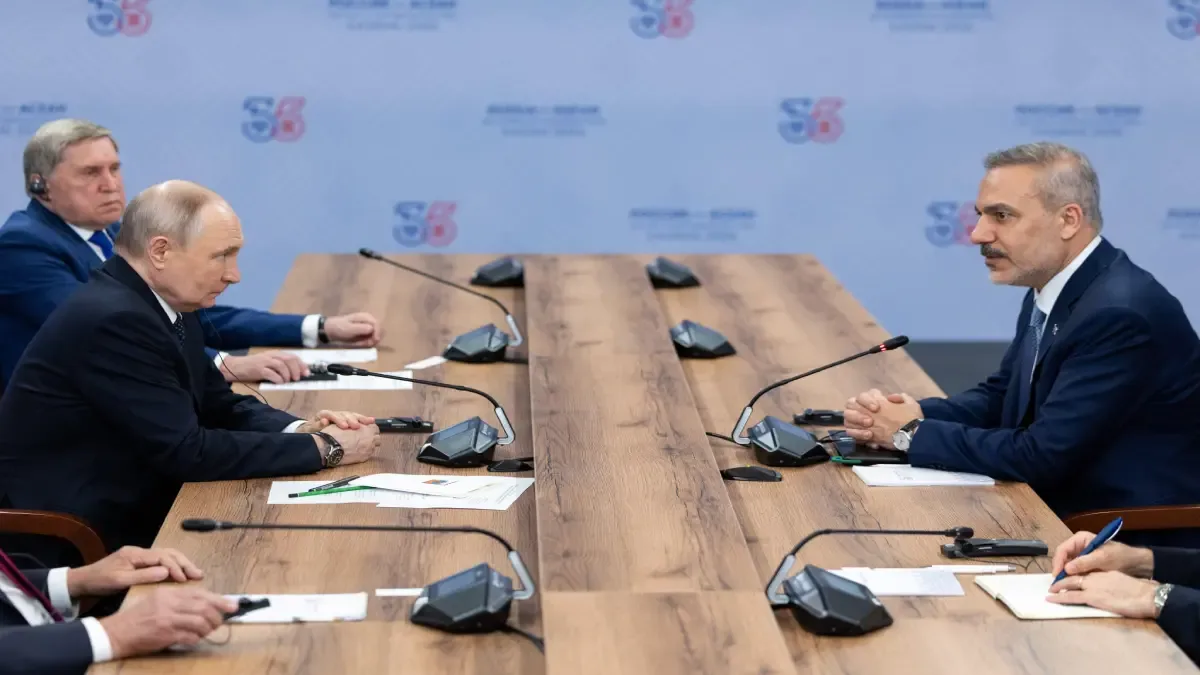
Foreign Minister Hakan Fidan took the maritime issue directly to Moscow on June 16. In his talks with Lavrov, he warned against developments that could harm Türkiye's interests and security in the Black Sea while renewing Ankara's offer to host further Russia-Ukraine negotiations. The Moscow visit placed renewed diplomacy and Türkiye's maritime security concerns on the same agenda.
Two days later, the National Security Council warned against the war escalating and spreading to neighboring regions, particularly the Black Sea.
A Turkish-owned ship near Chornomorsk was attacked on June 22 and two Turkish citizens were injured. This time the Foreign Ministry explicitly described such incidents as a threat to Türkiye's interests in the Black Sea.
Russia and Ukraine were also addressing Türkiye more directly.
Lavrov pressed Ankara to blame Ukraine publicly for attacks on commercial shipping. Türkiye did not adopt Moscow's attribution.
Ukraine approached Ankara from the opposite direction. In July, Acting Foreign Minister Andrii Sybiha described Türkiye as "the strongest Black Sea power" with a successful record in peace efforts since 2022 and said it could play a critical role in restoring freedom of navigation. Kyiv continued to attribute the maritime escalation to Russia.
Ankara kept its public warnings directed at both combatants.
Containing parts of the war
The maritime attacks did not end Türkiye's diplomatic effort. They narrowed the kind of agreement Ankara was seeking.
During talks in Kyiv on July 16, Fidan said that if a comprehensive ceasefire could not be achieved, Russia and Ukraine could consider a moratorium covering areas such as Black Sea security and energy security. He said the Ukrainian side shared a serious degree of understanding with Türkiye on the proposal.
Sybiha did not repeat the moratorium formula in his own public remarks. He placed his emphasis elsewhere, saying peace and security in the Black Sea required the restoration of Ukraine's territorial integrity and sovereignty over Crimea.
The proposal followed a line already visible in the grain initiative and the December 2025 ports-and-energy plan: isolate areas where hostilities might be suspended without waiting for agreement on the entire war.
Türkiye's regional naval mechanism was also being expanded.
Türkiye, Romania and Bulgaria created the Mine Countermeasures Black Sea Task Group to address the mine threat and protect navigation. In July 2026, the three governments expanded its mandate to include protection of critical undersea infrastructure. The amendment widened the mission beyond mine countermeasures as attacks and sabotage risks around maritime infrastructure became a larger part of Black Sea security.
The expanded mandate remains narrower than a direct response to drone attacks on commercial shipping. It gives the three coastal states a mechanism for protecting infrastructure that was outside the task group's original mine-clearance mission.
From Montreux to the Caspian
Ukraine then carried out operations in a sea where Türkiye has no coastline.
On July 25, Zelenskyy said Ukrainian forces had struck a Russian warship and vessels used for Iran-linked military cargo in the Caspian Sea. Iran separately said an attack on one of its commercial vessels had killed a sailor.
Tehran accused Ukraine of widening the war. On July 28, Zakharova called the attack on the Iranian ship an act of aggression and accused Kyiv of seeking to "expand the geographical scope" of what Moscow describes as terrorist activity. Russia said the Caspian should remain outside military confrontation.
Iran later said Sybiha had described the strike on the Iranian vessel as unintentional and had assured Tehran that Kyiv did not seek escalation.
Moscow and Tehran blamed Kyiv for taking the war into the Caspian. Türkiye did not adopt that attribution when its own National Security Council addressed the issue nine days after Zakharova's comments.
Before the council met, the maritime risk again touched a Türkiye-linked route.
A drone attack near Novorossiysk seriously injured three crew members aboard the Samsun-bound Nadezhda. Türkiye responded by calling on both Russia and Ukraine to protect civilian navigation in the Black Sea.
The August 6 National Security Council communiqué then brought the Caspian into Türkiye's official Russia-Ukraine language.
The council said the strategic deadlock in the war could not be overcome by turning neighboring regions, particularly the Black Sea and Caspian Sea, into conflict zones. It called on the belligerents to lower tensions and take concrete steps toward peace.
The communiqué did not assign responsibility to either belligerent. Moscow had blamed Ukraine for expanding the geographical reach of the conflict. Kyiv blamed Russia for the deterioration of Black Sea navigation. Türkiye named neither side in the Caspian warning.
The council's language had been moving in that direction throughout 2026. January's communiqué focused on preserving stability in the Black Sea. In April, the warning shifted to attacks spreading into the sea and threatening energy security. By June, the council was referring to the risk of the war reaching neighboring regions, particularly the Black Sea. On August 6, the wording widened again and named the Black Sea and the Caspian Sea together.
From the opening weeks of the war in 2022, Türkiye used Montreux to limit its naval consequences and Istanbul to create a negotiating channel between Moscow and Kyiv. The Istanbul table is still available four years later. The area Ankara is trying to keep outside the fighting is considerably larger.
Sources: Türkiye's National Security Council, Türkiye's Foreign Ministry, Türkiye's Defense Ministry, Presidency of Türkiye, Kremlin, Russian Foreign Ministry, Presidency of Ukraine, Ukrainian Foreign Ministry, Reuters, Associated Press, Bosphorus News review and reporting.