
By Bosphorus News Geopolitics Desk
Türkiye advances the PKK bill and details the Mecca defense pact as TPAO widens its overseas push. Hormuz, Aegean sovereignty claims and Balkan energy security shape the August 9 brief.
PKK bill clears parliamentary committee
The Turkish Parliament's Justice Committee approved the National Solidarity bill on August 8, moving legislation tied to the PKK disarmament process to its next parliamentary stage.
The bill makes its principal legal mechanisms conditional on security authorities determining that the Kurdistan Workers' Party (PKK), designated as a terrorist organization by Türkiye, the United States and the European Union, and formations linked to it have ended their de facto existence and surrendered all weapons and ammunition under their control.
That determination must then be confirmed by a National Security Council decision published in the Official Gazette. The legislation provides for the suspension of specified investigations, prosecutions and sentence enforcement under different conditions, with exclusions for some offenses including intentional homicide.
The committee vote closes the stage that remained unresolved when Bosphorus News reported on the legislation during the overnight debate.
Iran adds conditions to Hormuz reopening as UAE reports vessel strike
Iran said an emerging navigation agreement with Oman would not by itself reopen the Strait of Hormuz, tying restored access to wider demands on Washington.
Foreign Minister Abbas Araqchi said Tehran and Muscat were very close to agreement on a new shipping route. Mohammad Baqer Zolqadr, secretary of Iran's top national security body, separately listed demands including an end to U.S. threats against Iran, an end to attacks on Iran and its regional allies, removal of the blockade and sanctions, the release of Iranian assets and compensation.
U.S. Central Command said on August 8 that U.S. forces had turned away 53 ships, disabled two vessels and boarded two others since the current blockade began, while allowing more than 30 ships through for humanitarian purposes.
The United Arab Emirates also accused Iran of striking a carrier affiliated with state oil company ADNOC with a missile while it transited Hormuz. No injuries were reported. Iranian authorities did not immediately comment on the accusation.
Türkiye challenges Greek tourism plan over Aegean sovereignty claims
Türkiye has formally objected to Greece's new Special Spatial Framework for Tourism, saying the planning document includes geographic features in the Aegean whose sovereignty Ankara maintains was not transferred to Greece through international treaties.
Foreign Ministry spokesperson Öncü Keçeli said the Greek framework would have no legal consequences for Türkiye's position on Aegean disputes.
The ministry also called for unilateral actions to be avoided in closed or semi-enclosed seas such as the Aegean and Mediterranean and referred to the December 2023 Athens Declaration in reiterating Türkiye's readiness to address disputes through international law, equity and good neighborliness.
The sovereignty characterization is Türkiye's stated legal position. The Greek tourism framework does not itself determine the status of the geographical features concerned.
Fidan compares Mecca pact clause to NATO Article 5
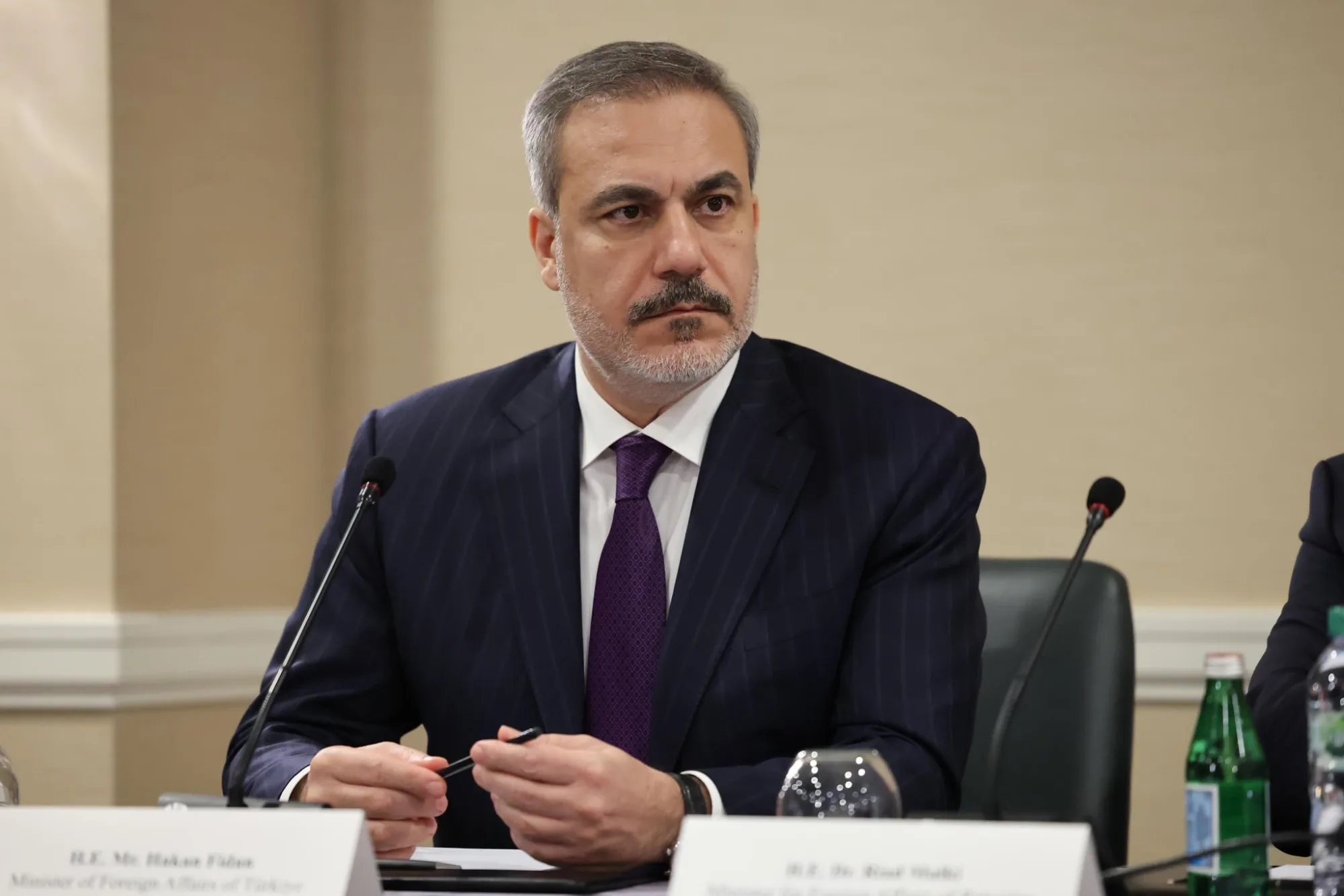
Foreign Minister Hakan Fidan said the collective-defense provision in the Mecca Joint Defense Agreement signed by Türkiye, Saudi Arabia and Pakistan is technically the same as NATO's Article 5 principle.
The comparison was Fidan's description of the clause, not a claim that the two arrangements are institutionally or legally identical. Under the pact, an armed attack against one of the three countries is regarded as an attack against all, but the form and level of assistance would be determined through consultations after the country under attack specifies what it requires.
Fidan said work on the agreement had continued for two years and eight months and rejected suggestions that Iran was its intended target. The pact contains no written definition of a common adversary.
A political-military committee will oversee the arrangement alongside a permanent secretariat based in Saudi Arabia. Fidan also identified Egypt as a potential next participant once remaining technical issues are resolved.
He separately said Türkiye should participate in an international coalition protecting Red Sea shipping from Houthi attacks because the security of maritime traffic through Bab el-Mandeb and toward the Suez Canal directly affects Turkish interests.
TPAO targets nearly 600,000 boe/d as overseas portfolio expands
Türkiye plans to raise the Turkish Petroleum Corporation's combined domestic and international production from around 330,000 barrels of oil equivalent per day to nearly 600,000 by 2028, Energy and Natural Resources Minister Alparslan Bayraktar said in an August 8 interview.
The target depends heavily on higher output from the Sakarya Gas Field, while TPAO's overseas portfolio has expanded across the Middle East, Africa and Europe.
TPAO acquired a 15% interest in BP Energy Company of Kirkuk Limited in July, joining BP and ConocoPhillips in fields with estimated hydrocarbon resources exceeding 3 billion barrels of oil equivalent.
Off Somalia, the Çağrı Bey drillship is working at the Curad-1 well after Oruç Reis completed 234 days of seismic surveys. Bayraktar described Curad-1 as Türkiye's first deep-sea exploration drilling operation abroad.
In Libya, production-sharing agreements signed in June cover onshore and offshore areas awarded through the country's first international exploration round in 17 years. In Oman, TPAO holds a 50% interest alongside OQ Exploration and Production in offshore Block 80 near the Strait of Hormuz, including the producing Bukha and West Bukha fields.
TPAO is also working with Shell in Bulgaria's Black Sea Khan Tervel block and with MOL on seismic operations in Hungary.
Türkiye-TRNC gas pipeline surveys continue under NAVTEX
Oruç Reis is continuing seismic surveys along the planned Türkiye-TRNC natural gas pipeline route under a NAVTEX valid through August 30.
The planned 101-kilometer connection would run from Anamur in Türkiye's Mersin province to Teknecik east of Kyrenia, with 97 kilometers offshore and four kilometers on land. The system is planned for bidirectional operation.
The work follows a July 10 memorandum between Türkiye and the Turkish Republic of Northern Cyprus on development of the pipeline.
Foreign Minister Fidan added a political dimension to the energy file on August 8, reaffirming Türkiye's preference for a two-state settlement while supporting practical cooperation before a comprehensive Cyprus agreement.
Fidan said cooperation in areas including water, energy, electricity and tourism should not have to wait for agreement on the island's final political status.
Drone explodes beside Trans-Balkan gas corridor
A drone crossed from Romanian airspace into Bulgaria and exploded near Kardam on August 8, landing close to infrastructure on the Trans-Balkan gas pipeline.
The blast occurred about 1,000 meters from Bulgaria's compressor station and 200 meters from the corresponding Romanian facility. Bulgarian authorities reported no casualties or infrastructure damage.
Bulgaria's Defense Ministry said its initial analysis indicated that the aircraft was most likely a Maya decoy drone, a type widely used by Ukrainian forces, and said there was no reason to believe the incident was intentional.
Prime Minister Rumen Radev said the aircraft had not been detected in advance in either Bulgarian or Romanian airspace. Bulgaria will strengthen surveillance along the border and around strategic infrastructure.
The Trans-Balkan pipeline stretches from Türkiye to Ukraine, putting the incident directly beside an energy corridor connecting the Black Sea war zone with southeastern Europe.
Strategic Take
The PKK legislation now has a defined sequence rather than an open-ended political commitment. Its legal provisions depend on verified disarmament, followed by National Security Council confirmation, before the suspension mechanisms can operate.
The Mecca agreement is also acquiring institutional detail. Fidan has explained how assistance would be requested, confirmed the Saudi-based secretariat and political-military committee, and placed possible Egyptian membership and Türkiye's Red Sea role beside the new collective-defense arrangement. His Article 5 comparison is politically important, but the assistance mechanism he described remains consultation-based rather than an automatic deployment commitment.
Türkiye's energy exposure is expanding across many of the same corridors where military and maritime risks are rising. TPAO has assets or active exploration programs from Kirkuk and Somalia to Oman, Libya and the Black Sea; the planned TRNC pipeline adds another Eastern Mediterranean connection. The Hormuz confrontation now sits beside a TPAO concession in Oman, while the Kardam drone landed within hundreds of meters of a pipeline running from Türkiye toward Ukraine.
The Aegean dispute is different in character. Ankara's objection concerns the legal reach of a Greek planning instrument rather than an operational confrontation, adding a sovereignty dispute to a day already dominated by defense commitments, shipping routes and cross-border energy infrastructure.
Sources: Türkiye's Ministry of Foreign Affairs, Ministry of Energy and Natural Resources, TRNC Public Information Office, Reuters, Associated Press, Anadolu Agency, Bosphorus News review and reporting.
Read Yesterday's brief: Eastern Mediterranean Strategic Brief | August 8, 2026.