
By Bosphorus News Geopolitics Desk
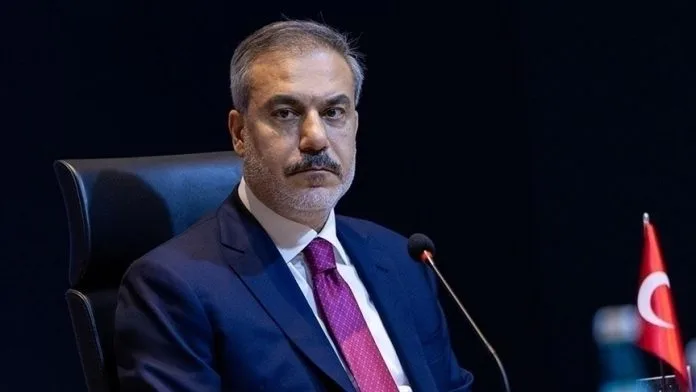
Turkish Foreign Minister Hakan Fidan said on August 8 that other countries want to join the Makkah Joint Defense Agreement signed by Türkiye, Saudi Arabia and Pakistan, identifying Egypt as the most likely next participant once several remaining technical issues are resolved.
Speaking at Anadolu Agency's Editors' Desk, Fidan said the three signatories would form the founding core of the new security structure, setting its principles and standards while retaining joint authority over future enlargement. Any country seeking membership would therefore require the approval of Türkiye, Saudi Arabia and Pakistan.
"In the next stage, I believe Egypt will also be among us," Fidan said, adding that the four countries already cooperate closely on regional issues and that neither Riyadh nor Islamabad objects to Egyptian participation. He said only "a few technical issues" remained and that, once they were resolved, there would be no reason for Egypt to stay outside the arrangement.
President Recep Tayyip Erdoğan, Saudi Crown Prince and Prime Minister Mohammed bin Salman and Pakistani Prime Minister Shehbaz Sharif signed the agreement at Al-Safa Palace in Makkah on August 7, creating a collective-defense framework under which an armed attack against any one of the three countries would be regarded as an attack against all of them.
Fidan described that provision as technically comparable to NATO's Article 5, although his explanation of the mechanism made clear that an attack would not automatically trigger the deployment of military forces. The country under attack would first request assistance and specify what it needed, with support potentially ranging from intelligence and logistics to ammunition and, at a more advanced stage, military units, depending on the circumstances and decisions taken through the pact's institutions.
The agreement provides for a political-military committee bringing together the foreign and defense ministers and chiefs of general staff of the participating countries, while a general secretariat based in Saudi Arabia will oversee implementation. Fidan said the structure and working procedures of the secretariat would be addressed at the committee's first meeting.
Beyond the collective-defense clause, the framework covers joint training and exercises, military interoperability, intelligence sharing, logistics, threat assessments and defense industry cooperation. Fidan said defense industry projects and technology sharing were among the subjects discussed most extensively by Erdoğan, Mohammed bin Salman and Sharif during their meeting in Makkah.
He also sought to separate the agreement from the latest regional escalation involving Iran, saying negotiations on the pact had begun two years and eight months earlier. Fidan rejected suggestions that Tehran was the intended target, saying the three countries had not written or signed any definition of a common adversary and that states which did not attack the pact's members were not considered targets.
Ankara has made a similar distinction regarding Türkiye's NATO membership, rejecting claims that the Makkah agreement conflicts with its alliance obligations. Turkish officials have presented the arrangement as a regional collective-defense mechanism rather than an alternative to NATO, while Fidan noted that NATO members already participate in bilateral and regional security frameworks alongside their commitments to the alliance.
Expansion, according to Fidan, was part of the concept from the outset. Türkiye had favored eventually widening participation, but the final arrangement preserved Türkiye, Saudi Arabia and Pakistan as the founding members and made the admission of additional countries dependent on their joint approval. Egypt is now the first country Ankara has publicly identified as a likely candidate.
Fidan also placed the new structure within a wider discussion of regional security extending beyond the Gulf, pointing to Türkiye's commercial interests in the Red Sea and Bab el-Mandeb and the importance of the maritime route linking the Indian Ocean to the Mediterranean through the Suez Canal.
With the agreement signed, the three governments will now move to build its institutional machinery, including the Saudi-based secretariat and political-military committee, while beginning work on interoperability, intelligence, logistics and defense industry cooperation. Egypt's possible entry would be the first test of how quickly the three-country framework can develop into a broader regional defense arrangement.
Sources: Presidency of Türkiye Directorate of Communications, Anadolu Agency, Qatar News Agency, Bosphorus News review and reporting.