
By Murat Yıldız
On September 2, 2026, I sent six questions to Meridiam, the French infrastructure investor preparing to acquire control of the Great Sea Interconnector (GSI), the planned electricity link between Greece and the Republic of Cyprus. Three concerned Türkiye. Had Meridiam notified Turkish authorities about the next seabed surveys? Would it do so? Did it agree with Athens that Turkish permission was unnecessary?
On November 12, the Turkish frigate TCG Gökova radioed the French-flagged survey vessel Abeille Marengo south of Karpathos and relayed Türkiye's position on consent, Kathimerini reported. The Greek frigate Limnos answered. SKAI separately reported a Turkish message allowing the vessel to proceed. The surveys continued, according to both outlets. Neither account described a physical attempt to stop the ship.
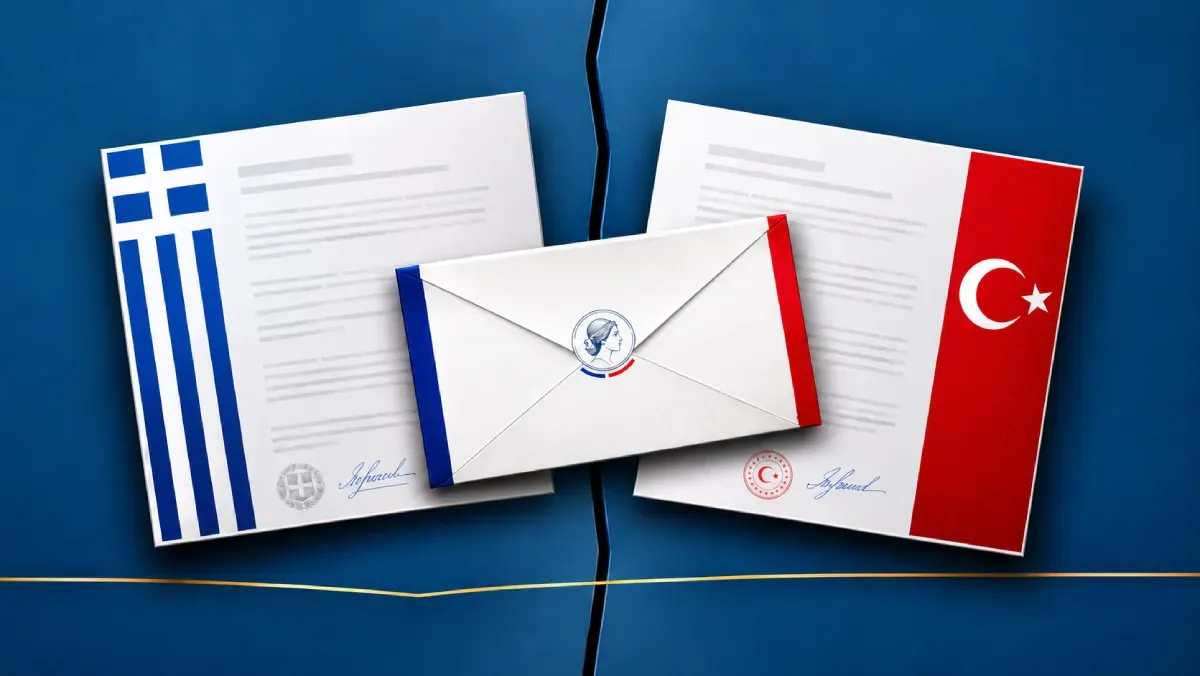
France had by then sent a diplomatic note to Ankara. A Turkish navigational warning recorded the survey lines as coordinated with, and consented to by, Turkish authorities. Greece maintained that permission had been sought only from Greece and the Republic of Cyprus. Neither the French note nor Ankara's written reply has been published.
The September inquiry concerned a possible commercial approach to Ankara. The eventual contact came through the French state. In October, a Greek government source had raised the possibility of creative ambiguity: Ankara could register a notification as satisfying its consent requirement while Athens rejected any Turkish licensing role. The subsequent French contact may have allowed such an accommodation. It is equally possible that each government acted independently and the surveys continued despite the disagreement.
The Corporate Question Came First
Meridiam signed an agreement on August 5 to acquire 66 percent of Great Sea Interconnector S.A., with Greece's Independent Power Transmission Operator (IPTO) holding 34 percent. Greek Prime Minister Kyriakos Mitsotakis attended the signing. GSI's current shareholder information lists Meridiam at 66 percent and IPTO at 34 percent. IPTO, GSI and French cable manufacturer Nexans signed a separate agreement that day on the project's next survey phase.
The French political backing was explicit at the ceremony. Meridiam chairman and chief executive Thierry Déau cited President Emmanuel Macron's support. Nexans executive Pascal Radue spoke of Team France. Their remarks show how the project was presented to its participants. They do not tell us who later proposed the diplomatic note to Ankara.
Meridiam already had substantial business in Türkiye. Its five city-hospital public-private partnership projects with Rönesans, in Adana, Yozgat, Elazığ, Bursa and Gaziantep, represented more than €2.3 billion in combined project investment, according to a statement by its Türkiye country director published by Türkiye's Presidency Investment Office and the International Investors Association. That amount refers to project value, not Meridiam's equity contribution. The hospital portfolio nonetheless meant that the incoming GSI shareholder had long-standing commercial relationships involving Turkish public institutions.
Those investments prompted my September questions to Meridiam. Communications director Antoine Lenoir acknowledged the inquiry on September 2 and requested more time. After the original investigation appeared, I removed the September 4 reply deadline and offered to publish a subsequent response. None arrived. Meridiam's exposure in Türkiye justified asking how it intended to deal with Ankara's objections. There is no evidence that the company asked Paris to intervene.
The idea of corporate notification had appeared in Greek reporting on August 27. On October 4, Kathimerini reported a more specific proposal attributed to a Greek government source. Nexans could inform Ankara of the planned surveys while seeking permits from Greece; Türkiye might describe the message as meeting its consent requirement, and Athens could maintain that it had provided only information. The source called this creative ambiguity.
Nexans denied that it had contacted or intended to contact Turkish authorities about the surveys. The company said its coordination was limited to the project promoter and the Greek and Republic of Cyprus authorities. Its denial left the reported Nexans option unexecuted on the public record. The communication that followed came from the French government.
On November 9, Greek government spokesman Pavlos Marinakis explained France's involvement by referring to Meridiam's majority shareholding and Nexans' industrial role. That put the corporate interests into Athens' own account of the diplomatic contact. Marinakis said the French note was informational and neither requested Turkish permission nor conceded Turkish maritime rights. He offered no evidence that Meridiam had helped draft the message or chosen the channel.
Why Paris Could Carry the Message
France had commercial interests in the cable and diplomatic access to the governments disputing its route. The project had a French majority shareholder, a French cable supplier and a survey vessel under the French flag. France and Greece renewed their defense and security partnership on April 25, 2026. France's defense cooperation agreement with the Republic of Cyprus dates from 2017 and entered into force in 2020. Macron met President Recep Tayyip Erdoğan on July 8 during the North Atlantic Treaty Organization summit in Ankara; Türkiye's Presidency said they discussed bilateral relations and defense cooperation.
None of those defense arrangements has been shown to affect the GSI notification, and the July presidential meeting cannot be treated as evidence of a deal. The relationships establish why Paris had a direct route to Ankara when the proposed contact by Nexans had not taken place.
The messenger also changed the nature of the exchange. A cable contractor can notify a government of planned work in its commercial capacity. A diplomatic note is a communication between states. Athens describes the French note as information; Ankara has described its written answer as permission. Without the documents, neither government's description establishes the precise request made or accepted.
Permits, NAVTEX Notices and the Unpublished Reply
Greece's Foreign Ministry said on November 6 that the permitting procedure had been completed following Nexans' application on behalf of GSI. After an interministerial review, Foreign Minister Giorgos Gerapetritis authorized survey and cable-laying work. Greece and the Republic of Cyprus issued navigational warnings for the operation.
Türkiye's Foreign Ministry objected the same day to proposed marine scientific research in an area Ankara claims as continental shelf. Türkiye submitted the outer limits of that claim to the United Nations on March 18, 2020. The ministry said the procedure for obtaining Turkish consent was incomplete; Antalya NAVTEX notices 1105/26 and 1106/26 challenged the Greek and Republic of Cyprus warnings. On November 7, Foreign Minister Hakan Fidan told Greek correspondent Manolis Kostidis that everything was normal and going well. He identified no jointly accepted procedure for the surveys.
Antalya NAVTEX 1127/26, issued on November 10, changed the Turkish public record. It described two Abeille Marengo survey lines as coordinated with and consented to by competent Turkish authorities, with an announced period from November 10, 2026, to March 19, 2027. It named no approving institution or permit number and did not expressly cancel 1105/26 or 1106/26. Any practical overlap among the notices depends on their respective coordinates and validity periods.
Mitsotakis acknowledged that France had notified Türkiye, but said no Turkish authorization had been requested and no precedent created. The Hellenic Hydrographic Service issued NAVTEX 1441/26, rejecting Ankara's asserted authority over the western survey lines. It cited Greek permits 31373, dated June 7, 2024; 9020, dated February 11, 2026; and 65808, dated November 6, 2026. The Republic of Cyprus' Larnaca coordination center issued warning 352/26, referring to Republic of Cyprus permit 05/2026 and an earlier Larnaca warning, 345/26.
On November 12, Cumhuriyet cited a Turkish Foreign Ministry source saying that the French Embassy had sent Ankara a written note and received written permission in reply. The source did not establish whether the French message had asked for permission. Marinakis continued to deny that either France or Nexans had sought Turkish authorization. In a separate interview, he included Egypt among the regional states informed. That account is consistent with a wider notification process, although the diplomatic communications themselves remain unpublished.
The dispute concerns authority over particular stretches of seabed. Türkiye asserts a right to approve the research. Greece regards its own permits, and those of the Republic of Cyprus where relevant, as sufficient. The Republic of Cyprus has also rejected Ankara's asserted consent requirement. The NAVTEX record shows each side maintaining its position; it does not settle the overlapping maritime claims.
The Explanation That Needs No Diplomatic Design
France may have helped the survey proceed under an informal accommodation. Ankara received a state-level communication and entered its consent claim into a navigational warning. Athens maintained that it had never sought Turkish permission. The vessel departed and, after the November 12 radio exchange, continued surveying. Governments can allow an operation to proceed while refusing to recognize one another's legal claims. The sequence is consistent with that possibility, although no participant has acknowledged agreeing to it.
There is a less elaborate explanation. France may have informed regional governments for navigational or diplomatic reasons, as Marinakis' reference to Egypt suggests. Türkiye then issued a reply reflecting its own legal position. Greece continued to rely on the permits it had issued. Each capital could have acted without agreeing on how the others would describe the correspondence. No particular flag-state duty to send this note has been demonstrated, but none is needed for France to have chosen to notify Ankara.
Both accounts fit the published statements and the continuation of work. The record supports operational coexistence: conflicting claims were voiced, and the survey continued. A negotiated understanding would require stronger evidence, such as prior coordination over the note's wording, agreement on how the responses would be described or conditions communicated to the vessel. The French note and Turkish reply may contain clues. Official summaries of their contents cannot replace the documents.
My questions went to Meridiam before France emerged as the messenger. The French government's involvement is now established. The companies' role, if any, in selecting that channel is not.
The EMC Comparison
Another cable survey had already produced opposing consent records without a publicly documented French diplomatic intervention. In October, the Bahamas-flagged Kobi Ruegg worked on the East to Med Data Corridor (EMC), a separate submarine data-cable project. Türkiye's NAVTEX 1050/26 announced revised survey lines with the consent of Turkish authorities and expressly cancelled its earlier 1032/26. Greece's NAVTEX 1361/26 disputed the Turkish station's authority, cited Greek permit 2461 of October 2 and cancelled an earlier Greek warning, 1337/26.
Türkiye's consent claim and Greece's counter-record in EMC preceded the French GSI note. The publicly examined EMC material contains no comparable French communication, although that cannot rule out contacts not made public. The operations also involved different vessels, routes and project arrangements, so the comparison has limits.
One documentary difference stands out. EMC notice 1050/26 expressly replaced the earlier Turkish warning. GSI notice 1127/26 did not expressly cancel 1105/26 or 1106/26. That could reflect the notices' geographic scope, their drafting or a choice to leave earlier objections in place. The text alone does not reveal a diplomatic motive. Kathimerini reported on November 12 that permission had been sought from Türkiye for EMC, whereas Athens characterized the GSI contact as notification. The underlying communications would be needed to evaluate that distinction.
EMC leaves little basis for crediting Paris with inventing a way to continue surveys amid rival claims. It also shows why the GSI radio exchange cannot prove a negotiated arrangement. Similar conduct at sea may arise from separate decisions by the governments involved.
Cable-Laying Rights and Research Consent
The legal dispute is complicated by the type of work Abeille Marengo was carrying out. Article 79 of the United Nations Convention on the Law of the Sea protects the laying and maintenance of submarine cables on the continental shelf, subject to qualifications on coastal-state rights. Article 79(3) requires coastal-state consent for the course of pipelines. It contains no corresponding general rule requiring consent to the route of a submarine cable.
Article 246, however, generally subjects marine scientific research in a coastal state's exclusive economic zone or on its continental shelf to that state's consent under the convention. The vessel's actual methods and purpose would matter in deciding whether its seabed work falls under the research rules or is preparatory activity associated with cable-laying. Türkiye's description of the campaign as marine scientific research does not determine that classification. Nor does its connection to a cable automatically exempt every survey activity from consent requirements.
Türkiye is not a party to the convention. Its treaty provisions cannot be applied to Ankara as though it had ratified them, although rules reflecting customary international law may remain relevant. The overlapping continental-shelf claims create another problem: the governments dispute which state has the relevant coastal-state rights in the survey area. NAVTEX notices do not adjudicate those claims.
Retired Rear Admiral Ali Deniz Kutluk, whom I interviewed about GSI, has warned about the possible legal and political weight of conduct in disputed maritime areas, as discussed in my earlier analysis of Greek-Turkish disputes. Recording a claim or objection therefore matters even when a ship is permitted to work. Neither side can turn a single radio message into a maritime boundary decision.
What the Encounter at Sea Established
On November 12, Kathimerini reported that TCG Gökova relayed Türkiye's consent position to Abeille Marengo and that Limnos responded. SKAI reported a Turkish message saying the vessel could proceed. ERT separately reported that the Greek frigate's reply asserted that the surveys were taking place on the Greek continental shelf under a Greek NAVTEX. Cyprus News Agency also reported continued operations in international waters. Those reports do not establish how many survey lines were completed, whether the vessel reached every contested segment or what instructions accompanied the diplomatic correspondence.
In Dublin the same day, Republic of Cyprus President Nikos Christodoulides discussed GSI separately with Mitsotakis and Macron on the sidelines of the European Political Community summit, according to Cyprus News Agency. No common operating formula was announced.
The first reported naval encounter ended without an interruption to the work. Subsequent passage through the disputed lines could show whether that tolerance holds. A later attempt to stop the vessel would challenge any claim of a stable operating accommodation. Neither outcome would establish what France wrote to Ankara. The EMC precedent cautions against reading too much into a survey proceeding after rival maritime warnings.
In Parallel Monologues, I examined how Ankara and Athens sustain diplomatic contact while pursuing different objectives. TEMBEL. ΤΕΜΠΕΛΗΣ. considered their habit of managing disputes rather than resolving them. GSI places that argument aboard a working survey vessel. Türkiye, Greece and the Republic of Cyprus have preserved conflicting claims on the record; the reported maritime exchange did not prevent the work from continuing.
The September inquiry asked whether a French investor with substantial Turkish interests planned to contact Ankara about GSI. Nexans subsequently denied plans for company-level contact, and France used a diplomatic channel. Who chose that channel, whether either company helped shape the approach and what the two governments actually exchanged remain unresolved. The French note, Ankara's reply and any related company correspondence could answer those questions. A survey vessel continuing after a radio exchange cannot.
Sources: Hellenic Prime Minister's Office, Hellenic Foreign Ministry, Hellenic Ministry of National Defence, Hellenic Government Spokesperson's Office, Hellenic Hydrographic Service, Türkiye's Foreign Ministry, Türkiye's Presidency Directorate of Communications, Directorate General of Coastal Safety, Republic of Cyprus Joint Rescue Coordination Center, Cyprus News Agency, French Foreign Ministry, Nexans, Meridiam, Great Sea Interconnector S.A., IPTO, United Nations Convention on the Law of the Sea, Kathimerini, SKAI, ERT, Cumhuriyet, original Bosphorus News correspondence, Bosphorus News review and reporting.