
By Murat Yıldız
French infrastructure investor Meridiam has signed an agreement to become the majority shareholder in the Great Sea Interconnector while already holding a five-hospital Türkiye portfolio it values at more than €2.3 billion, built with Rönesans. IPTO's latest investor document says cable manufacturer Nexans still has not received the Full Notice to Proceed, while the remaining seabed surveys would return east of Kasos, where Greece and Türkiye assert competing continental-shelf positions.
Meridiam has spent more than a decade investing in Türkiye, with Rönesans as the recurring Turkish corporate partner across its city hospital portfolio. The French group has also been reported as considering a consortium with Makyol İnşaat for possible operating rights to Istanbul's two Bosphorus bridges and parts of the state motorway network.
Its new GSI role now places an investor with long-standing Turkish commercial and public-sector relationships inside an unresolved Greek-Turkish maritime dispute. Greece says it will not seek Turkish permission for the remaining surveys, while Greek reporting says Meridiam may nevertheless notify Ankara before work resumes, a role the company itself has not confirmed.
Nexans Still Does Not Have the Full Notice to Proceed
Greece's Independent Power Transmission Operator (IPTO) tied the outstanding regulatory issues directly to its Nexans contract in its April 2026 annual report, listing revenue recovery in the Republic of Cyprus, joint Greek-Cypriot approval of operating expenses including survey-vessel demurrage through February 2025, and joint approval of the concession agreement transferring the project to the GSI special-purpose company.
The same report said the Full Notice to Proceed (FNTP) had not been issued and that the most recent payment to Nexans had been made in April 2025. Nexans, according to IPTO, expected the accumulated delay to add approximately one year to the schedule once the FNTP was released and the remaining work could be rescheduled.
A newer IPTO investor document dated June 16 separates what remains into four steps. It lists Republic of Cyprus government disbursements of €25 million for 2025 and another €25 million for 2026 to offset project costs for Cypriot consumers, followed by a nominal-tariff decision, while separately identifying the 2025 allowed-revenue decision, joint approval of operating expenses and survey-vessel demurrage, and joint approval of the concession agreement.
The €50 million is part of the regulatory mechanism governing project revenue and consumer costs, rather than a conventional unpaid invoice.
Cyprus Energy Regulatory Authority (CERA) Decision 280/2025 had already approved recovery of €82 million in investment expenditure while setting €25 million as allowed revenue for 2025, subject to licensing conditions. Yet IPTO's June 2026 document continues to list the 2025 allowed-revenue step among the requirements still to be cleared, an apparent overlap the public documents reviewed by Bosphorus News do not reconcile.
Funding and regulatory uncertainty around the GSI has been visible for months. IPTO's own filings now show how those unresolved issues reach directly into the Nexans contract.
More Than 500 Kilometres of Cable Have Already Been Manufactured
The contractual bottleneck comes after substantial industrial work and spending. IPTO says €301.4 million had been invested by the end of 2025, including €251.4 million paid to the cable contractor, while by March 31, 2026, 513 kilometres of submarine cable had been completed and another 10 kilometres were in production.
The European Union grant for the Crete-Cyprus section totals €658 million, but the amount actually received by that date was far smaller. IPTO records €164.5 million in EU pre-financing as of March 31, roughly one quarter of the grant, separately from the €251.4 million already paid to the cable contractor.
The project has sometimes been described as though the entire European grant were already in hand. IPTO's documents do not support that reading.
The operator also says it formally submitted a financing request to the European Investment Bank in May, while the records reviewed by Bosphorus News show no signed EIB loan for the GSI. More than half of the 898-kilometre Crete-Cyprus cable section has thus been manufactured even though Nexans is still waiting for the instruction that would allow the full contractual program to proceed.
October Is the Earliest Reported Survey Window
The unfinished seabed campaign is now being discussed for October, although no fixed operation has been announced.
Oikonomikos Tachydromos reported on August 31 that once the outstanding Republic of Cyprus issues are cleared, the companies involved intend to seek a Navigational Telex (NAVTEX) for renewed surveys. The remaining work is concentrated in international waters east of Kasos and off western Cyprus, after surveys inside Greece's six-nautical-mile territorial sea and the Republic of Cyprus' 12-nautical-mile territorial sea were completed.
No NAVTEX setting dates and coordinates for a new operation has yet been published.
Preparations for a return to the Kasos survey area were already under way in August, when Republic of Cyprus Energy Minister Michalis Damianos said a new NAVTEX was expected within weeks and that a French vessel would carry out the next phase. The August 31 reporting now places the prospective campaign in October, conditional on the remaining Republic of Cyprus steps.
A specialist vessel belonging to a French company is being selected for the work, according to that report, but neither the company nor the vessel has been publicly identified.
Meridiam's Türkiye Relationship Runs Through Five Hospital PPPs
Meridiam enters this dispute with a Türkiye exposure unusual for a private investor joining a project of such sensitivity in Greek-Turkish relations.
In the 2024 Foreign Direct Investment in Türkiye Century publication issued by Türkiye's Presidency Investment Office and the International Investors Association (YASED), Meridiam Country Director Günay Gökçen said the company had operated in Türkiye for more than a decade. He put its hospital portfolio at more than 6,300 beds across Adana, Yozgat, Elazığ, Bursa and Gaziantep, with investment in the five projects exceeding €2.3 billion.
Gökçen also said Meridiam intended to continue investing in Türkiye, including in green and sustainable infrastructure financing.
Meridiam described Rönesans as its partner when Bursa City Hospital opened in 2019, at which point its Turkish portfolio also included the Adana, Yozgat and Elazığ projects. The two companies later entered the Gaziantep project alongside Samsung C&T and İstanbul Portföy, bringing Meridiam's hospital portfolio in Türkiye to five projects.
Türkiye's Health Ministry is the public counterparty in the city-hospital PPP program, and the relationship became particularly direct at Gaziantep. Meridiam says the ministry, Turkish Treasury authorities and development-finance lenders approached Meridiam and Rönesans after the project encountered delays and cost overruns, asking them to restructure and complete the hospital, which entered operation in 2023 with 1,875 beds.
The result is a set of long-duration public infrastructure investments that keep Meridiam embedded in Türkiye well beyond construction and financing.
Makyol Could Add a Transport Relationship
Meridiam may also be looking beyond healthcare. Bloomberg reported on July 29 that the French group was considering forming a consortium with Makyol İnşaat for a possible process involving operating rights to the 15 July Martyrs Bridge, Fatih Sultan Mehmet Bridge and sections of Türkiye's motorway network, although no formal Meridiam-Makyol bid has been announced.
Both Bosphorus bridges remain operated by Türkiye's General Directorate of Highways (KGM), under the Transport and Infrastructure Ministry. The legal framework also distinguishes ownership from operating rights: the Presidency Communications Directorate has said that state ownership of the bridges and motorways would remain unchanged under any privatization arrangement, which could instead involve a time-limited transfer of operating and maintenance rights under Law No. 4046, with the Privatization Administration acting as the competent state body under that framework.
A week after the Bloomberg report, Meridiam signed its GSI agreement in Athens. Meridiam's August agreement to become GSI's majority shareholder also put completion of the remaining seabed surveys at the front of the revised implementation schedule.
Macron's Interest Is on the Official Record
France's involvement goes beyond the nationality of Meridiam and Nexans. At the August 5 signing in Athens, Greek Environment and Energy Minister Stavros Papastavrou said the process that brought Meridiam into GSI followed political direction after French President Emmanuel Macron's visit to Greece.
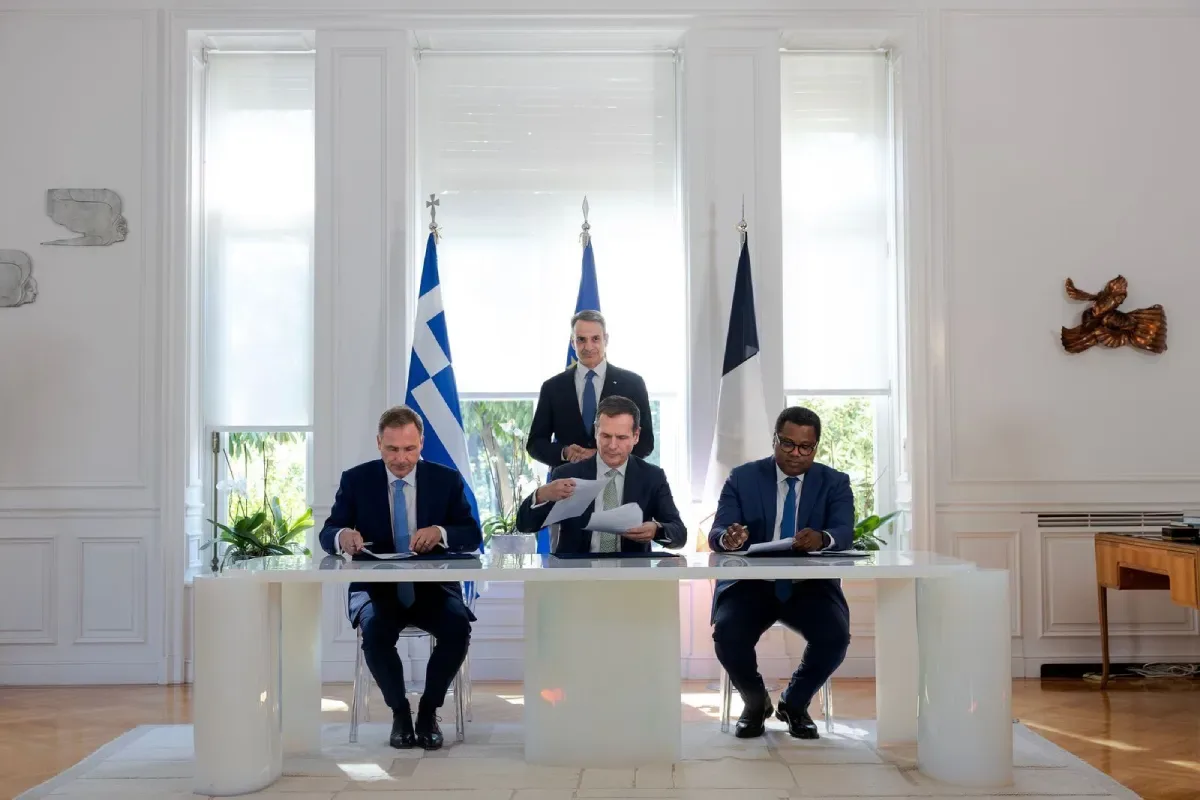
Meridiam Chairman and Chief Executive Thierry Déau placed the project within the Greece-France strategic partnership and described Macron as a major supporter. "He calls me every day about it," Déau said at the signing ceremony, where Nexans Senior Executive Vice President Pascal Radue described the French companies involved as "Team France."
Meridiam remains a private infrastructure investor, not a French state company, but the Greek government's own record leaves little doubt about the level of political backing in Paris and Athens for its entry into GSI.
Why Athens and Ankara Read the Same Cable Differently
Article 79 of the United Nations Convention on the Law of the Sea (UNCLOS) gives all states the right to lay submarine cables and pipelines on the continental shelf and provides that the coastal state may not impede their laying or maintenance, subject to its other rights under international law.
Paragraph three adds a specific rule for pipelines: the course followed by a pipeline on the continental shelf is subject to the consent of the coastal state. Article 79 contains no equivalent route-consent requirement for submarine cables, a distinction Athens relies on when it argues that laying the GSI outside territorial waters does not require Turkish permission.
Türkiye is not a party to UNCLOS and approaches the issue from a different starting point. Ankara's official maritime position says continental-shelf rights require no proclamation and arise ab initio and ipso facto, language rooted in the International Court of Justice's 1969 North Sea Continental Shelf judgment, while Türkiye also disputes Greece's continental-shelf delimitation in the waters east of Kasos.
Greece begins with the legal regime governing the cable. Türkiye begins with its position that part of the seabed already falls within a Turkish continental shelf.
The practical clash appears before the cable itself is laid, because survey vessels first have to collect data over seabed to which both sides attach competing continental-shelf claims.
Athens Says No Permission, but Meridiam May Still Notify Ankara
Greek Foreign Minister George Gerapetritis said on August 31 that Greece would not seek Turkish permission for the project. Turkish sources quoted by Kathimerini five days earlier said Türkiye does not oppose submarine connectivity projects in principle but expects the flag state of survey or cable-laying vessels to contact Ankara through diplomatic channels before operating in maritime areas where Türkiye claims sovereign rights and jurisdiction.
An April 2025 Kathimerini report used stronger language, attributing to unnamed Turkish Defense Ministry officials the position that projects passing through areas claimed by Türkiye could not proceed without Turkish consent. That account was not a named written statement by the ministry, a distinction that remains important in the absence of a newer public Turkish position directly responding to Gerapetritis.
Kathimerini reported on August 27 that Athens, Paris and the Republic of Cyprus were discussing a formula under which Meridiam would write to countries in the region, including Türkiye, before work resumed and provide information about the operations required to complete the project. The newspaper presented the idea as a plan under discussion, and Meridiam has not publicly confirmed either that such a letter exists or that one will be sent.
Such an arrangement would leave Athens' legal position intact, since Greece itself would not be requesting Turkish permission, while still providing Ankara with advance information through the project's incoming private majority investor. Any contact of that kind would also come from a company with more than a decade of infrastructure investment and established corporate and public-sector relationships in Türkiye.
TEİAŞ and IPTO Are Already Developing Another Power Link
Türkiye's position on GSI does not amount to opposition to electricity interconnection with Greece itself. Türkiye Electricity Transmission Corporation (TEİAŞ) and IPTO are simultaneously developing a second land-based connection between the two countries, having signed a memorandum in December 2023 for a new 400-kilovolt Nea Santa-Babaeski line.
IPTO's June 2026 document puts the planned link at about 130 kilometres and 2 gigawatts, with approximately 600 megawatts of additional transfer capacity expected in each direction under a joint TEİAŞ-IPTO steering structure.
The same Greek transmission operator promoting GSI is therefore working directly with Türkiye's state grid operator on another physical electricity link. The Kasos dispute is narrower and maritime: continental-shelf delimitation, sovereign rights and the procedure governing seabed survey activity before the submarine cable is laid.
Bosphorus News Sought Answers in Türkiye and From Meridiam
Bosphorus News contacted Meridiam on September 2 seeking confirmation of its current Turkish hospital holdings, its reported interest in a Makyol consortium for the Bosphorus bridges and motorway process, whether it intends to contact Turkish authorities before the GSI surveys and whether it shares Athens' position that Turkish permission is unnecessary.
Türkiye's Foreign Ministry was asked whether the position attributed to Defense Ministry officials in April 2025 remains valid, whether Ankara has received or expects notification concerning the planned survey campaign and whether communication from Meridiam would satisfy Türkiye's demand for prior coordination. The Transport and Infrastructure Ministry and Privatization Administration were asked about the status of the bridge and motorway operating-rights process and Meridiam's reported interest, while the Health Ministry was asked to confirm Meridiam's current shareholdings in its five Turkish hospital projects.
No responses had been received by publication time. Any replies will be added to this article.
As of September 2, no NAVTEX for the next Kasos survey campaign had been published, no French survey vessel had been named, and IPTO's latest investor document still said Nexans had not received the Full Notice to Proceed.
Sources: IPTO annual financial report and June 2026 investor document, Cyprus Energy Regulatory Authority, Greek Prime Minister's Office, Hellenic Foreign Ministry, Türkiye Presidency Investment Office and YASED, Türkiye Ministry of Health, Ministry of Transport and Infrastructure, General Directorate of Highways, Privatization Administration, Presidency Communications Directorate, TEİAŞ, Meridiam, Rönesans, United Nations, International Court of Justice, Oikonomikos Tachydromos, Kathimerini, Bloomberg, Bosphorus News review and reporting.