
By Bosphorus News Energy Desk
The Great Sea Interconnector, one of the European Union's most strategic Eastern Mediterranean energy projects, is facing a new funding test after Cyprus warned that the Greece-Cyprus-Israel power cable may need additional financing if updated cost estimates confirm overruns.
Cyprus Energy Minister Michael Damianos said Nicosia and Athens are waiting for the European Investment Bank to assess how far the project's cost may have moved above earlier estimates. If the project costs more, he said, there are "two or three different ways" to respond, including seeking additional investors or asking for more support from the European Investment Bank.
The current step is not an automatic funding decision. It is a cost and viability assessment that could determine whether the European Investment Bank, new investors or a revised financing structure enter the project.
The political sensitivity is clear in Cyprus. Under the current cost-sharing arrangement, Nicosia would carry 63 percent of the construction cost, with that burden passed to Cypriot consumers through electricity bills. Damianos said that if the project costs more, "63 percent again will come from us," turning the cable into a domestic cost issue as well as an energy-security project.
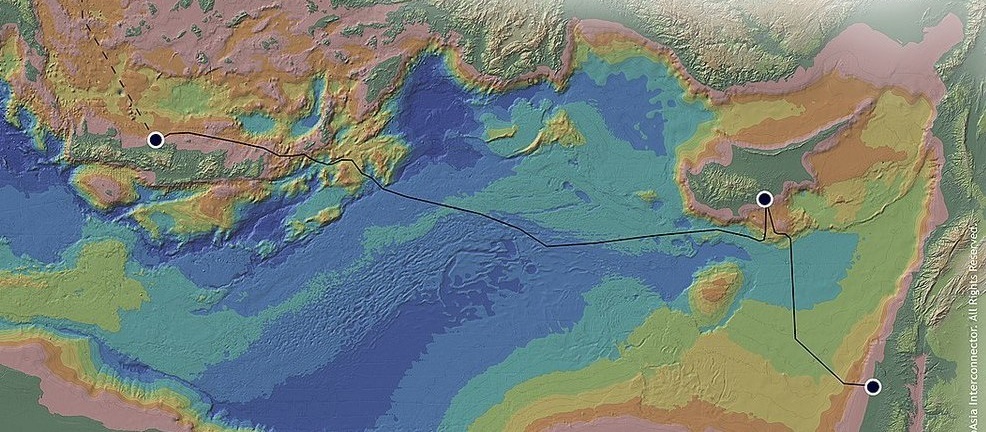
The Great Sea Interconnector is designed to link Greece and Cyprus first, with a later extension to Israel. Its first major section would connect Crete and Cyprus through a subsea cable of about 898 kilometres, ending Cyprus' isolation from the European Union electricity grid and creating a new power corridor across the Eastern Mediterranean.
The project still carries strong European backing. The European Commission has treated the interconnector as a strategic energy link and a Project of Common Interest. The Greece-Cyprus section has received €657 million from the Connecting Europe Facility, with cable works awarded to Nexans and converter stations assigned to Siemens.
Nicosia has also kept the project at the level of state strategy. Cyprus' official government portal has listed the Great Sea Interconnector as a presidency-level file, while Damianos has placed the cable inside the island's broader strategic infrastructure agenda. Cyprus, Greece and Israel also expressed "strong commitment" to the project in their December 2025 trilateral declaration and said they would work together to advance it.
That support has not removed the pressure around the project. Rising costs, regulatory friction and regional risk have turned the cable into a test of whether European-backed infrastructure can move through the Eastern Mediterranean at the same pace as Brussels' strategic ambitions.
The warning lands as Türkiye moves its Blue Homeland maritime doctrine closer to domestic law, sharpening the legal risk around subsea cables, offshore surveys and maritime planning.
That makes the cable more than a financing question. It is also a test case for how European-backed infrastructure moves through waters Ankara regards as legally contested.
Türkiye has long argued that energy and infrastructure projects in the Eastern Mediterranean cannot bypass Turkish or Turkish Cypriot rights. That position now intersects directly with projects such as the Great Sea Interconnector, whose route and political logic are tied to the Greece-Cyprus-Israel energy axis.
Ankara's position predates the current funding dispute and is rooted in a broader doctrine linking maritime jurisdiction, Cyprus and energy infrastructure. President Recep Tayyip Erdoğan stated that doctrine in 2020. "No equation in the Eastern Mediterranean in which our country and the Turkish Republic of Northern Cyprus are not fairly included can produce peace and stability," Erdoğan said, according to the Turkish Presidency.
That message was not directed only at one cable. It defined Ankara's broader view of the Eastern Mediterranean as a space where energy routes, maritime jurisdiction, Cyprus and regional security belong to the same strategic file.
The Great Sea Interconnector sits inside that file. For the European Union, the project would connect Cyprus to the bloc's electricity market, improve supply security and support the integration of renewable energy. For Greece and Cyprus, it is part of a larger infrastructure layer linking the Eastern Mediterranean to Europe. For Ankara, the same project touches maritime claims, Turkish Cypriot rights and the legal status of offshore activity in contested waters.
The debate is also complicated by rival connectivity ideas involving Türkiye and northern Cyprus, which Brussels has not treated as an alternative to the European Union-backed interconnector. European Energy Commissioner Dan Jørgensen reiterated support for the Great Sea Interconnector this week while warning against a separate cable plan linking Cyprus with Türkiye through the north.
Cyprus is therefore caught between two pressures. It needs the interconnector to reduce its isolation from the European electricity system, but it also faces the prospect of higher consumer costs and a route exposed to Eastern Mediterranean political risk.
The next phase will depend on the European Investment Bank's assessment and on whether Athens, Nicosia and Brussels can keep the project financially credible while limiting geopolitical exposure. The cable still carries strong European political backing. Its next test, however, will not be limited to engineering, procurement or finance. In the Eastern Mediterranean, every kilometre of subsea infrastructure now runs through a legal and geopolitical map that Türkiye, Greece, Cyprus and the European Union read differently.
***Sources: Republic of Cyprus official government portal, Cyprus Presidency, Cyprus Ministry of Energy, Commerce and Industry, European Commission, Great Sea Interconnector project, Presidency of the Republic of Türkiye, Presidency Communications Directorate.