By Bosphorus News Geopolitics Desk
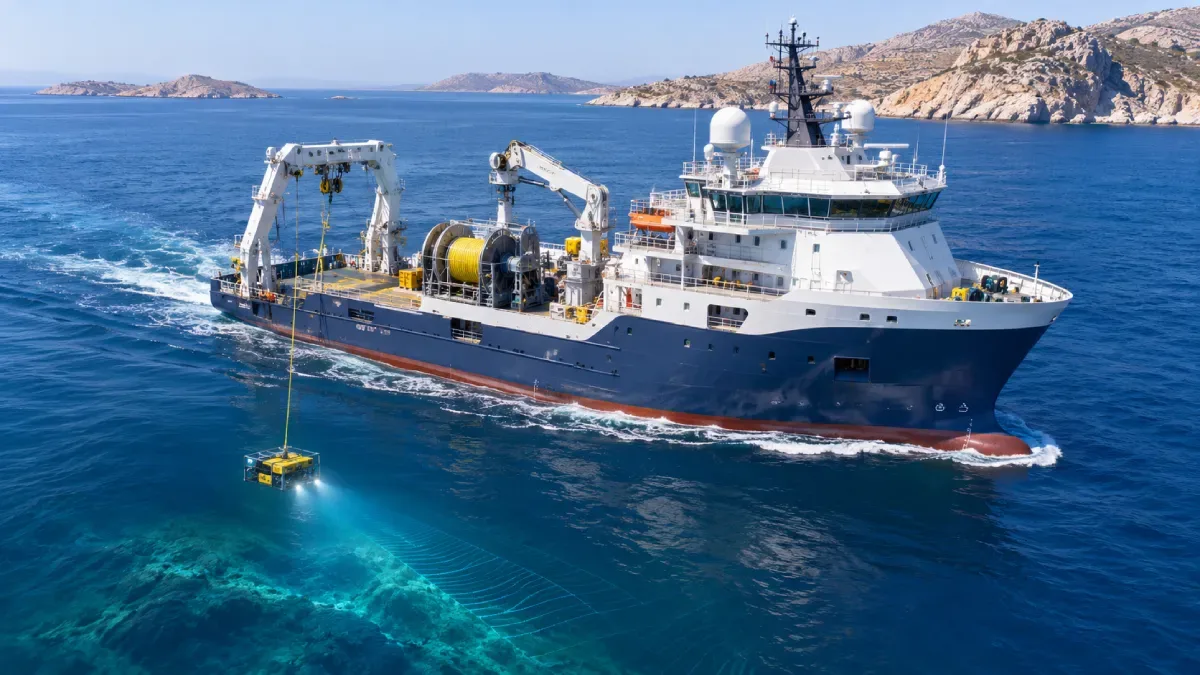
On November 10, 2026, the French-flagged Abeille Marengo left Heraklion for seabed surveys along the Great Sea Interconnector (GSI) route between Crete and Cyprus. Earlier, Greek Prime Minister Kyriakos Mitsotakis confirmed that France had notified Türkiye of the work and said Athens accepted the move. Ankara had formally challenged navigational warnings issued by Greece and the Republic of Cyprus.
The vessel departed at 6:26 p.m. Its initial work covers equipment calibration and seabed mapping for the planned electricity cable. By Tuesday evening, surveys in the disputed waters near Kasos had not been independently confirmed. Greek and Turkish naval units deployed in the area during an earlier survey in July 2024.
Athens Defends the French Notice
At the Greece Talks conference, Mitsotakis said the French communication neither sought Turkish permission nor set a legal precedent. The project had applied for authorizations only from Greece and the Republic of Cyprus, he maintained.
"The Greek government has no problem with this notification, which was made to the Turkish authorities by France."
Kyriakos Mitsotakis, Greece Talks, November 10, 2026. BN translation from the official Greek transcript.
In September, Athens and Paris had yet to settle who would contact Ankara: the vessel, the project's French investor or the French government. The notification has now come from the French side, as confirmed by Mitsotakis. The wording of its diplomatic note has not been published.
PASOK leader Nikos Androulakis asked in parliament whether Athens had approved the note or authorized France to send it on Greece's behalf. Former Foreign Minister Nikos Kotzias questioned the need for any notification and criticized the government for delegating the task to Paris. Energy Minister Stavros Papastavrou defended the distinction between notification and permission.
The French Companies Behind GSI
French infrastructure investor Meridiam owns 66 percent of Great Sea Interconnector S.A.; the remaining 34 percent belongs to Greece's Independent Power Transmission Operator (IPTO, or ADMIE). French cable manufacturer Nexans holds a €1.43 billion contract for the Crete–Cyprus section. At a ceremony attended by Mitsotakis on August 5, IPTO, GSI and Nexans signed an agreement covering the next survey phase.
Italy's Next Geosolutions is carrying out the marine survey work using the French-flagged commercial support vessel Abeille Marengo. On October 4, Nexans denied contacting, or planning to contact, Turkish authorities about the surveys. It said its coordination was with the project promoter and the Greek and Republic of Cyprus authorities. France subsequently sent the diplomatic notification.
Meridiam chief executive Thierry Déau spoke of President Emmanuel Macron's support at the August signing. Nexans executive Pascal Radue described the participating French businesses as "Team France."
Meridiam also has substantial investments in Türkiye. Meridiam values its five-city-hospital portfolio with Rönesans in Türkiye at more than €2.3 billion. The projects operate under long-term public-private partnerships with Türkiye's Health Ministry.
Ankara's Two Objections
Greece's Foreign Ministry approved the Nexans application on November 6 after an interministerial review. Greece and the Republic of Cyprus issued separate navigational warnings (NAVTEX) for the surveys. Türkiye challenged both.
Turkish NAVTEX 1105/26 contested the Greek warning over waters Ankara included in its March 2020 continental-shelf submission to the United Nations. NAVTEX 1106/26 challenged the Republic of Cyprus notice and reiterated Ankara's objection to the Greek Cypriot administration representing the island. Both recorded the absence of Turkish consent.
Türkiye's Foreign Ministry described the intended work as marine scientific research in its claimed continental shelf. On November 6, it said the process for obtaining Turkish consent had not yet been completed. Foreign Minister Hakan Fidan later told a Greek reporter that everything was normal and going well. No Turkish authorization for GSI had been made public when the ship departed.
A separate Turkish NAVTEX, 1102/26, expressly recorded Türkiye's consent for the Bahamas-flagged Kobi Ruegg to undertake work on the East to Med Data Corridor (EMC). It was issued the same day as Ankara's objections to GSI.
Cable Laying and Seabed Research
Kotzias grounded his criticism in Article 79 of the United Nations Convention on the Law of the Sea. The provision protects the laying and maintenance of submarine cables on the continental shelf, while requiring coastal-state agreement for pipeline routes. Kotzias argues that the cable does not require Ankara's permission.
The vessel's immediate task is to survey the route ahead of installation. The legal treatment of those surveys, including which activities qualify as marine scientific research, remains disputed. Greece relies on the freedom to lay submarine cables; Türkiye invokes its claimed continental-shelf rights over the planned research. Türkiye is not a party to the convention.
In July 2024, an Italian survey vessel worked near Kasos as Greek and Turkish warships deployed nearby. The same maritime dispute now surrounds the French-flagged vessel's mission.
The Payment Pending in Nicosia
The Republic of Cyprus linked a planned €25 million payment to the resumption of work. In October, Bosphorus News examined the regulatory cost gap: IPTO had claimed roughly €302 million in expenditure, while Cyprus's energy regulator recognized €82 million. The €220 million difference concerns cost recognition, rather than an approved debt payable by Nicosia.
The NAVTEX notices have been issued and Abeille Marengo has sailed, but the €25 million disbursement had not been publicly confirmed by November 10. The European Investment Bank was still assessing the project, which has been awarded approximately €657 million in European Union grant funding.
France has handled the notification that Athens and Paris were discussing in September. Türkiye's objections remain in the maritime record as Abeille Marengo approaches the survey area near Kasos. The vessel's next movements near Kasos will provide the first operational test of the diplomatic arrangements surrounding the survey campaign.
Sources: Greek Prime Minister's Office, Hellenic Foreign Ministry, Türkiye Foreign Ministry, Directorate General of Coastal Safety, Great Sea Interconnector S.A., IPTO, Nexans, Meridiam, Cyprus News Agency, Cyprus Energy Regulatory Authority, United Nations, APE-MPE, Kathimerini, Bosphorus News review and reporting.