
By Bosphorus News Defense Desk
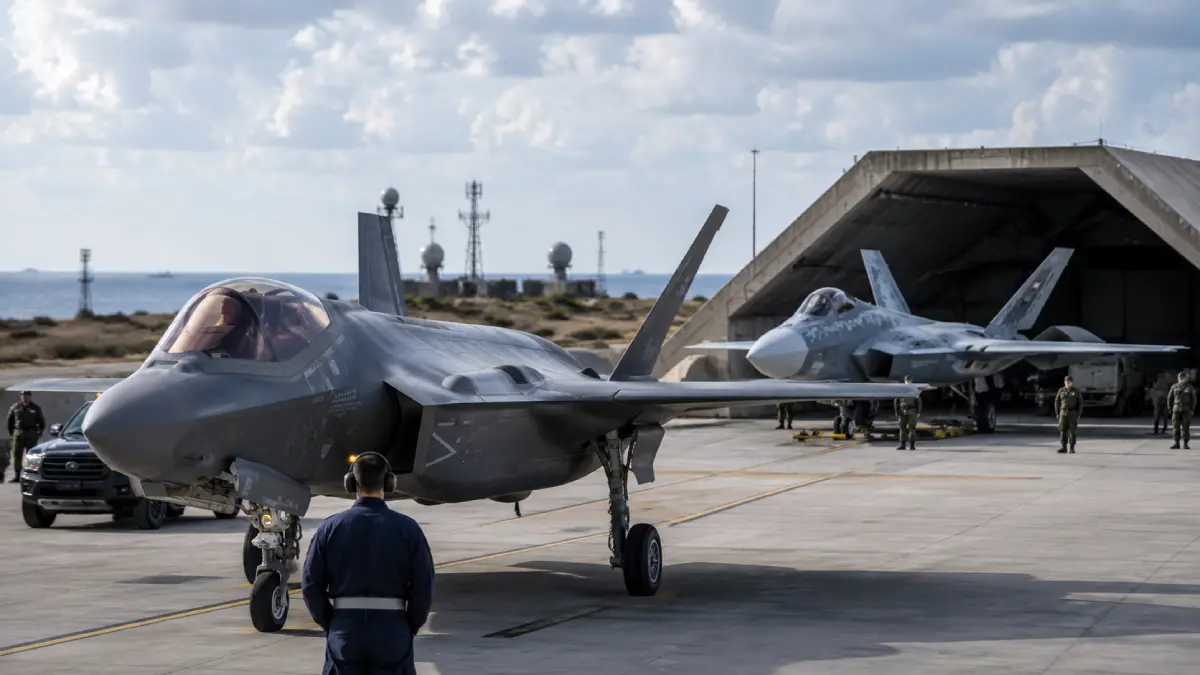
Greece and Israel are pressing Washington over Türkiye's possible return to the F-35 programme and its access to American engines for the KAAN fighter, but their objections rest on different arguments. Athens wants conditions designed to protect the military balance between NATO allies. Israeli Prime Minister Benjamin Netanyahu is challenging Türkiye's regional intentions and lobbying against the transfer itself.
President Recep Tayyip Erdoğan rejected both positions after the NATO summit in Ankara. He also said U.S. sanctions against Türkiye had already been lifted "to a large extent," although Washington has not announced the legal steps required to remove the restrictions or restore Türkiye to the F-35 programme.
Greece Seeks Conditions on Türkiye's Air Power
Greek Defense Minister Nikos Dendias set out Athens' position during an Economist conference in Athens on July 9.
"To be honest, Greece will not be happy if Türkiye gets the F-35s, or if Türkiye gets the engines for the new-generation aircraft," Dendias said.
He acknowledged that Washington decides which countries may acquire American equipment, but asked whether providing such aircraft without assurances that they would not be used against another NATO ally served U.S. interests.
Türkiye is negotiating a return to the F-35 after its removal over the purchase of the Russian-made S-400 air-defence system. Ankara is also seeking General Electric F110 engines for KAAN prototypes and early production aircraft.
Dendias did not present Greece's position solely as an indefinite veto. His remarks left room for Washington to attach restrictions or assurances concerning the use of American aircraft against another ally.
Prime Minister Kyriakos Mitsotakis used more guarded language during the NATO summit. He said alliance relations should rest on good neighbourly conduct and repeated Greece's objection to Türkiye's 1995 parliamentary position on a possible Greek extension of territorial waters in the Aegean to 12 nautical miles.
Greece is scheduled to take delivery of its first F-35s in the United States from 2028 for training, with the first aircraft expected to arrive in Greece around 2030. A Turkish return would narrow the period in which Athens expected to operate the only fifth-generation fighter fleet on either side of the Aegean.
Opposition to the KAAN engine package widens the Greek position beyond the F-35. Restricting F110 access would affect Türkiye's national combat-aircraft programme even if the S-400 dispute continued to block its return to the American platform.
Bosphorus News previously examined how Mitsotakis used the Ankara summit to press Greece's concerns over Türkiye's possible F-35 return. Dendias has now stated that objection directly and extended it to KAAN.
Greek officials have also argued that Türkiye would need to prove it no longer possessed the S-400 and that existing U.S. legislation might have to be amended before an F-35 transfer could proceed.
Netanyahu Turns the Aircraft Dispute Into a Türkiye File
Netanyahu's argument is not confined to the conditions governing an arms sale.
He has accused Erdoğan of supporting Hamas, threatening Israel and pursuing aggressive regional ambitions. In a CNN interview before the Ankara summit, Netanyahu confirmed that he had personally objected to the sale in conversations with U.S. President Donald Trump.
He said Turkish access to the F-35 would damage the military balance in the Middle East. His wider case has linked Türkiye's defence capabilities to Ankara's role in Syria, its relationship with Hamas and Erdoğan's rhetoric toward Israel.
Netanyahu returned to the subject during a telephone conversation with Trump after the summit. His office said he raised statements by Erdoğan and other Turkish officials concerning Israel's existence, together with Israel's demand for security zones around its borders.
The call placed Türkiye inside Israel's wider security argument on Syria and Lebanon rather than treating it only as a prospective American arms customer.
Israel's opposition is also tied to the preservation of its qualitative military advantage, which influences U.S. decisions on advanced weapons transfers in the Middle East.
Israeli officials have reportedly considered a fallback request if Washington refuses to block the sale. Under that approach, Türkiye would receive aircraft without some of the capabilities available to the Israeli Air Force.
Deputy Foreign Minister Sharren Haskel has said Israel would retain its military superiority even if Türkiye obtained the F-35. Israel is therefore lobbying against the transfer in Washington while assuring its own public and regional partners that its advantage would survive.
Erdoğan Rejects the Objections but Keeps the Greek Channel Open
Erdoğan answered the comments by Netanyahu and Mitsotakis during his closing press conference after the NATO summit.
"Neither statement has any place in my world," he said.
He then treated the two leaders differently. Erdoğan dismissed Netanyahu more sharply, saying it was clear "in which waters" the Israeli prime minister was operating. Mitsotakis, he said, should not have made the same mistake.
Erdoğan argued that Türkiye had never asked Greece why it was purchasing particular defence systems.
"Did we ever say to him, 'Why are you buying these systems?'" he said, referring to Mitsotakis. "He is our next-door neighbour. He can buy them or sell them."
Ankara says it has not tried to obstruct Greek procurement and sees no legitimate role for Athens in determining Turkish access to American aircraft.
Erdoğan added that Türkiye already produced fighter aircraft, tanks, ships and air-defence systems, but remained entitled to purchase additional capabilities.
He did not close the diplomatic channel with Greece. In response to a Greek journalist, Erdoğan said the two countries' foreign ministers should continue discussing Aegean disputes and that the leaders could meet if necessary.
There was no similar opening toward Netanyahu.
Erdoğan Says Sanctions Are Largely Gone
Erdoğan gave a more expansive account of the U.S. sanctions imposed under the Countering America's Adversaries Through Sanctions Act than either Turkish or American officials had previously placed on the public record.
Pointing to senior officials standing beside him, including the defense minister, foreign minister, chief of the general staff and vice president, Erdoğan said they had experienced that the restrictions were no longer being applied as before and had been lifted "to a large extent."
His language may describe the political and operational change in relations since Trump returned to office. It does not establish that Washington has completed the formal procedure required to remove the measures.
Trump said in Ankara that he would lift the sanctions. Foreign Minister Hakan Fidan later said Turkish and American officials were still working through the legal and technical process. Fidan also described CAATSA and the F-35 as separate matters under U.S. law.
Improved access between officials and fewer practical restrictions do not remove the legal condition tied to the S-400.
Bosphorus News examined the remaining requirements in its report on the F-35, S-400 and CAATSA negotiations after the Ankara summit.
The S-400 Transfer Has Not Been Announced
Ankara appears to be discussing a formula that would remove the Russian system from Türkiye without publicly accepting Washington's original demand that it be abandoned.
Abdülkadir Selvi, a Hürriyet columnist known for his close access to Erdoğan and senior Justice and Development Party circles, reported that Türkiye was preparing to transfer the S-400s to an unnamed Gulf country. The United Arab Emirates and Qatar have been mentioned as possible destinations.
The Kremlin confirmed contacts with Ankara over the future of the system but did not confirm a sale or transfer.
No completed transaction had been announced by Türkiye, Russia, the United Arab Emirates or Qatar by Sunday. A Turkish announcement that Selvi said was expected on July 10 did not take place.
A third-country transfer could offer Ankara a route out of the dispute. Russia may need to approve any resale under the original contract, and Washington would still have to determine that Türkiye no longer possessed or operated the system.
Government-aligned commentary has presented the emerging package as a Turkish gain involving the removal of sanctions, renewed F-35 access and approval of the KAAN engine sale. Only the engine process has cleared a defined procedural stage. The sanctions and F-35 files remain under negotiation.
KAAN Engines Clear a Stage That the F-35 Has Not
The Trump administration notified Congress of a package worth more than $700 million involving F110 engines, integration work, testing, certification, technical data and related services for Türkiye.
The congressional review period ended without lawmakers blocking the transaction, allowing technical and commercial negotiations to continue.
The package does not give KAAN a permanent domestic propulsion solution. Türkiye still intends to develop a national engine, while the F110 units are expected to support prototypes and early production.
Greek objections and an effort by members of Congress to stop the package did not prevent the review period from expiring.
Bosphorus News previously reported on the KAAN engine package and the congressional attempt to block it.
The F-35 process remains tied to the S-400, existing American legislation and Türkiye's former programme status. Trump's support has revived negotiations but has not produced a delivery decision.
Ankara Links Procurement to NATO Duties
Erdoğan placed the aircraft dispute inside Türkiye's argument over NATO burden-sharing.
"NATO should be an alliance of allies who strengthen one another," he said, while calling for the removal of remaining barriers to defence trade "without any ifs or buts."
Türkiye commands NATO's second-largest land force and is preparing to deploy F-16s to Estonia for the alliance's air-policing mission. It has held command responsibilities in the Kosovo Force and is scheduled to command the Alliance Response Force in 2028 and 2029.
In the Black Sea, Türkiye is working with Romania and Bulgaria on a mission that has expanded from clearing drifting mines to protecting energy installations, communications cables and other infrastructure on and beneath the seabed.
Ankara argues that requests for larger Turkish operational contributions should not coexist with political attempts to restrict its access to aircraft, engines and other defence technologies.
Erdoğan also referred to Türkiye's Steel Dome air-defence programme, saying that if others possessed different "domes," Türkiye was building one of its own. He did not identify Israel in that passage, but the reference placed domestic air-defence production inside the debate over regional military capabilities.
Trump has supported Erdoğan publicly and advanced the KAAN engine package. Congress, the Pentagon and the formal sanctions process still determine whether that political support can produce an F-35 transfer.
Türkiye has moved the KAAN engine package through congressional review. Its F-35 return still depends on an S-400 arrangement that Ankara has not announced and a U.S. legal determination that Washington has not issued.
Sources: Presidency of the Republic of Türkiye, Greek Ministry of National Defence, Reuters, Israeli officials, Hürriyet, U.S. congressional records, Bosphorus News review and reporting.