
By Bosphorus News Defense Desk
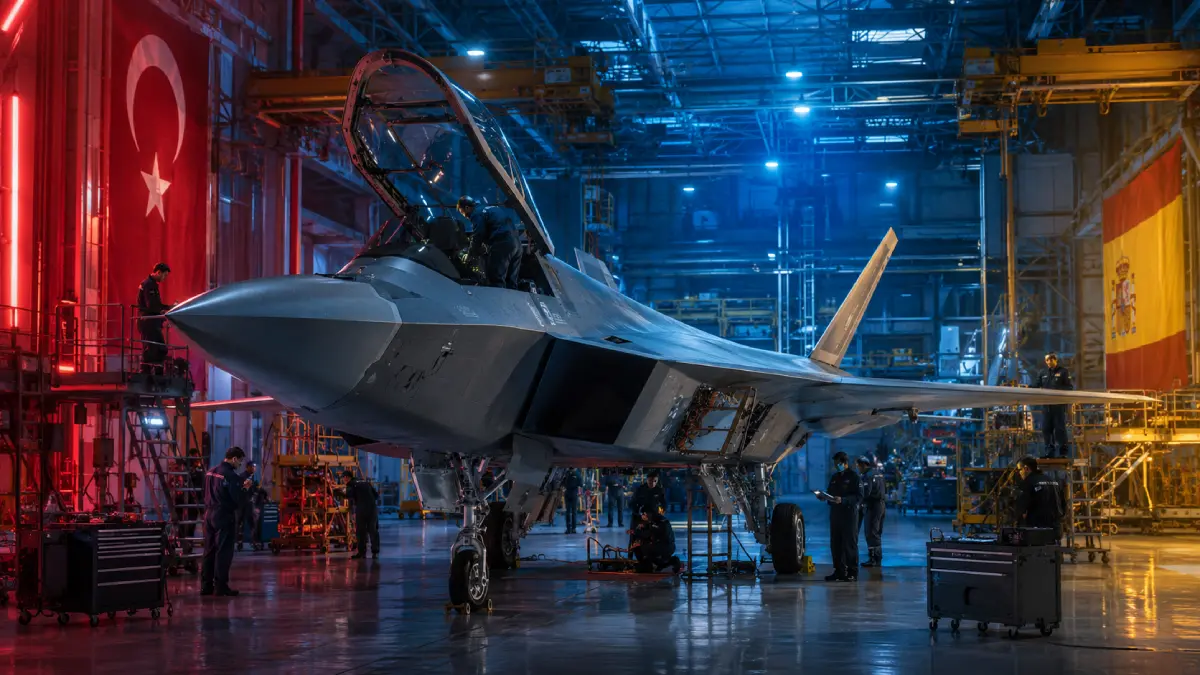
The Trump administration has formally notified Congress of a more than $700 million General Electric F110 engine sale to Türkiye, moving the KAAN fighter program into a 15-day review period days before NATO leaders gather in Ankara.
The notification, dated June 24, covers U.S.-built engines intended for Türkiye's first domestically developed combat aircraft. For Ankara, the timing matters as much as the hardware: the congressional window overlaps with the July 7-8 NATO summit at the Beştepe Presidential Complex, where President Recep Tayyip Erdoğan is expected to meet U.S. President Donald Trump.
The sale is not final until the congressional review period expires without a successful challenge. Because Türkiye is a NATO member, arms-sale notification rules give Congress 15 calendar days rather than the standard 30-day window. Lawmakers can seek a joint resolution of disapproval, though blocking the sale would require passage through Congress and would still face Trump's veto power.
Representative Gregory Meeks, the top Democrat on the House Foreign Affairs Committee, accused the State Department of bypassing the informal congressional review process before moving to formal notification. Meeks said the administration had not invoked emergency authority, provided a written rationale or briefed lawmakers on the sale's implications for U.S.-Türkiye relations, sanctions enforcement and regional security.
That distinction is important. The administration has not bypassed the statutory notification window now under way. The dispute concerns the informal review process that normally allows senior lawmakers to scrutinize major arms sales before formal notification.
What the engines are for
The F110 engines are intended to power early KAAN aircraft while Türkiye works toward a domestic engine for later blocks. Turkish officials have previously said the program received an initial batch of F110 engines for testing and that talks continued for a larger follow-on engine package.
KAAN completed its maiden flight in February 2024 and is designed to become the backbone of Türkiye's next combat-aircraft generation. The aircraft is being developed by Turkish Aerospace Industries, known in Türkiye as TUSAŞ, as Ankara seeks to reduce dependence on foreign suppliers after years of procurement blocks, sanctions pressure and export-control disputes.
The engine issue remains one of the program's main bottlenecks. Early KAAN blocks still depend on U.S.-origin propulsion, even as Türkiye develops the TF35000 domestic turbofan for later integration. Without a reliable F110 supply line, production timing, expanded flight testing and early air force deliveries face a heavier schedule risk.
Bosphorus News previously traced how KAAN moved from its first production contract into NATO-linked fighter politics, including Spain's exploratory interest and the Block-10 aircraft's reliance on the F110 engine family before a planned domestic engine transition.
The S-400 and F-35 barrier
The F110 notification does not restore Türkiye's access to the F-35 program.
Türkiye was removed from the F-35 Joint Strike Fighter program after it acquired the Russian-made S-400 air defense system in 2019. U.S. law still bars a transfer of F-35 aircraft to Türkiye unless conditions tied to the S-400 are satisfied. Ankara has not disposed of the system.
The KAAN engine sale therefore gives Washington a narrower path: it can move a U.S.-origin component into Türkiye's indigenous fighter program without reversing the F-35 exclusion. That is why the package has become politically sensitive. For Ankara, it supports KAAN. For critics in Congress, it risks normalizing defense trade while the S-400 dispute remains unresolved.
Trump added to the political reading when he told reporters that he would "probably do something" that would make Türkiye happy. Vice President JD Vance also said the administration was reviewing what would be required for Türkiye to regain access to F-35s, but noted that legal certifications would have to be met first.
That keeps the F-35 question alive without changing the legal position. The engine sale is a KAAN file, not an F-35 deal.
Congress and the lobby front
Opposition has crossed party lines. Meeks has been joined by lawmakers including Nicole Malliotakis, Mike Lawler, Chris Pappas and Dina Titus, while Greek-American and Armenian-American advocacy groups have pressed Congress and the White House to block or condition the sale.
The American Hellenic Institute urged Trump to reverse course on the F110 package and abandon any move that could help Türkiye return to the F-35. The Armenian National Committee of America said it was working with Hellenic American allies and bipartisan members of Congress to oppose the sale.
Those groups have tied the engine package to the S-400, CAATSA sanctions, F-35 access, Cyprus, Greece and Armenia-related congressional pressure. Their argument is not only about KAAN propulsion; it is about whether the United States should reopen defense channels with Türkiye before the S-400 dispute is resolved.
The administration's calculation appears different. By moving the F110 notification into the NATO summit window, Washington gives Erdoğan a visible defense-industrial signal while preserving the formal barriers around the F-35.
A summit-timed test
The Ankara NATO summit gives the sale its strategic setting. Alliance leaders are expected to focus on defense spending, industrial capacity and procurement after NATO moved toward a 5% defense and security-related spending target. Türkiye wants to present itself not only as a host country, but as a defense producer inside the Alliance's next procurement cycle.
KAAN sits inside that argument. It is an airpower replacement program, an export project and a sovereignty marker for Türkiye's defense industry. Those ambitions depend on whether early aircraft can move through testing, production and engine integration without new export-control shocks.
The congressional review period now turns that ambition into a Washington test. If the sale proceeds, KAAN gains a critical engine channel for its early blocks. If Congress succeeds in slowing or blocking it, Türkiye's most visible fighter program will again face the same U.S. export-control politics that shaped Ankara's post-F-35 defense turn.
Either outcome keeps the larger dispute intact. The F110 sale can help KAAN move forward, but it does not settle the S-400 file, lift CAATSA sanctions or reopen the F-35 program. It gives the Trump administration a limited defense opening before the Ankara summit while leaving the S-400 dispute and Türkiye's F-35 exclusion unresolved.
Sources: Reuters, U.S. House Foreign Affairs Committee Democrats, American Hellenic Institute, Armenian National Committee of America, Congressional Research Service, Breaking Defense, Bosphorus News review and reporting.