
By Bosphorus News Defense Desk
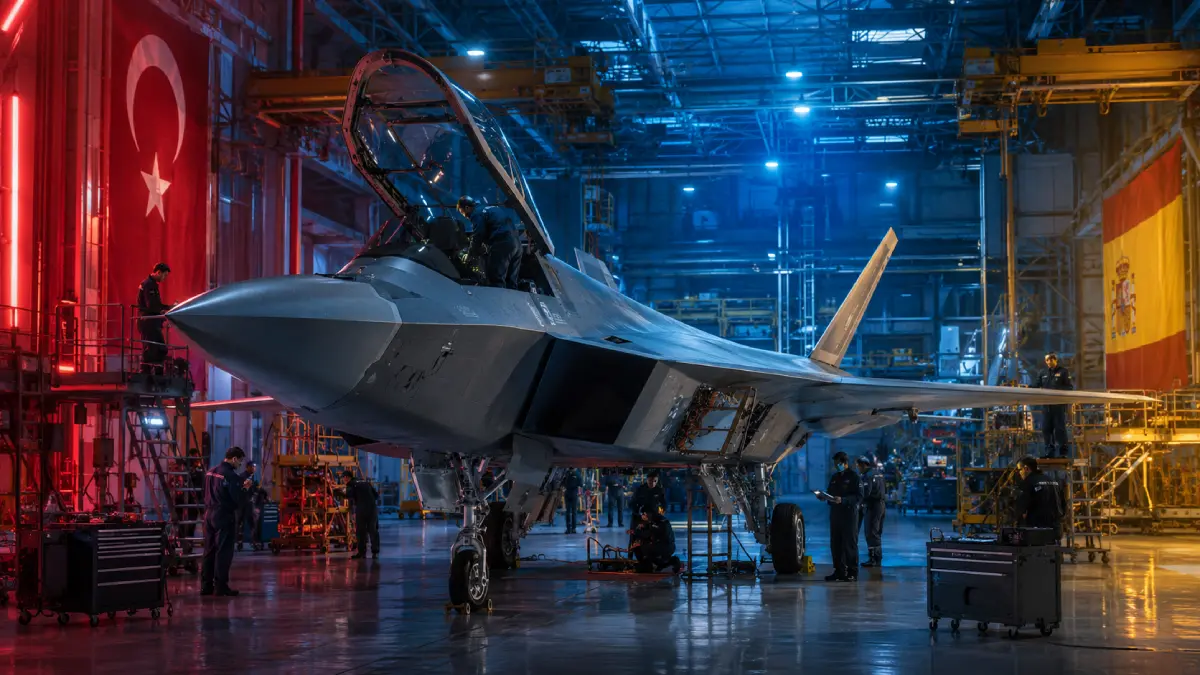
Türkiye signed its first production contract for the KAAN fifth-generation stealth fighter on May 6 at the SAHA 2026 International Defence and Aerospace Exhibition in Istanbul, covering an initial batch of 20 Block-10 aircraft for the Turkish Air Force with deliveries scheduled between 2028 and 2030. Within 24 hours, Turkish Aerospace Industries confirmed that the Spanish Air and Space Force had formally requested information on the KAAN, opening the first government-to-government fighter discussions between the two countries.
The Presidency of Defence Industries and Turkish Aerospace Industries signed the supply contract on the second day of SAHA 2026. The agreement also covers serial production of more than 50 ANKA-3 stealth unmanned combat aerial vehicles, which are designed to fly as loyal wingmen alongside the crewed fighter. TAI CEO Mehmet Demiroglu described the contract as the definitive transition from experimental prototyping to industrial-scale manufacturing. "The initial sale was made for the first batch of 20 Block-10 aircraft. This is the first order. Over time, we expect the numbers to increase," he told Breaking Defense.
Block-10 and What Comes After
The Block-10 aircraft will be powered by two General Electric F110-GE-129 engines, the same powerplant family used in Turkish F-16s. TEI, Türkiye's engine development company, is developing the indigenous TF35000 turbofan to replace imported powerplants in later production blocks, with a target integration date around 2032. As Bosphorus News reported in February, Türkiye was already evaluating a strategic cooperation with Spain's ITP Aero to support TF35000 development, a partnership that would give the engine programme a European industrial partner and strengthen its certification pathway for export markets.
The KAAN completed its maiden flight on February 21, 2024. Additional prototypes are progressing through flight envelope expansion, avionics maturation and stealth validation. SSB President Haluk Görgün described the Block-10 phase as the baseline from which Block-30 variants carrying the domestic engine and additional capabilities will emerge. Demiroglu told SAHA audiences that TUSAŞ has begun work on sixth-generation technologies built around the manned-unmanned teaming concept. "Even if we don't define the sixth generation alone, we will be one of those who define it," he said.
Spain at the Table
The fighter discussion with Spain did not begin at SAHA 2026. It grew from a bilateral aerospace relationship that has been building for years. In December 2025, Spain and Türkiye signed a €2.6 billion agreement covering 30 HÜRJET advanced jet trainers for the Spanish Air and Space Force, marking the first major European export of the Turkish-designed platform. The deal placed HÜRJET inside Spain's future combat pilot training system, with Airbus España leading integration and Spanish companies including Indra, GMV, Sener, ITP Aero and Orbital participating in the industrial chain.
On May 7 at SAHA, Demiroglu disclosed that the Spanish Air and Space Force had formally requested information regarding a high-tier fifth-generation fighter, and that government-to-government contacts coordinated through the Presidency of Defence Industries had entered an exploratory phase involving both technical and political evaluation. He said any potential KAAN sale would be managed between the two governments, and cautioned that negotiations remained early-stage with no numbers, timelines or financial terms announced.
Spain's interest is driven by a convergence of pressures. Its EF-18 Hornet fleet is ageing. The AV-8B Harrier force faces retirement. Madrid formally suspended F-35 procurement in August 2025. The Future Combat Air System programme jointly developed with France and Germany has accumulated delays that push realistic delivery into the 2040s.
As Bosphorus News examined in its analysis of the HÜRJET deal's European implications, Madrid is constructing a training architecture around a Turkish platform while Brussels continues to debate Ankara's place in EU-linked defence frameworks. Spain's Defence State Secretary María Amparo Valcarce described the SAETA II trainer programme as a step toward reducing critical dependencies and strengthening strategic autonomy, even as the platform at its centre is Turkish-designed. The KAAN discussions extend that logic into combat aviation.
Indonesia First, Spain Next
Indonesia formalised a contract for 48 KAAN aircraft at IDEF 2025 in Istanbul on July 26, 2025, following a government-to-government agreement signed on June 11. The deal, Türkiye's largest defence export in its history, made Indonesia the first international customer and provided the programme with external validation. A Spanish agreement would carry a different institutional weight. Spain is a founding NATO member and an EU state. Its decision to approach Ankara rather than Washington or its own FCAS partners reflects where European confidence in the transatlantic and intra-European defence-industrial models currently stands.
Türkiye is positioning the KAAN not only as an aircraft but as a procurement model. Control over mission software, electronic warfare integration and sustainment architecture sits with the buyer rather than with an American or multinational supply chain. That argument has particular resonance in capitals that have found the F-35's software and logistics architecture politically constraining.
TAI sources cited by Spanish outlet El Español indicated that formal KAAN discussions could intensify after 2027 as the aircraft completes its testing programme and approaches operational maturity. The Spanish delegation that attended SAHA 2026 was led by Lieutenant General Ivorra and held high-level meetings with Turkish defence officials throughout the exhibition. Neither government has disclosed details on the number of aircraft potentially under discussion.
If the talks advance, the KAAN would become the first non-American fifth-generation fighter exported to a NATO member state, as the F-35 has until now been the only fifth-generation platform available to Western alliance air forces.
***Sources: Turkish Aerospace Industries official statements (SAHA 2026), Presidency of Defence Industries (SSB), Anadolu Agency, Breaking Defense, Infodefensa, Atalayar, GBP Defence.