
By Murat Yıldız
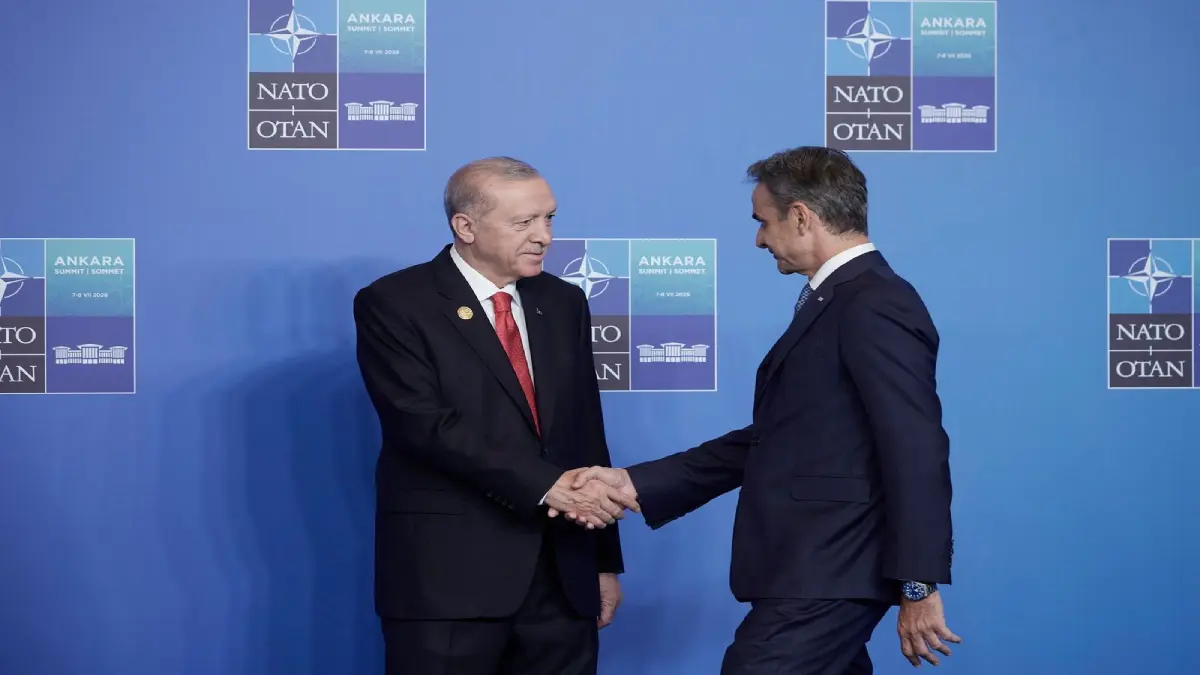
Greek Prime Minister Kyriakos Mitsotakis returned from the NATO Ankara summit on July 8 facing a domestic test over Türkiye's possible return to the F-35 programme, as Greek media and PASOK questioned whether Athens is relying too heavily on U.S. law, Congress and Israel to hold the line.
Mitsotakis avoided a direct veto demand over what Washington might sell to Ankara. "It is not my job to tell anyone, certainly not the United States, what they will sell and where they will sell it," he said after the summit, while pointing to "important legal obstacles" in U.S. legislation because Türkiye was removed from the F-35 programme after buying Russia's S-400 air-defense system.
He also pulled the aircraft file back toward the Aegean. Türkiye's 1995 parliamentary position treats a Greek extension of territorial waters in the Aegean to 12 nautical miles as a cause for war. "I think it is a historical irregularity," Mitsotakis said, adding that the position did not fit either the Athens Declaration or the climate Greece and Türkiye are trying to build as neighbours.
A careful line from Athens
The answer gave Athens a careful line after President Donald Trump's Ankara remarks reopened the question of Türkiye's access to the F-35 and the future of U.S. sanctions imposed after the S-400 purchase. Mitsotakis did not publicly ask Washington to block Türkiye. He placed the issue inside NATO's language of good-neighbourly relations, alliance cohesion and legal constraint.
Greek government-aligned and mainstream coverage played down panic. Kathimerini reported the government's position through Greece's own air-power timetable, noting that Greek pilots are expected to begin training on Greek F-35s in 2027 and that Athens expects to receive the aircraft before Türkiye could realistically return to the programme. Mitsotakis made the same case in Ankara, citing Greece's F-35 order, Rafale fighters and the upgrade of its F-16 fleet to the Viper standard.
Protothema reported that Athens is keeping a "small basket" on Türkiye's F-35 prospects while watching the role of Congress and Israel. Greek outlets also highlighted Israeli Prime Minister Benjamin Netanyahu's opposition to any F-35 sale to Türkiye, adding another external brake to a file Trump appeared willing to reopen politically but cannot settle alone.
External brakes, domestic pressure
The harder pressure came from PASOK and opposition-leaning Greek media. PASOK warned that Türkiye's possible access to General Electric F110 engines for the KAAN fighter and any return to the F-35 market would alter the regional air-power debate. The party argued that any U.S. move to reverse current restrictions should either fail politically or be blocked in Congress, otherwise it would undermine the logic of the Countering America's Adversaries Through Sanctions Act (CAATSA).
PASOK also attacked the government's "calm waters" policy toward Türkiye, saying Ankara has used the period to push its defence access, advance its Blue Homeland doctrine domestically and seek a place inside European defence structures. In that reading, the F-35 file is not a narrow aircraft question. It is part of Türkiye's effort to re-enter Western defence markets while core Aegean disputes remain unresolved.
In.gr accused Mitsotakis of having given Washington a "white cheque" and now relying on allied sensitivity to protect Greek interests. Efsyn read the summit as one that suited Türkiye's entry into a wider armaments race. Militaire argued that Ankara was being upgraded while Athens remained too passive.
Those readings do not amount to a single opposition line. SYRIZA and the Communist Party of Greece did not immediately provide the same direct, usable response on the Ankara F-35 file that PASOK did. The pressure still lands on Mitsotakis because the debate has shifted from whether Greece is buying enough weapons to whether its diplomatic assumptions about Türkiye's exclusion from the F-35 programme still hold.
Türkiye is pressing from the opposite direction. President Recep Tayyip Erdoğan used the Ankara summit to urge NATO allies to lift defense industry restrictions and argued that alliance solidarity cannot coexist with barriers among members. Bosphorus News reported after the NATO Ankara declaration that Türkiye had succeeded in putting defence trade barriers onto the summit record, tying Ankara's F-35, KAAN, Eurofighter and European defence access files to a wider alliance debate over production capacity, burden-sharing and market access.
That shift makes the Greek debate harder than a single aircraft sale. Greece can point to Rafales, F-16 Vipers, Belharra frigates and its incoming F-35 fleet. It can also point to Türkiye's unresolved S-400 file and the legal structure that still blocks F-35 delivery. Ankara has now placed the access question inside NATO's summit-level conversation on defence production, burden-sharing and alliance market rules.
Mitsotakis tried to answer that pressure by presenting Greece as a front-line NATO spender. He said Greece is already among the five allies that have reached or exceeded the alliance's 3.5 percent core defense spending target for 2026, placing Athens where many European states hope to be only by 2035. He also described Greece's 28 billion euro defense programme as the "price of freedom."
Spending gives Mitsotakis one answer. It does not close the political file. If Washington keeps Türkiye outside the F-35 programme, Athens can argue that law, patience and alliance management held. If Trump moves further toward Ankara, PASOK and opposition leaning Greek media will say the government treated external brakes as strategy.
Mitsotakis avoided a direct clash with Trump, avoided claiming a veto over U.S. arms sales and avoided turning the press conference into an anti-Türkiye platform. By bringing casus belli back into the NATO setting, he made clear that Athens will try to attach Türkiye's defencs access push to the unresolved Aegean file.
That file now runs through the White House, Congress, the Pentagon, Israel's objections and the still unresolved S-400 question. Netanyahu's opposition gives Athens another external brake to cite, but it also exposes the fragility of the Greek position: the F-35 debate is being shaped outside Athens, by U.S. politics, Israeli security calculations and Türkiye's bargaining power inside NATO.
Ankara left Mitsotakis with a domestic problem. Greece has its own procurement programme and a strong spending record, but the question now being asked in Athens is whether those assets are enough if Türkiye's return to Western defence markets becomes part of a larger NATO bargain.
Sources: Greek Prime Minister's Office, PASOK, Kathimerini, Protothema, In.gr, Efsyn, Avgi, CNN Greece, To Vima, Capital, Militaire, Reuters, Mitsotakis press conference transcript, Bosphorus News review and reporting.