
By Bosphorus News Geopolitics Desk
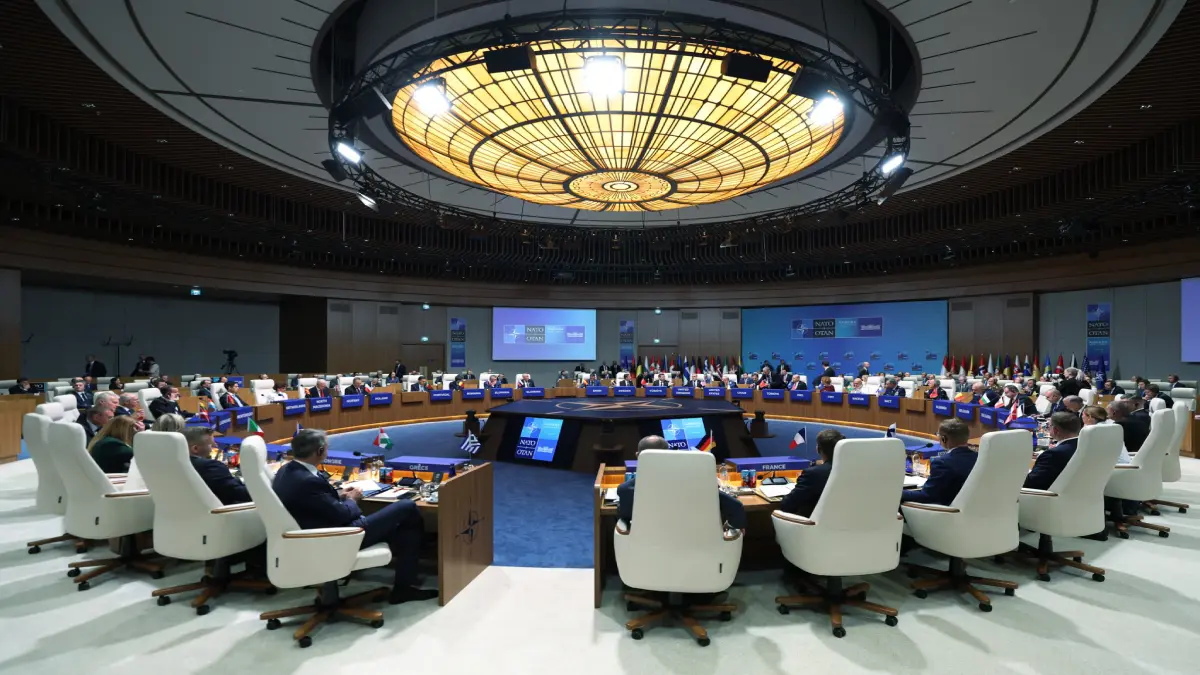
NATO's Ankara Declaration on July 8 placed defence-trade barriers, procurement commitments and freedom of navigation in the Strait of Hormuz into the summit's final record, giving Türkiye's defence-access push a formal alliance setting after President Recep Tayyip Erdoğan urged allies to remove restrictions inside NATO.
TRT Haber's published account of the final declaration said the text reaffirmed Article 5 collective defence, transatlantic unity and NATO's 360-degree deterrence and defence approach. It also said allies pledged to continue work to remove defence-trade barriers among them.
Erdoğan made the Turkish position explicit during the summit. "Restrictions among allies on defence cooperation, especially in the defence industry, must be lifted," he told NATO leaders, according to Reuters.
He also warned that European security initiatives should complement NATO and should not exclude non-European Union allies with relevant capabilities. Reuters reported that Erdoğan said Türkiye is on course to meet NATO's 5 percent defence-spending target by 2030 and has allocated an additional $24 billion for its Steel Dome air-defence project.
The declaration language matters for Ankara because Türkiye's complaint is no longer limited to one weapons system. It reaches F-35 access, Countering America's Adversaries Through Sanctions Act sanctions, KAAN engine supply, SAMP/T air defence, co-production, components and entry into European defence procurement tools.
The U.S. side of that file had already moved into the summit's first day. Bosphorus News' NATO Ankara Summit Brief | Day One mapped how the Trump-Erdoğan meeting brought CAATSA sanctions, F-35 access and KAAN engine supply back into the U.S.-Türkiye channel. Bosphorus News had also reported ahead of the summit that the Trump-Erdoğan defence track was becoming a test of whether Washington would treat Türkiye as a restricted ally or a full participant in NATO's capability build-up.
The European side of the file is just as important. Bosphorus News reported this week that France's reported willingness to revisit a SAMP/T air-defence sale to Türkiye had moved Ankara's air-defence access question into the summit window. The declaration's defence-trade language now gives that argument a broader NATO frame.
NATO Secretary General Mark Rutte used the Ankara Defence Industry Forum to push the same production logic. "The money is there, and more is coming," Rutte said, urging governments and industry to "do more, faster, together."
Reuters reported that more than $50 billion in defence procurement and industrial agreements were promoted around the Ankara summit. NATO's official forum account listed new capability and procurement tracks including GlobalEye airborne warning and control aircraft, MQ-4C Triton high-altitude surveillance drones, A330 Multi Role Tanker Transport aircraft, NATO Drone Edge, NATO Front Door for Industry and NATO Engine.
The forum linked higher spending to procurement, industrial access and deployable systems. That is where Türkiye's position cuts into the summit record. Ankara is not only asking for more NATO spending. It is asking whether the alliance's new production cycle will still leave Turkish industry facing political restrictions from allies.
The declaration also moved the Strait of Hormuz into NATO's southern-flank language. TRT Haber's account said allies called on Iran to fully respect freedom of navigation in the waterway.
That sentence landed during a live maritime disruption. The United Kingdom Maritime Trade Operations centre and Joint Maritime Information Center listed incidents near Oman, including a liquefied natural gas tanker hit by an unknown projectile that caused an engine-room fire. Reuters reported that the Qatari LNG tanker Al Rekayyat was awaiting salvage after the strike near Hormuz, while shipping risk around the strait had risen sharply.
Rutte also tied the waterway to alliance security, saying freedom of navigation through the Strait of Hormuz was "crucial for all 32 Allies."
Ukraine remained inside the declaration as a separate commitment. TRT Haber's account said allies pledged €70 billion in military equipment, aid and training for Ukraine in 2026 and committed to maintaining at least the same level in 2027.
The Ankara Declaration therefore did more than close a summit. It put Türkiye's defence-access complaint, NATO's procurement push, Ukraine funding and Hormuz navigation into the same record.
The hard part now moves to sanctions waivers, congressional review, export licences, European political consent and procurement decisions.
Sources: NATO, Reuters, TRT Haber, Türkiye's Directorate of Communications, UKMTO/JMIC, Bosphorus News review and reporting.