
By Bosphorus News Geopolitics Desk
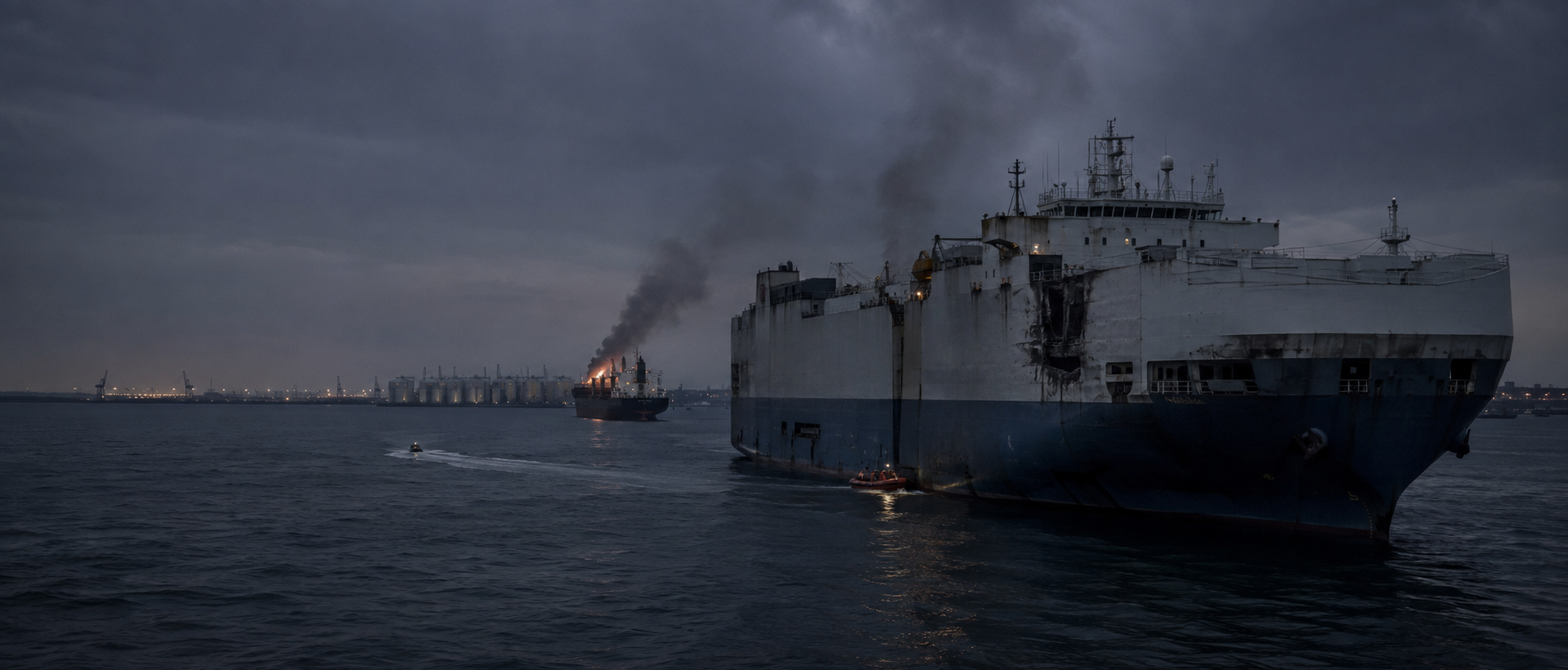
The Cameroon-flagged Ro-Ro Ural had just rescued 18 sailors from the drone-hit cargo ship Necibe when it was attacked near Russia's Black Sea coast. İlker Lazoğlu, a 47-year-old Turkish cook evacuated from the first vessel, died aboard the second. Eight people were reported injured when Ural reached Samsun on Aug. 22.
The attack came eight days after Russia rejected the Black Sea moratorium publicly raised by Foreign Minister Hakan Fidan. By then, Turkish-owned ships and Turkish crews had already been caught repeatedly in the expanding maritime campaign, while attacks had put most of the grain export capacity used by Russia and Ukraine in the Black Sea and Sea of Azov basin last season out of operation.
No moratorium has been agreed.
The Ship That Rescued 18 Sailors Was Hit Next
The San Marino-flagged Necibe was struck at Tuapse on Aug. 18 while preparing to load about 20,000 tons of wheat. The ship caught fire.
Ural, operated by Turkish company Kalyoncu Denizcilik on the Samsun-Novorossiysk route, came alongside and evacuated all 18 crew members. Lazoğlu was among them.
Ural later resumed its voyage and was itself attacked near Novorossiysk during the overnight period leading into Aug. 22. Turkish reporting placed the strike around midnight. The vessel continued to Samsun carrying Lazoğlu's body and injured sailors.
The sequence left a Turkish seafarer who had escaped one damaged civilian ship dead after the vessel that rescued him was hit.
Ukraine's Foreign Ministry responded on Aug. 23 by offering condolences to the families of sailors killed in Black Sea incidents and acknowledging that Turkish citizens were among the dead. Spokesperson Heorhii Tykhyi said Ukraine was ready to coordinate with Turkish authorities to clarify the circumstances and improve civilian navigation safety.
The statement did not assign responsibility for the specific attacks on Necibe or Ural.
That distinction remains necessary across the wider sequence. Turkish and regional reporting has attributed individual attacks to different sides, sometimes citing crews, local officials or military sources, but Ankara has not publicly identified the attacker in every case. Bosphorus News is therefore treating responsibility vessel by vessel.
Turkish-Owned Ships Were Already in the Firing Line
The attacks on Necibe and Ural followed several incidents involving vessels connected to Türkiye through ownership, flag or crew.
On Aug. 3, the Turkish-owned civilian vessels Yaşar and Nadezhda were attacked by unmanned aerial vehicles after leaving Novorossiysk. Türkiye's Foreign Ministry said several crew members, including Turkish citizens, were injured.
Nadezhda captain Yalçın Şahin subsequently blamed Ukraine and said six or seven drones had been used against the vessel. Türkiye's Foreign Ministry did not make the same attribution.
The ministry instead warned that the Russia-Ukraine war was spreading farther across the Black Sea and increasingly affecting civilian vessels. It said continued escalation could threaten international shipping and food security.
Bosphorus News had already documented the growing exposure in July as Turkish-linked commercial shipping moved deeper into the Black Sea risk zone.
The Turkish-flagged Reyhan Sarı was damaged on July 22 after leaving Russia's Taman port with coal for Türkiye. Casualty reports from that attack subsequently conflicted, and Bosphorus News has not treated an initially reported death aboard the ship as independently established.
Other Turkish-owned or Turkish-linked vessels have also been hit on routes connected to Ukrainian ports.
The exposure is wider than the Turkish flag. Turkish companies operate ships under foreign registries, Turkish seafarers work aboard internationally owned vessels and Turkish trade depends on ports on both sides of the war.
Fidan Asked Both Sides for a Moratorium
Fidan had begun discussing a limited arrangement before the August attacks.
During talks in Kyiv on July 16, he said that if a comprehensive ceasefire could not be reached, Russia and Ukraine could consider narrower moratoriums in areas including Black Sea and energy security. He said there was serious agreement with the Ukrainian side on the need to protect navigation.
The attacks on Yaşar and Nadezhda gave the proposal new urgency.
On Aug. 8, Fidan said military operations had spread beyond naval and military targets to commercial shipping. Turkish-owned vessels, Turkish-flagged ships and foreign vessels carrying Turkish crews were all being affected.
He said Türkiye had raised with both Russia and Ukraine the establishment of a mechanism for a mutual moratorium in the Black Sea. Ukraine had made a similar proposal, he said, and Ankara passed the issue to its Russian counterparts.
Russia answered on Aug. 14.
Foreign Ministry spokesperson Maria Zakharova said Moscow had received no formal Turkish submission containing detailed terms. She nevertheless rejected the ceasefire concept being discussed and said Russia saw no grounds for limited measures that it believed could favor Ukraine.
Zakharova also ruled out returning to the 2022-23 Black Sea Grain Initiative brokered by Türkiye and the United Nations, describing the previous arrangement as one-sided.
The public record is narrower than saying Moscow rejected a written Turkish plan. Fidan says Ankara conveyed the moratorium idea to Russia. Moscow says no formal proposal specifying the terms arrived. Russia has nonetheless rejected the limited ceasefire being discussed.
Four days later, Necibe was hit. Ural was attacked during the following week.
Türkiye's National Security Council had already warned on Aug. 6 that the deadlock in the war should not be allowed to turn neighboring regions, particularly the Black Sea and Caspian Sea, into further areas of conflict.
Bosphorus News traced that expansion in an Aug. 7 analysis, from attacks involving Türkiye-linked shipping in the Black Sea to a widening military risk reaching toward the Caspian.
The warning now has a measurable commercial cost.
Most Black Sea Grain Capacity Is Offline
Russia and Ukraine exported an average 7.2 million metric tons of grain a month through Black Sea and Sea of Azov terminals last season.
By Aug. 19, Ukraine's Black Sea grain terminals were no longer shipping. On the Russian side, the only terminal in the basin not officially shut was the much smaller Tuapse facility, with capacity of about 160,000 tons a month.
Reuters calculated that more than 97% of the grain export capacity used by the two countries in the basin last season was out of operation.
The damage had been building since July.
Bosphorus News reported that the maritime campaign was spreading from individual vessels to grain terminals and export corridors. Russian strikes had already reduced Ukrainian Black Sea capacity, while Ukrainian attacks were putting Russian shipping and the Sea of Azov export route under growing pressure.
Russian strikes effectively halted operations at Ukraine's main Odesa ports by the end of July. Ukrainian attacks later forced major terminals at Novorossiysk to stop operations after security measures had already narrowed access through the Sea of Azov.
Chicago wheat futures rose sharply between early July and Aug. 20. Egypt, which sourced more than four-fifths of its wheat imports from Russia and Ukraine during the first half of 2026, is among the large buyers exposed. Asian importers have also looked at replacement cargoes from Australia, Argentina and North America.
Türkiye has its own exposure to the supply shock. Russian grain feeds its milling industry and flour exports, leaving Turkish buyers vulnerable to higher freight, insurance and replacement costs even when wheat remains available elsewhere.
Ukraine's Harvest Is Backing Up Inland
Ukraine's problem is moving from the coast into farms and storage facilities.
The Ministry of Agrarian Policy and Food warned on Aug. 7 that agricultural exports in the 2026/27 marketing year could fall from an expected 64.4 million tons to about 29.6 million tons if maritime restrictions continue.
The 29.6 million-ton figure is a forecast rather than an accomplished fall.
Current data are already severe. Ukrainian grain exports were down about three-quarters year on year in the first half of August.
The ministry expects storage capacity to be full by October. By November, more than 9 million tons of grain, oilseeds and meal could be left without sufficient space. Wheat exports alone could fall from 17.6 million tons to 8.3 million tons.
Farmers unable to move existing stocks receive less export revenue and lose storage space needed for the next crop.
Kyiv has asked the European Commission for €220 million in non-repayable assistance to cover interest payments on loans to small and medium-sized agricultural producers. The proposal was designed to support a subsidized credit portfolio of up to €4 billion and preserve liquidity for wages, storage, land rent and sowing.
The European Commission responded in August without announcing the requested additional €220 million grant, instead pointing to possible assistance through existing interest-rate subsidies and lending mechanisms.
Moldova and Constanța Offer an Expensive Escape Route
Ukraine is again trying to push more agricultural exports west.
Kyiv and Chişinău have discussed moving grain by rail through Moldova to Romania's Port of Constanța. Ukraine has sought a 50% reduction in Moldovan railway tariffs, while Moldova wants guaranteed cargo volumes.
The proposed corridor could carry about 4.5 million tons annually, roughly a tenth of Ukrainian exports under the estimates cited during the talks.
That provides additional capacity, but not a substitute for the deep-water Black Sea ports.
Rail, road and Danube routes cost more and face border, infrastructure and capacity limits. Danube shipping has also been affected by low water levels and repeated attacks on port facilities.
Russia is dealing with a parallel logistics problem.
Before the latest shutdowns, Bosphorus News reported that major Russian Black Sea grain terminals had begun restricting truck deliveries as security restrictions squeezed the Azov route and diverted more cargo towards Novorossiysk and Taman.
Three terminals with more than 20 million tons of combined annual capacity were affected. Night navigation at Novorossiysk had also been restricted because of the drone threat.
Russia can redirect some grain towards Baltic ports, but producers in southern regions then face longer rail journeys and higher transport costs. Caspian routes serve smaller markets and have become less predictable as military risk has spread across a wider area.
Neither side has an inland network capable of replacing Black Sea shipping at comparable scale and cost.
Grain Shipping Is Now Part of the Energy War
The expanding campaign against economic infrastructure has made Fidan's limited moratorium harder to isolate.
Ukraine has increased attacks on Russian refineries, oil installations, ports and export infrastructure. Russia has continued striking Ukrainian ports, grain facilities and energy targets.
Zelenskiy said on Aug. 24 that Moscow wanted any agreement protecting agricultural shipping to include an end to Ukrainian strikes on Russian refineries and other energy infrastructure. Kyiv, he said, would require reciprocal protection for Ukraine's own energy system.
The Kremlin acknowledged the same day that Ukrainian attacks were disrupting Russian grain exports and said measures were being developed to reduce the impact.
The Black Sea Grain Initiative operated under a different premise. Agricultural exports received a defined mechanism while fighting elsewhere continued.
Ports, commercial vessels, grain terminals, refineries and logistics infrastructure are now being attacked as interconnected parts of the two countries' economies. A ceasefire for grain shipping would require Russia and Ukraine to agree where civilian commerce ends and economic warfare begins.
Neither has done so.
Türkiye Is Paying for the Breakdown
Commercial passage through the Turkish Straits continues. The disruption begins farther north, before many cargoes reach the Bosphorus.
Shipowners are delaying or cancelling calls at affected ports. Russia is redirecting exports towards alternative ports and railways. Ukraine is trying to move more grain through Moldova, Romania and the Danube. Buyers outside the region are searching for replacement wheat.
Türkiye sits at the southern end of that network as a major grain buyer, maritime state and trading economy. It also helped build the only wartime mechanism that kept large-scale Ukrainian agricultural exports moving through the Black Sea.
Its latest attempt has gone nowhere so far.
Russia rejected the limited ceasefire concept on Aug. 14. Necibe was hit four days later. Ural rescued its 18 crew members and was then attacked itself, killing a Turkish sailor who had already survived the first strike.
At sea, the diplomatic failure now has a human cost. On shore, the same campaign has removed most of the grain export capacity used by Russia and Ukraine last season and pushed both countries toward slower and more expensive alternatives.
Sources: Reuters, Türkiye's Foreign Ministry, Türkiye's National Security Council, Ukraine's Ministry of Agrarian Policy and Food, Ukraine's Foreign Ministry, European Commission, Anadolu Agency, Demirören News Agency, İhlas Haber Ajansı, Bosphorus News review and reporting.