
By Bosphorus News Defense Desk
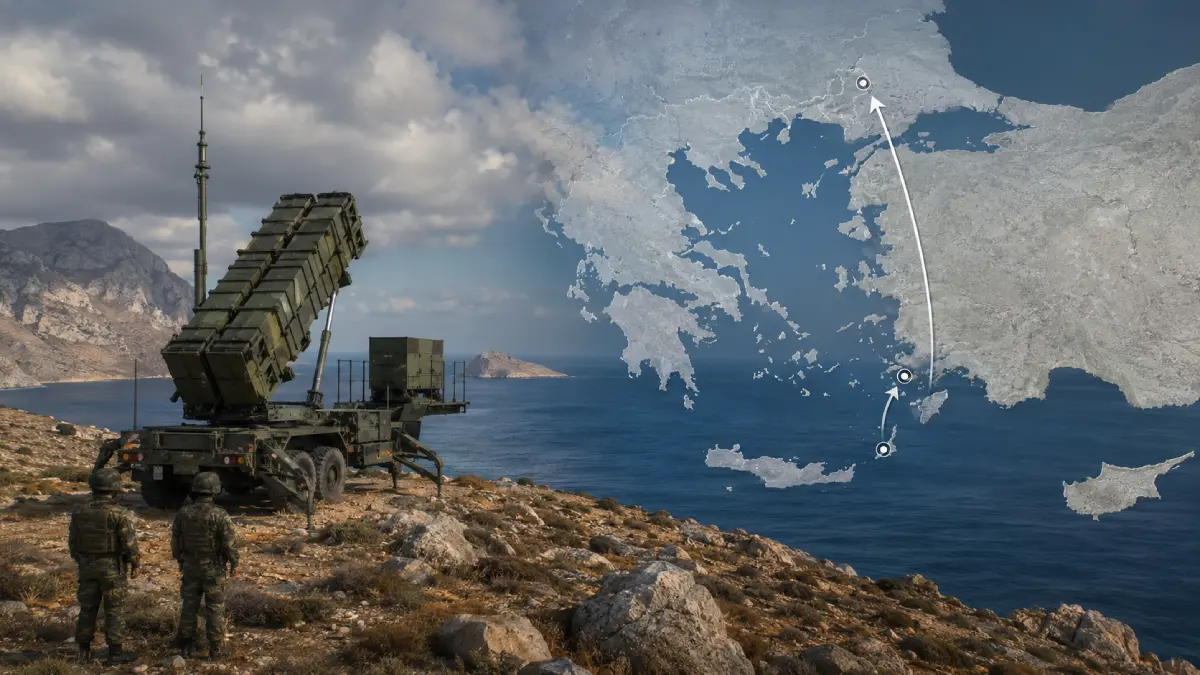
Greece has begun moving a Patriot air-defense battery from Karpathos to Crete, according to Greek state broadcaster ERT, while a four-aircraft Hellenic Air Force F-16 presence remains around Cyprus following the security deployments ordered in March.
The Greek Defense Ministry has not publicly confirmed the transfer. ERT reported on August 24 that the battery was being moved toward Souda as Greece adjusted its air defenses in the Eastern Mediterranean. Greek Defense Ministry sources had told the Athens-Macedonian News Agency five days earlier that a transfer from Karpathos to Souda was under consideration.
The move would place the Patriot closer to Souda Bay, home to Greek, United States and North Atlantic Treaty Organization (NATO) military infrastructure on Crete. It comes days after the Financial Times, citing people close to the Iranian establishment, reported that military facilities in Cyprus and Bulgaria were among sites being examined as possible targets if the United States resumed attacks on Iran.
Iran has repeatedly warned that foreign bases used for operations against it could themselves be targeted.
The same Greek Defense Ministry sources said on August 19 that four Greek F-16s and the Hellenic Navy frigate Nikiforos Fokas remained in the Cyprus area. Athens was also prepared to examine another Patriot deployment in support of Bulgaria if Sofia submitted a new request.
The Greek fighter presence around Cyprus dates to the March 2 attack on Royal Air Force (RAF) Akrotiri, one of Britain's two Sovereign Base Areas on the island.
An Iranian-made Shahed-type drone struck Akrotiri, causing limited damage and no casualties. Senior Cypriot officials assessed that the drone had probably been launched from Lebanon by Hezbollah rather than directly from Iran. Two additional drones approaching the base were intercepted later that day.
Greek Defense Minister Nikos Dendias responded by announcing the deployment of military assets to support the defense of the Republic of Cyprus. Greece sent four F-16s and two frigates as Athens reacted to the missile and drone threat created by the Iran conflict.
The presence did not disappear when the immediate alert eased.
In May, the Government Council for National Security (KYSEA) decided that Patriot batteries sent to Karpathos and Didymoteicho during the Iran war would eventually return to their permanent bases. Bosphorus News reported at the time that no equivalent public withdrawal timetable had been announced for the Greek aircraft and naval assets deployed around Cyprus.
The Karpathos battery did not leave immediately either.
Greek reporting later said the Patriot would remain on the island until Karpathos airport could accommodate fighter aircraft intended to replace part of the temporary air-defense coverage. No fixed withdrawal date was announced.
The August move therefore changes the destination rather than simply completing the May drawdown. Instead of returning directly to its permanent base, the Patriot is now reported to be heading to Souda.
That gives the transfer a different operational meaning.
Bosphorus News tracked the original Greek redistribution in March, when the Akrotiri attack was followed by a Patriot deployment to Karpathos, fighter aircraft and frigates toward Cyprus, and a separate air-defense package designed to protect Bulgaria.
The Bulgarian deployment came after a formal request from Sofia. On March 6, Dendias announced that Greece would position a Patriot battery in northern Greece to provide ballistic-missile coverage over a large part of Bulgarian territory. Two F-16s were assigned to help protect Bulgarian airspace, while two Hellenic Air Force officers were sent to the Bulgarian Armed Forces operations center.
Bosphorus News reported that deployment as it unfolded, when the decision also triggered debate inside Greece over how far Athens should extend protection around allied military infrastructure during the Iran conflict.
Five months later, the same geography has returned to the security picture.
Military facilities in Bulgaria have appeared in reporting on Iranian contingency planning. So have sites in Cyprus. Akrotiri has already been struck once, and a four-aircraft Greek F-16 presence remains around the island.
Souda now forms the third point.
Bulgaria, Crete and Cyprus are not covered by one Greek command structure or a single declared defense plan. The deployments were ordered at different times, under different arrangements and for different purposes.
But they occupy the same southeastern European arc that Athens began reinforcing when the Iran conflict reached Cyprus in March.
The reported shift from Karpathos to Souda shows that the emergency air-defense map drawn during the war has not simply been erased. Parts of it remain in place, while others are being moved as Greece adjusts to a threat environment that now places Cyprus and Bulgaria inside Iran-related contingency reporting.
Sources: Hellenic Republic Ministry of National Defence, Athens-Macedonian News Agency, ERT, Financial Times, Reuters, Kathimerini, Bosphorus News review and reporting.