
By Bosphorus News Geopolitics Desk
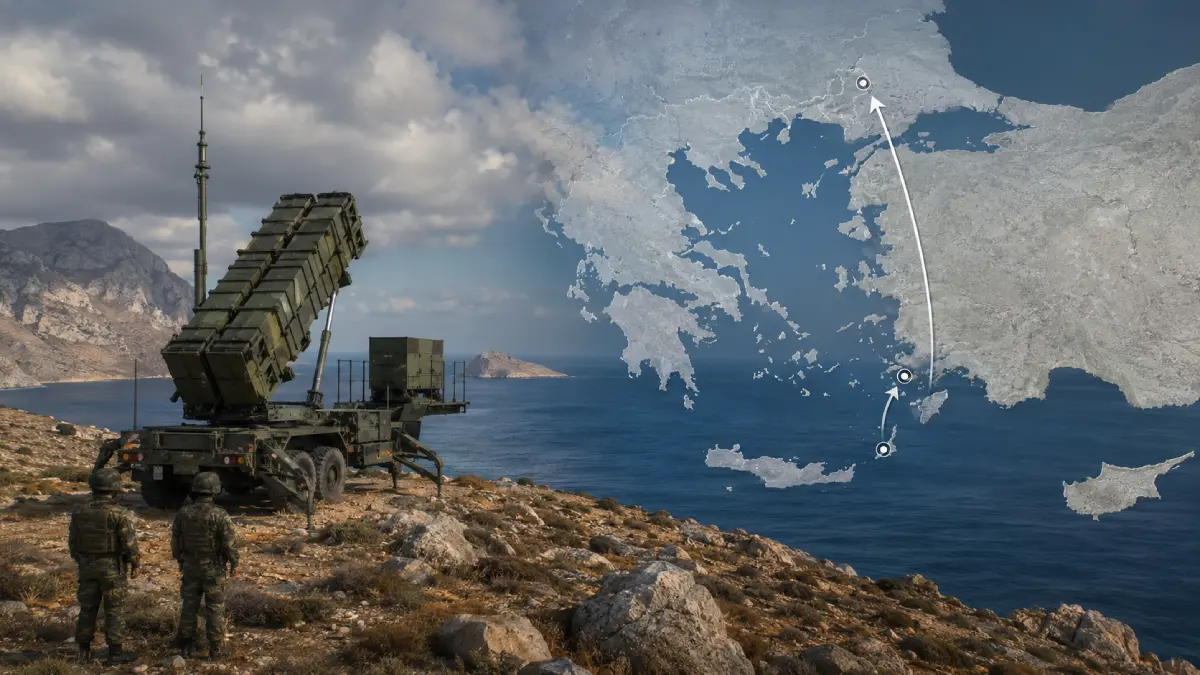
Greece's top national security council has ordered Patriot air-defence batteries deployed to Karpathos and Didymoteicho back to their permanent bases, ending a forward deployment activated during the Iran-war alert and reopening a domestic debate over Athens' posture toward Türkiye.
The decision was taken on May 18 by the Government Council for Foreign Affairs and Defence, known by its Greek acronym KYSEA, during a meeting chaired by Prime Minister Kyriakos Mitsotakis.
KYSEA is Greece's top foreign affairs and defence council, chaired by the prime minister. Its decisions carry cabinet-level weight on national security, military deployments and major defence procurement.
Greek reports said the council assessed that the heightened alert over ballistic missile threats had ended, allowing the Patriot batteries to return from Karpathos in the southeastern Aegean and Didymoteicho in northern Greece.
The Karpathos deployment had drawn Turkish objections in March, when Ankara said the presence of air-defence systems on the Dodecanese island violated its demilitarised status under post-war treaties. Athens rejected Türkiye's protest as unfounded.
Why the Patriots Were Deployed
The Patriot battery on Karpathos was deployed in early March after Iranian drone and missile threats pushed Greece and Cyprus into a higher state of alert.
The move followed reported Iranian drone incidents involving British facilities at Akrotiri in Cyprus and was described in Greek reporting as part of a broader Greece-Cyprus defence coordination effort rather than a routine exercise deployment.
Karpathos sits in the southeastern Aegean, close to the maritime space between Türkiye, Rhodes, Crete and Cyprus. That geography gave the deployment weight beyond a temporary air-defence adjustment.
A second Patriot battery was deployed to Didymoteicho, near Greece's borders with Türkiye and Bulgaria, after a Bulgarian request for additional air-defence coverage at the start of the Middle East war.
Athens presented both deployments as emergency responses to the Iran-war environment rather than permanent changes to Greece's force posture. Their withdrawal removes one visible air-defence point from the Aegean and northern Greek theatre, while leaving the legal and political dispute with Ankara intact.
Türkiye's March Protest
Türkiye's Foreign Ministry protested the Karpathos deployment in March, saying the eastern Aegean islands and the Dodecanese have a permanent demilitarised status under the 1923 Lausanne Treaty and the 1947 Paris Peace Treaty.
Turkish officials framed the deployment as part of a wider pattern of Greek military steps on islands whose status Ankara says cannot be reinterpreted.
Greece dismissed the protest, saying Türkiye's claims had been repeatedly rejected. Athens has long argued that its defensive posture in the Aegean is shaped by Türkiye's military presence across the water and by the long-running dispute over maritime rights, airspace and sovereignty.
The Patriot withdrawal therefore reduces a specific point of friction without changing the dispute itself. Ankara's objection was never only about one battery. It centred on the principle of military deployments on islands whose treaty status Türkiye continues to contest.
Blue Homeland Reaches KYSEA
The May 18 KYSEA meeting also placed Türkiye's maritime agenda inside Greece's highest security framework.
Greek reports said the council discussed Athens' response to an expected Turkish maritime jurisdiction bill linked to the Blue Homeland doctrine. Greek officials and media have framed the draft as an attempt to codify Türkiye's maritime claims into domestic law, including claims that Greek officials say could affect maritime jurisdiction up to 200 nautical miles in the Aegean, the Black Sea and the Eastern Mediterranean.
Greece describes such moves as unilateral and without legal force under international law.
Bosphorus News could not immediately verify a final Turkish parliamentary text. The Blue Homeland element is therefore best understood as a Greek government and media framing of an expected Turkish legislative move, rather than a confirmed final text adopted by Ankara.
The fact that the issue reached KYSEA level still matters. Athens is treating the expected legislation as a national security file linked to maritime jurisdiction, deterrence and Greece's wider Aegean posture.
Frigates, Drones and Defence Procurement
The same KYSEA meeting also approved several major defence items.
Greek reports said the council backed the modernisation of Greece's MEKO-class frigates and the acquisition of two Italian Bergamini-class frigates. It also approved the implementation of the National Strategy for Unmanned Vehicles 2026-2030 and authorised the procurement of cryptographic communication devices for the armed forces.
The council also approved the dispatch of additional M113 armoured personnel carriers to Lebanon.
The May 18 decisions extend Greece's defence reform track, which Bosphorus News previously covered when Athens' security council renewed the country's military leadership as procurement and force-structure changes advanced.
The Patriot withdrawal was therefore not taken in isolation. Greece is reducing an emergency air-defence deployment tied to the Iran-war alert while continuing to invest in naval modernisation, unmanned systems and secure military communications.
Samaras Attacks the Withdrawal
The decision drew a sharp response from former Prime Minister Antonis Samaras, who issued a statement on May 19 during commemorations for the Pontian Greek Genocide.
Samaras questioned the withdrawal of Greek weapons systems from Karpathos, Didymoteicho and Cyprus, arguing that the timing raised serious concerns while Türkiye was advancing what he described as a new illegal casus belli against Greek sovereign rights.
"The government must immediately request an emergency EU summit regarding the incredible Turkish threats," Samaras said.
He accused Türkiye of executing long-term plans and warned that Greece could not remain inactive while Ankara's maritime agenda advanced.
Samaras had made a similar argument in March, when he welcomed the deployment of Greek frigates and F-16s to Cyprus and the Patriot battery to Karpathos, but warned against any later pullback. Speaking at the Hellenic War Museum on March 30, he said any withdrawal of Greek forces from Cyprus would amount to national humiliation and called for a permanent multinational military presence on the island.
His 19 May statement moved that argument directly into the Patriot withdrawal debate.
The Cyprus Question
The KYSEA decision clearly covered Karpathos and Didymoteicho. It did not publicly specify a timeline for the naval and air assets Greece deployed to Cyprus in March.
Greek reports identified the March deployment as including two frigates and four F-16 fighter jets sent to Cyprus during the heightened alert.
That silence gives Samaras room to press the government from the right.
Greece-Cyprus defence coordination has historically been shaped around the Türkiye file. In March, Greek deployments to Cyprus were presented as a response to Iranian ballistic missile and drone risks rather than as a direct escalation with Türkiye.
The question now is whether assets sent to Cyprus under that emergency logic will follow the same return path as the Patriot batteries.
Athens has not publicly answered that question. Samaras is using the ambiguity to argue that Greece should not reduce its posture while Türkiye's maritime agenda returns to the centre of Greek national security debate.
The Patriot withdrawal removes one visible military irritant from the Aegean. It does not remove the larger dispute. Greece is sending systems deployed for the Iran-war emergency back to their bases while its own security council treats Türkiye's maritime agenda as a live national security file.
***Sources: Greek state broadcaster ERT via Kathimerini and DNews, Keep Talking Greece, Kathimerini, ProtoThema, News247, Naftemporiki, Republic of Türkiye Ministry of Foreign Affairs, Antonis Samaras statement and Bosphorus News reporting.