By Bosphorus News Defense Desk
On November 25, 2026, European Union (EU) foreign policy chief Kaja Kallas outlined Operation IRINI's expanded maritime security responsibilities at the 11th Union for the Mediterranean (UfM) Regional Forum in Barcelona, where she also reiterated the EU's opposition to Türkiye's maritime delimitation agreement with Libya.
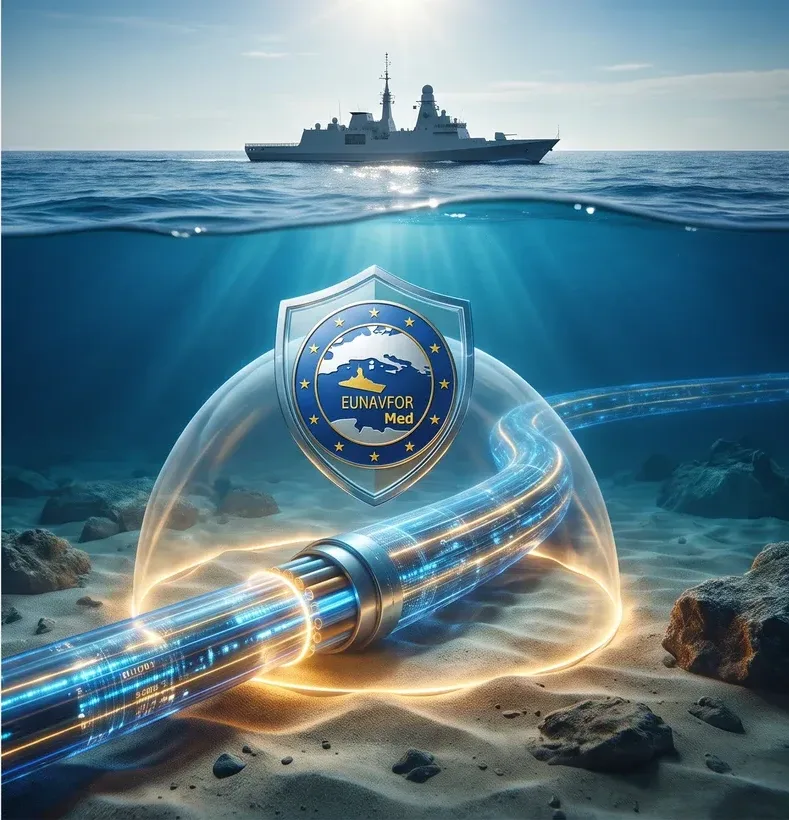
Kallas identified submarine cables and pipelines among the infrastructure the European naval mission will help protect, alongside expanded cooperation with regional navies and coastguards. On the same day, applications closed for a €40 million European Commission funding program intended to strengthen submarine communication cable repair capacity, including in the Mediterranean and Atlantic.
Through separate military, technological and civilian initiatives, the EU is developing the capacity to monitor maritime activity, identify threats to submarine infrastructure and restore damaged connections.
Italy occupies a central position in this emerging security architecture. Greece and the Republic of Cyprus are participating in the development of a multinational cable security mechanism without Turkish participation, at a time when competing maritime jurisdictional claims continue to complicate major infrastructure projects in the Eastern Mediterranean.
From Libya to European Maritime Security
IRINI's expanded role follows a fundamental change in the international legal framework governing its original activities.
Established on March 31, 2020, the European Union Naval Force Mediterranean (EUNAVFOR MED) Operation IRINI was primarily tasked with contributing to the implementation of the United Nations (UN) arms embargo on Libya through naval, aerial and satellite surveillance.
Its authority to inspect vessels on the high seas off Libya derived from UN Security Council Resolution 2292 of 2016. Renewed for six months through Resolution 2804 in November 2025, that authorization expired on May 25, 2026, without another extension.
The arms embargo remains in force, as do separate measures addressing illicit petroleum exports from Libya. The latter, examined in the April 7 Eastern Mediterranean Strategic Brief, were subsequently extended until August 1, 2027, through Security Council Resolution 2819.
On October 9, the EU adopted three legislative measures reflecting the changed legal circumstances. Council Decision 2026/2242 amended the restrictive measures concerning Libya, while Council Regulation 2026/2259 removed the corresponding vessel inspection provisions from EU law. Both entered into force on October 13. Council Decision 2026/2243, effective from October 9, established IRINI's revised mandate through March 31, 2029.
The Council set a financial reference amount of €16.88 million for common operational costs between April 1, 2027, and March 31, 2029, excluding expenditure associated with national military contributions.
The revised mandate establishes three strategic objectives: safeguarding EU interests in the Mediterranean, contributing to peace and stability in Libya, and developing regional maritime partnerships.
Maritime situational awareness, efforts to constrain Russia's shadow fleet and support for critical infrastructure protection acquire greater prominence, alongside continuing responsibilities concerning Libya, illicit petroleum exports and human smuggling networks. These expanded tasks are to be implemented within the operation's means and capabilities.
Kallas also identified Egypt, Lebanon, Tunisia and Libya as partners for closer naval and coastguard cooperation through training, exercises and capacity building.
The expiration of the original UN inspection authorization has coincided with the transformation of IRINI into a broader naval instrument serving European interests under the EU's Common Security and Defence Policy (CSDP).
Russia's Shadow Fleet and European Naval Authority
Russia had already objected in June to European plans to use IRINI's naval assets to inspect vessels associated with its oil transport network. The June 14 Eastern Mediterranean Strategic Brief examined the dispute within the wider context of sanctions enforcement, Russian oil flows and European naval authority in the Mediterranean.
On November 13, IRINI personnel boarded the tanker MV MIDAG in the Mediterranean. Two days later, Kallas announced that the vessel, suspected of belonging to Russia's shadow fleet, had been found to be sailing under a false flag.
The boarding was conducted under Article 110 of the United Nations Convention on the Law of the Sea (UNCLOS), which establishes a right of visit in specified circumstances, including reasonable suspicion that a vessel is without nationality.
Inclusion on an EU sanctions list does not independently confer a general right to inspect foreign vessels on the high seas. Flag verification and sanctions enforcement remain subject to distinct legal requirements.
IRINI's October 2026 activity report illustrates the extent of the operation's existing surveillance capacity. Since March 2020, the mission had contacted 26,268 merchant vessels by radio, conducted 824 visits with the consent of ships' masters and carried out 33 inspections under the Libyan arms embargo framework, three of which resulted in cargo seizures. Six flag verification boardings had been recorded by the end of October.
The revised mandate gives this established surveillance capability additional responsibilities connected to European economic security and the protection of maritime infrastructure.
Italy at the Center of Mediterranean Cable Security
On August 4, IRINI signed a technical arrangement with the Italian Navy in Rome covering information exchange, coordinated surveillance and the protection and resilience of critical maritime infrastructure in the Central Mediterranean.
According to the European Commission's Funding & Tenders Portal project record reviewed by Bosphorus News, the three-year Mediterranean Regional Cable Hub (EU MED HUB) project formally began on September 30 with a total budget of €4.71 million, including €3.30 million in EU funding under the Digital Europe Programme.
Coordinated by the Italian Defense Ministry, the project brings together 19 participating organizations from Italy, Greece, the Republic of Cyprus, Malta, France and the Netherlands.
The consortium includes Italy's National Cybersecurity Agency and Coast Guard, Greece's Ministry of Digital Governance and Public Power Corporation (PPC), and the Republic of Cyprus' Digital Security Authority. Industrial participants include Fincantieri, Saipem, Sparkle and RINA, while the Cyprus Telecommunications Authority (CYTA) participates as an associated partner.
The project record describes a planned technological architecture built on Smart FENIX, the Italian Navy's existing maritime situational awareness platform, which is to be expanded into a federated Mediterranean network integrating information from different maritime surveillance and security systems.
Scheduled to run until September 29, 2029, EU MED HUB aims to establish a multinational capability for detecting physical and cyber threats to submarine communication cables, exchanging security information and coordinating responses to infrastructure incidents.
Italy consequently occupies a central position in both the military and technological dimensions of Mediterranean infrastructure security. Rome hosts IRINI's operational headquarters, the Italian Navy maintains an infrastructure protection arrangement with the mission, and the Italian Defense Ministry coordinates the regional cable security project around an existing naval surveillance platform.
These institutional connections provide opportunities for coordination. The published documents establish no common operational command between IRINI and EU MED HUB.
The composition of the consortium also introduces a regional institutional asymmetry. Greece and the Republic of Cyprus participate in developing the new cable security mechanism, while Türkiye has no institutional representation within the project.
Türkiye's absence should be understood in the context of existing maritime cooperation. The Italian Navy's records identify Türkiye as a participant in the Virtual Regional Maritime Traffic Centre (V-RMTC), an Italian-led maritime information-sharing initiative dating back to 2006. In December 2021, participating delegations were briefed on Smart FENIX as part of the network's technological development.
Türkiye's participation in regional maritime information-sharing arrangements therefore predates EU MED HUB, whose institutional composition reflects a separate EU-funded initiative.
Building Europe's Emergency Repair Capacity
The European Commission is also investing in the technical resources needed to restore communications following damage to submarine infrastructure.
On June 23, the Commission announced €5.8 million in funding for the first two regional cable security hubs in the Baltic and Mediterranean seas, alongside a separate €40 million call for proposals to expand submarine communication cable repair capacity.
Managed by the European Health and Digital Executive Agency (HaDEA) under the Connecting Europe Facility (CEF) Digital program, the initiative builds on a €9.5 million Baltic pilot project known as Merikarhu.
The technical approach centers on modular repair equipment to be stored at ports or shipyards. Applicants must identify at least three vessels configured, or to be configured, to accommodate the modules, which must be capable of being installed aboard a suitable vessel within three days of its arrival at a port. Naval forces and coastguard authorities are among the eligible applicants, alongside civilian organizations.
By making repair equipment available for installation when required, the EU seeks to improve emergency response capacity without relying exclusively on permanently dedicated cable repair ships. Project selection following the November 25 application deadline will determine where the additional resources are established.
The scale of European investment in Mediterranean digital connectivity illustrates the economic interests behind these initiatives.
On November 19, the European Commission and European Investment Bank (EIB) announced an additional €11.1 million EU grant for a terrestrial extension of the MEDUSA submarine cable network from Port Said in Egypt to Jordan, bringing EU grants channeled through the EIB for associated research and education connections to €51.1 million.
The wider MEDUSA network comprises more than 8,000 kilometers of submarine cable and 21 landing points across southern Europe, North Africa and the Eastern Mediterranean.
Although IRINI's revised mandate encompasses submarine cables and pipelines, the €40 million repair funding call specifically concerns submarine communication cables. Electricity interconnectors and pipelines fall outside the scope of this particular funding initiative.
Türkiye, GSI and the East to Med Data Corridor
Türkiye's reservations about IRINI date back to the establishment of the operation. In August 2020, Türkiye, Libya and Malta issued a joint statement expressing concerns about its implementation.
Tensions intensified in November when the German frigate Hamburg inspected the Turkish-flagged commercial vessel M/V Roseline A. Türkiye challenged the legality of the inspection and questioned the operation's impartiality. IRINI subsequently confirmed that the inspection had been discontinued after Türkiye communicated its refusal of consent and that no evidence of prohibited material had been found during the inspection.
Six years later, IRINI's infrastructure protection responsibilities intersect with a separate dispute between Türkiye and the EU over maritime jurisdiction.
At the Barcelona forum, Kallas reiterated the EU's opposition to the 2019 Türkiye-Libya maritime delimitation memorandum and expressed support for Greece and the Republic of Cyprus. Türkiye maintains that the agreement protects the continental shelf rights of both Türkiye and Libya and is consistent with international law.
These competing positions have practical implications for two major submarine infrastructure projects: the Great Sea Interconnector (GSI) electricity link and the East to Med Data Corridor (EMC) fiber-optic cable.
As documented in Bosphorus News' November 10 reporting on the GSI survey dispute, Türkiye and Greece took differing positions concerning the activities of the French-flagged survey vessel Abeille Marengo.
France notified Türkiye of the planned work, while Athens maintained that the notification did not constitute a request for Turkish authorization. Türkiye subsequently issued Navigational Telex (NAVTEX) 1127/26, stating that consent had been granted for survey activities covering the period from November 10, 2026, to March 19, 2027. As detailed in Bosphorus News' November 12 investigation, the full texts of the diplomatic documents had not been made public, leaving the precise legal characterization of the French notification contested.
Türkiye had separately communicated its consent for survey activities involving the EMC vessel Kobi Ruegg through NAVTEX 1102/26.
Both cases demonstrate the importance of distinguishing between the rights governing submarine cable installation and maintenance, the legal characterization of preparatory seabed surveys, and competing claims to continental shelf jurisdiction.
Article 79 of UNCLOS recognizes the right to lay submarine cables and pipelines on the continental shelf and provides that coastal states may not impede their laying or maintenance, subject to specified coastal state rights and reasonable measures. The delineation of pipeline routes is separately subject to coastal state consent.
Türkiye, which is not a party to UNCLOS, maintains that research activities on its claimed continental shelf require its authorization. Greece and the Republic of Cyprus invoke international maritime law in support of their respective jurisdictional positions.
IRINI's revised mandate provides no mechanism for resolving overlapping continental shelf claims or establishing maritime boundaries. The EU has announced no dedicated IRINI escort arrangement for either GSI or EMC.
The Jurisdictional Risk Beyond Installation
The EU is expanding its military, technological and logistical capacity to protect Mediterranean infrastructure while the region's principal maritime jurisdictional disputes remain unresolved.
The institutional asymmetry surrounding EU MED HUB could acquire operational significance if the new European capabilities are deployed in maritime areas subject to competing jurisdictional claims involving Türkiye.
The risks extend beyond seabed surveys and cable installation.
As examined in the November 25 Eastern Mediterranean Strategic Brief, a future GSI cable failure could require repair vessels to operate in maritime areas where the parties previously disagreed over survey activities. Similar operational challenges could arise in the maintenance of submarine communication infrastructure, including EMC.
International maritime law recognizes cable maintenance rights. Their practical exercise in disputed waters may nevertheless require operational coordination and political arrangements to prevent confrontation.
The availability of naval surveillance, multinational threat detection systems and modular repair equipment could improve Europe's ability to respond to infrastructure incidents. Their effective deployment in the Eastern Mediterranean will also depend on the geographical scope of the relevant mandates and the management of competing jurisdictional claims.
Submarine cables represent investments intended to operate for decades. The commercial reliability of GSI, EMC and other regional infrastructure will depend on whether maintenance and emergency repairs can be carried out throughout their operational lifetime without repeatedly reopening the disputes that complicated their development.
Europe's investment in Mediterranean infrastructure security is advancing faster than the resolution of the maritime disputes that could shape its application. The long-term challenge is one of jurisdiction as well as capability.
Sources: Council Decision (CFSP) 2026/2243, IRINI mandate; Council Decision (CFSP) 2026/2242, Libya restrictive measures; Council Regulation (EU) 2026/2259; EEAS, Kaja Kallas' opening remarks, November 25; EEAS, Kallas' joint press conference, November 25; UN Security Council, Libya sanctions resolutions; EEAS, IRINI October 2026 Activity Report; IRINI and Italian Navy Technical Arrangement, August 4; Open University of Cyprus, EU MED HUB; European Commission, Regional Cable Hubs and €40 million repair capacity program; HaDEA, emergency submarine cable repair modules; HaDEA, Baltic submarine cable repair pilot project; European Commission and EIB, MEDUSA, November 19; Türkiye Ministry of Foreign Affairs, Joint Statement by Türkiye, Malta and Libya, August 6, 2020; Türkiye Ministry of Foreign Affairs, Roseline A statement, November 23, 2020; Operation IRINI, Roseline A statement, November 23, 2020; Türkiye Ministry of Foreign Affairs, maritime memorandum with Libya, October 20, 2026; United Nations Convention on the Law of the Sea, Articles 79 and 110; European Commission Funding & Tenders Portal, European Hub for the MED, Project ID 101338216, updated October 28, 2026; Italian Navy, Virtual Regional Maritime Traffic Centre & Trans Regional Maritime Network; Italian Navy, International Maritime Security Cooperation, December 16, 2021; Maritime Executive, MV MIDAG boarding.