
By Bosphorus News Geopolitics Desk
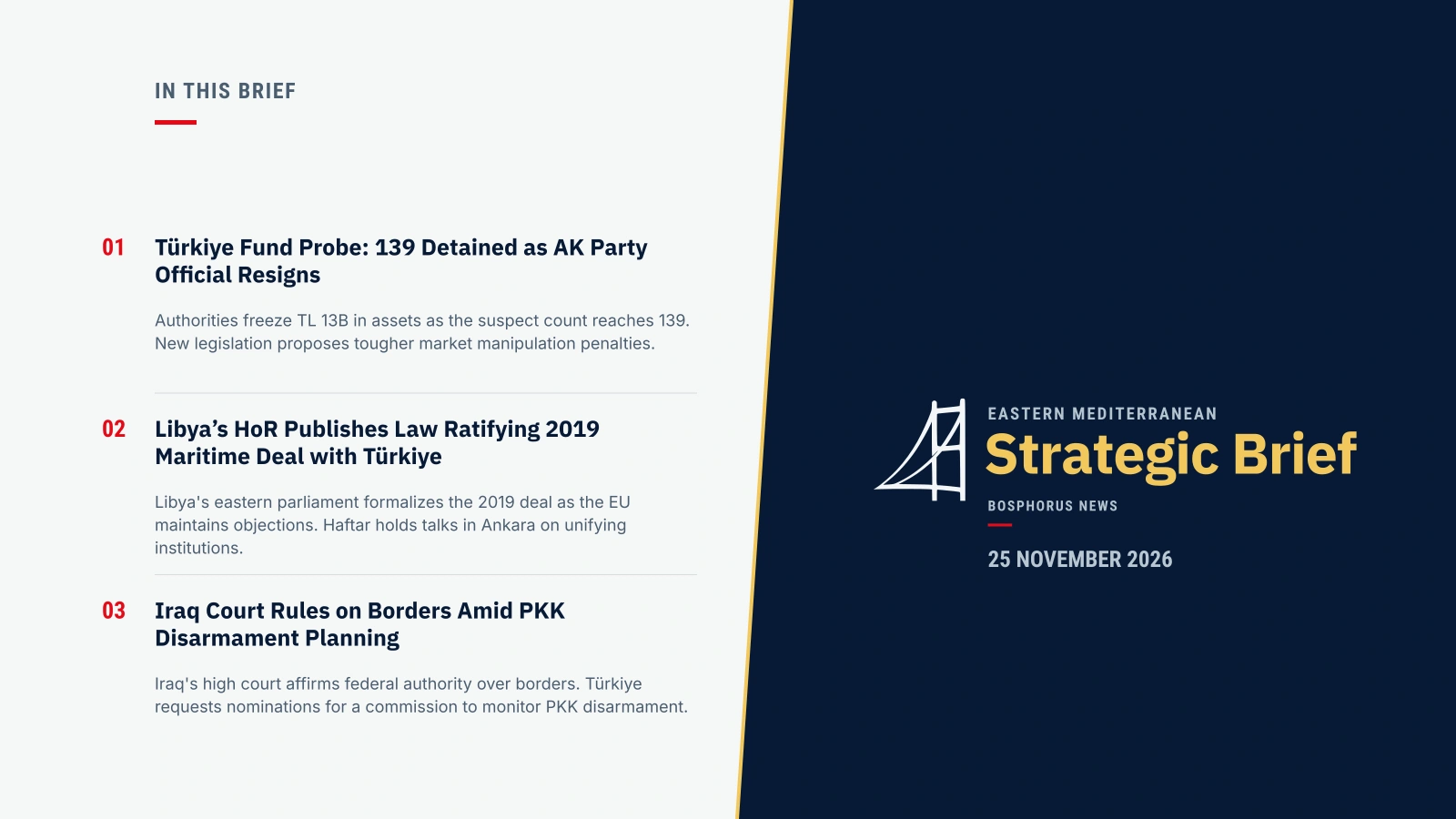
On November 25, 2026, Türkiye faced a widening investment fund investigation and prepared new capital markets legislation. Libya's eastern parliament published the law ratifying the maritime agreement with Türkiye, and Iraq's highest court affirmed federal authority over the country's international borders.
Türkiye's Investment Fund Crisis
An Istanbul court ordered Burhan Tunç Özkan into pretrial detention on November 25, bringing the number of jailed suspects to 139. The previous day, Justice and Development Party (AK Party) co-founder Hayati Yazıcı announced his resignation from the party's Central Executive Board and Central Decision and Executive Board after his son Mustafa was questioned as a suspect and placed under judicial control. Yazıcı denied that his son held shares in Adil Katılım Bankası or had obtained unlawful earnings. Former minister Fatma Betül Sayan Kaya, held in pretrial detention since November 6, was placed under house arrest on health grounds on November 24.
Istanbul prosecutors released findings from Türkiye's Financial Crimes Investigation Board (MASAK) on November 21, tracing TL 21 billion in transactions routed through London-based Gildencrest Capital over nine years. The investigation into cross-border fund transactions also covers orders placed through intermediaries in Switzerland. Prosecutors allege that the arrangement disguised domestic trades as foreign institutional investment. Yeni Şafak reported on November 25, citing the investigation file, that authorities had frozen TL 13 billion in assets across nine jurisdictions.
The Presidency's Directorate of Communications announced late on November 24 that it aims to complete the final tranche of interim investor payments of up to TL 1 million per fund under Law No. 7596 on November 27. A draft amendment to the Capital Markets Law has been prepared for submission to the governing party's parliamentary group, with provisions for earlier regulatory intervention, asset recovery and tougher penalties for market manipulation.
Türkiye, Libya & Eastern Mediterranean
President Recep Tayyip Erdoğan received Libyan National Army commander Khalifa Haftar at the Presidential Complex in Ankara. Foreign Minister Hakan Fidan, Defense Minister Yaşar Güler, Energy and Natural Resources Minister Alparslan Bayraktar, Chief of the General Staff Gen. Selçuk Bayraktaroğlu and intelligence chief İbrahim Kalın took part in earlier talks with the Libyan delegation. Haftar's command said the talks covered bilateral cooperation and efforts to unify Libyan institutions. Turkish authorities released no account of any agreements reached.
Libya's eastern-based House of Representatives published Law No. 8 of 2026 ratifying the 2019 maritime delimitation memorandum with Türkiye in Issue 17 of its Official Gazette, following the October 20 parliamentary vote. The memorandum had entered into force in December 2019. Turkish state media, citing the published law, reported that it contains six articles and two annexes, including a map and 36 geographical coordinate points. The same reports said the law provides for bilateral consultations on maritime intersections with third states and excludes the boundary coordinates from the review mechanism.
European Commissioner for the Mediterranean Dubravka Šuica and Irish Minister of State Charlie McConalogue, representing the Council of the European Union (EU), reiterated the EU's objections during the European Parliament debate on November 24, arguing that the memorandum is incompatible with the United Nations Convention on the Law of the Sea and has no legal effect on third states. A resolution is scheduled for a vote on November 26. The US State Department had criticized the October ratification vote earlier this month.
In Benghazi, Haftar's command reported that two Libyan naval officers had died from injuries sustained in the November 22 Ukrainian attack and announced its intention to retaliate. Italy had warned against the conflict spreading into the Mediterranean. Greek Deputy Foreign Minister Tasos Chatzivasileiou expressed similar concerns on November 25, whereas French Foreign Minister Jean-Noël Barrot defended Ukraine's right to self-defense. The United Nations Support Mission in Libya had called for an independent investigation.
The Chevron-led consortium's seismic exploration campaign in the southern Ionian Sea starts in western Greek waters outside the disputed South Crete concessions. Surveys for the two South Crete blocks, covering a combined 35,000 square kilometers, are expected in 2027. Türkiye and the Tripoli-based Libyan government have objected to those concessions. Greek Foreign Minister Giorgos Gerapetritis has acknowledged the possibility of Turkish or Libyan interference during that phase. Türkiye-Greece political dialogue is scheduled for December 7 and 8. The Africa-Türkiye Partnership Summit is scheduled for December 8 and 9 in Tripoli.
Türkiye, Iraq & Syria
Türkiye's parliamentary speaker Numan Kurtulmuş requested nominations from seven parliamentary groups for a 19-member monitoring commission under the legislation adopted in August to oversee the disarmament process involving the Kurdistan Workers' Party (PKK), designated a terrorist organization by Türkiye, the United States and the EU. The deadline is November 30. Kurtulmuş distinguished parliamentary monitoring from the verification of the PKK's dissolution and disarmament, which he said falls to security and intelligence institutions.
Iraq's Federal Supreme Court ruled that federal authorities may deploy forces along the country's international borders, including those in the Kurdistan Region. The November 25 ruling, reported by Iraqi state media and Reuters, also affirmed federal oversight of border-crossing agencies and required coordination with regional authorities on customs administration. Iraqi state media also reported that the court addressed federal powers over oil-related matters. The ruling follows Prime Minister Ali al-Zaidi's orders concerning Kurdish-administered crossings and oilfields, measures the regional government rejected. Among the crossings affected by the dispute is Ibrahim Khalil, opposite Türkiye's Habur border gate.
In Damascus, Syrian Defense Minister Murhaf Abu Qasra received a Chinese military delegation on November 25 to discuss military cooperation. Reuters reported on November 23 that the United States was considering mine-clearance training for Syrian personnel. No new training agreement was announced. Syria's Foreign Ministry also signed a cooperation memorandum with the Saudi-Syrian Business Council on November 25.
A November 24 report by the Organisation for the Prohibition of Chemical Weapons (OPCW) identified 19 unresolved issues concerning the former Syrian government's 2013 chemical weapons declaration, out of 26 originally identified. Inspectors collected 12 samples during visits to three priority sites in November; laboratory analysis is pending. Syrian Emergency and Disaster Management Minister Raed al-Saleh met OPCW Director-General Sabrina Dallafior in The Hague on November 23 to discuss accelerating the elimination of remnants of the Assad-era program.
Defense Industry & Military Reform
Baykar and ASELSAN announced on November 25 that the TOLUN-L guided munition hit its target in its first live-fire test from a Bayraktar AKINCI unmanned combat aerial vehicle. Other defense industry announcements between November 22 and 25 covered naval weapons, drones, mine clearance and aviation software. ASELSAN demonstrated the GÖKDENİZ naval close-in weapon system in autonomous mode; STM delivered the first ALKAN first-person-view drones to Turkish security forces following acceptance tests; the Machinery and Chemical Industry Corporation (MKE) completed field trials of its airborne ALPAY-D mine-clearing system; and HAVELSAN completed acceptance procedures for mission-planning software developed for the HÜRKUŞ aircraft.
Greek Defense Minister Nikos Dendias presented a defense industry and military innovation bill to the Cabinet on November 25. It proposes compulsory domestic industrial participation in new procurement programs, a dedicated defense industry office, expanded responsibilities for the Hellenic Centre for Defence Innovation and a framework for government-to-government defense exports. The ministry cites Article 346 of the Treaty on the Functioning of the European Union as a legal basis for the domestic participation measures. Kathimerini reported a proposed minimum domestic participation of 25 percent; the bill has yet to become law.
On November 24, Dendias also outlined plans to reorganize Greece's reserve forces under Agenda 2030. The military aims to build an active reserve of 150,000 personnel, establish three training centers and modernize mobilization procedures.
Cyprus: Diplomacy, Defense & Legal Affairs
US Ambassador John Breslow met Republic of Cyprus President Nikos Christodoulides and Foreign Minister Konstantinos Kombos on November 25. Discussions covered defense procurement, access to excess American military equipment and an extension of the waiver of US arms export restrictions. Kombos said his government was seeking permanent relief or a waiver lasting three to five years. Breslow also acknowledged that the United States receives refueling support in Cyprus from time to time. No new arms transfer or permanent lifting of restrictions was announced.
Greek Cypriot negotiator Menelaos Menelaou told the Cyprus Broadcasting Corporation that he expected a meeting between the two Cypriot leaders and United Nations Secretary-General António Guterres in the first half of December. Menelaou also claimed that the Turkish Cypriot side had moved toward political equality in its negotiating position, an assessment Turkish Cypriot leader Tufan Erhürman had not confirmed. The United Nations had yet to set a date publicly.
Following Simon Aykut's release from prison in Israel, the Israeli embassy maintained that his conviction in Cyprus remained valid. Kombos said Israel would brief Christodoulides and that the Republic of Cyprus would continue pursuing cases involving Greek Cypriot-owned property in northern Cyprus. He put asset seizures across the wider set of property investigations at €10 million.
The Republic of Cyprus's digital security and air navigation supervisory authorities signed a memorandum on November 25 to coordinate enforcement of aviation cybersecurity requirements. Separately, a November 24 Check Point Research report identified an Iran-linked cyberespionage group, Volant Manticore, which researchers said had targeted Cypriot aviation, telecommunications and critical infrastructure before expanding its activities to Saudi Arabia in September.
Filo Jet Investigation
Kyrenia District Court continued the custody hearing for nine suspects in the August 30 sinking of Filo Jet. Prosecutor Doğa Tokay alleged on November 25 that the company had avoided sending the damaged catamaran to a shipyard to avoid a $200,000 shipyard expense. A company director denied the allegations and offered TL 5 million as bail security. The hearing was adjourned until November 26 without a ruling on the custody request.
The latest proceedings follow expert testimony that closed watertight doors would have kept the vessel afloat despite damage to both bows. Police have alleged that an improvised repair used adhesive costing TL 400 and that the ship made 79 subsequent sailings. The defense challenged the expert's qualifications and findings, as well as the response of rescue services. Twenty-seven people died and one child remains missing. A separate investigation in Mersin remains open. Türkiye's transport ministry has confirmed technical checks on June 2 but has not released their findings.
Maritime Security & Strategic Infrastructure
At the Union for the Mediterranean Regional Forum in Barcelona on November 25, EU foreign policy chief Kaja Kallas said Operation IRINI would protect undersea cables and work more closely with regional navies and coastguards under its expanded mandate, which runs until 2029. A separate €40 million Connecting Europe Facility Digital funding call for emergency repair capacity for submarine communications cables, covering the Mediterranean and Atlantic among other areas, closed to applications on November 25.
Greek media reported on November 24 that the Great Sea Interconnector (GSI) could enter its cable-laying phase in the second half of 2027. Cyprus Mail on November 24 reiterated a target of completion by the end of 2031 for the Greece-Cyprus segment, first reported earlier this month. The Greek transmission operator's 2027-2036 development program is still at the consultation stage. Neither the expanded IRINI mandate nor the communications cable repair funding call establishes an announced arrangement for the GSI electricity cable.
Romania and Bulgaria are developing maritime surveillance cooperation in the Black Sea, with particular attention to unmanned maritime threats, shipping and critical infrastructure. On November 24, European Parliament members called for stronger protection of commercial shipping and financial support for affected industries. The European Commission pledged €50 million on November 10 to accelerate a maritime security hub coordinated by the two countries. Türkiye participates in their existing trilateral mine countermeasures initiative; its participation in the new hub has not been established.
Greece is preparing a pilot multimodal corridor for Ukrainian grain through Alexandroupolis (Dedeağaç) and potentially Thessaloniki, To Vima reported on November 23, with Ukrainian media following on November 24. The proposed two-way freight route would give Ukrainian exporters an alternative to Black Sea shipping and the Danube, subject to available rail capacity and commercial viability. Reuters reported on November 25 that Russian attacks had placed Odesa's electricity infrastructure under severe pressure.
Middle East & Gulf Security
Türkiye's Foreign Ministry condemned the November 24 Houthi attack on the King Abdullah Financial District in Riyadh. The Houthis claimed a further attack on Saudi Arabia's largest refinery, which was not independently confirmed. The Gulf Cooperation Council, Organisation of Islamic Cooperation and Arab League condemned the attack on Riyadh. US Secretary of State Marco Rubio and Saudi Foreign Minister Prince Faisal bin Farhan discussed the protection of navigation in the Strait of Hormuz and Bab al-Mandeb in a call on November 24. Iran's Islamic Revolutionary Guard Corps Navy claimed on November 25 that tankers had struck mines in Hormuz and demanded that vessels coordinate passage with Iranian authorities.
Gerapetritis received Yemeni Foreign Minister Afrah Abdulaziz Al-Zouba in Athens on November 25 and announced that Greece, in cooperation with the United Kingdom, would contribute to the training of Yemen's coastguard personnel. He also identified maritime security as a priority for Greece's EU Council presidency in the second half of 2027.
The United Nations reported on November 24 that its Interim Force in Lebanon had recorded 433 instances of Israeli artillery and mortar fire and 130 airspace violations between November 19 and 23. Reuters reported that an Israeli airstrike in Gaza on November 25 killed a senior Hamas security official and members of his family, citing local officials. In northern Lebanon, Transport Minister Fayez Rasamny told Reuters that the government aims to open Kleiat airport in December, with initial flights envisaged to Türkiye, Egypt and Jordan.
South Caucasus & Middle Corridor
Armenia and the United States announced the launch of the implementation phase of the Trump Route for International Peace and Prosperity (TRIPP) and the establishment of its development company on November 23. The bilateral implementation framework published in January envisaged a 74 percent US share and a 26 percent Armenian share in the company, with Armenian sovereign and customs powers retained. In a message to a conference in Iğdır on November 24, Azerbaijani President Ilham Aliyev said that the route through southern Armenia would strengthen Azerbaijan's overland connection with Türkiye and increase the capacity of the Middle Corridor.
Financial Integration, Sanctions & Energy
The Association of Cyprus Banks has raised objections with the European Payments Council to Türkiye's bid to join the Single Euro Payments Area (SEPA), citing Turkish banks' relationships with the banking system in northern Cyprus, Phileleftheros reported on November 24. Türkiye formally conveyed its intention to join SEPA in July. The European Payments Council assesses admission applications under its eligibility criteria.
On November 25, the head of the Turkish Cypriot banking association said some local banks had resumed international transfers through new channels. Turkish Cypriot Finance Minister Özdemir Berova separately said the closure of exchange offices' bank accounts was confined to one Türkiye-based bank operating in northern Cyprus, whose management would be asked to explain the decision. The bank's reasons have not been independently established.
The US Treasury's November 23 sanctions targeted Iranian shadow banking facilitators, including Boğaziçi Gümrükleme, based in Türkiye. The Financial Crimes Enforcement Network (FinCEN) separately identified $14.7 billion in potentially Iran-linked shadow banking activity from January 2025 through August 2026. The estimate is based on suspicious activity reports from financial institutions.
November financial filings on SOCAR's refining and petrochemical operations in Türkiye show Petkim recording a nine-month operating loss of TL 6.3 billion, with affiliate earnings lifting its net profit to TL 3.83 billion. STAR-linked operations reported TL 52.5 billion in net profit over the same period. SOCAR's October investment announcement sets out a TL 6 billion investment in a new unit at STAR Refinery, due for commissioning in early 2029, that would free up existing processing capacity to produce an additional 600,000 tonnes of diesel annually. SOCAR's Türkiye-booked revenue rose to $9.71 billion in 2025, although geographical revenue reporting is based on subsidiary domicile rather than final customer location.
The European Bank for Reconstruction and Development published details on November 24 of financing of up to €25 million for Gemlik Gübre, including a seawater desalination project intended to reduce the fertilizer producer's dependence on freshwater resources.
Bosphorus Read
The fund investigation raises a question about how Türkiye identifies foreign portfolio investment. A trade may be booked through a foreign intermediary even when the people directing it are based in Istanbul. If the prosecution's account is substantiated, regulators will need to examine the relationship between the apparent foreign investor, the ultimate owner of the capital and the person placing orders. Earlier intervention would require timely access to information on beneficial ownership and control of trading accounts. The draft law's effectiveness will depend partly on whether regulators can obtain that information from foreign intermediaries.
The eastern Libyan parliament's ratification reverses its earlier rejection of the maritime agreement, widening domestic legislative support for the pact. If the agreed boundary coordinates are excluded from review, as Turkish state media reported, what room does the bilateral consultation provision leave for dealing with overlapping third-country claims? Greece has a maritime dispute with Libya in its own right. Chevron's current surveys in western waters avoid the contested South Crete blocks. Its anticipated move to South Crete next year gives the December Türkiye-Greece political dialogue a practical subject: procedures for notification and maritime research before operations reach disputed waters. Agreement on those procedures would not require agreement on the boundary itself.
At Habur, the value of Iraq's court ruling will be measured at the border. A Turkish truck operator needs to know which Iraqi authority clears the cargo, collects customs duties and handles disputes. Federal oversight without disruption to trade will require workable administrative arrangements between Baghdad and Erbil. Türkiye's parliamentary commission has a separate mandate. Parliamentary scrutiny of the disarmament process will depend in part on the evidence shared by the security and intelligence agencies charged with verifying it.
Individual procurement contracts will reveal the scope of Greece's proposed domestic participation requirement. A percentage can be met through assembly or component production, with very different consequences for a country's ability to modify equipment, maintain it and sell it abroad. The joint Baykar-ASELSAN munition test and HAVELSAN's HÜRKUŞ software work provide concrete examples of the engineering relationships Türkiye has developed between manufacturers. The reserve reform addresses a different constraint: the availability of trained crews and replacements. The 150,000-person target will have operational meaning only as the training centers, call-up system and reserve units become functional.
The Cypriot banking industry's SEPA objection introduces the dispute over northern Cyprus into an assessment of payment system eligibility. The European Payments Council will have to consider the relevant eligibility criteria and the evidence submitted about Turkish banks. If those concerns require further compliance checks, the scope of the checks will matter: which institutions and transfer channels they cover, and whether specific deficiencies can be remedied. The objection itself does not establish a failure to meet SEPA standards. Washington's defense relationship with the Republic of Cyprus involves a separate set of legal conditions, including cooperation against money laundering and restrictions on Russian military vessels' access to ports. Any multi-year waiver will need to account for how those conditions are reviewed over its duration. Breslow's acknowledgment of refueling support establishes an existing logistical dimension to that relationship.
The availability of a repair vessel and permission to operate in disputed waters can determine how long a damaged submarine cable stays out of service. The European Union's funding call addresses repair capacity for communications cables; IRINI's extended mandate addresses maritime protection. Neither provides an announced security or repair arrangement for GSI. The electricity link faces jurisdictional questions beyond the survey stage: a future repair vessel could encounter the same unresolved jurisdictional disputes once the cable is operating. The Black Sea's proposed security hub faces its own practical questions over information sharing and assistance to commercial vessels. Greece's proposed grain route could offer an alternative when Ukrainian ports or Danube transport are disrupted, provided it can absorb substantial cargo. Rail capacity, rather than the availability of an alternative port alone, will determine much of its usefulness.
STAR's planned diesel expansion offers a way to reduce Türkiye's reliance on imported finished fuel, provided the refinery has access to suitable crude. Disruption in Hormuz can affect the price and availability of that feedstock even if domestic processing capacity increases. Petkim's operating losses and the sharp increase in STAR-linked affiliate earnings help explain why SOCAR is committing capital to refining. The relevant measures of the investment's contribution to fuel security are the share of diesel imports it can replace and the refinery's access to alternative crude supplies during a disruption.
Sources: Istanbul Chief Public Prosecutor's Office and MASAK findings via TRT Haber, Türkiye's Presidency Directorate of Communications, Yeni Şafak, Türkiye's Presidency and Foreign Ministry, Libyan News Agency, Anadolu Agency, European Parliament, Reuters, Associated Press, Greece's Foreign Ministry, African Union, Grand National Assembly of Türkiye, Iraqi state media, SANA, Organisation for the Prohibition of Chemical Weapons, ASELSAN, Baykar, STM, MKE, HAVELSAN, Greece's Defense Ministry, Kathimerini, Cyprus News Agency, Cyprus Broadcasting Corporation, Cyprus Mail, Check Point Research, Republic of Cyprus Ministry of Transport, Turkish Agency Cyprus, Bayrak Radio Television, European External Action Service, European Health and Digital Executive Agency, ADMIE, Ta Nea, To Vima, European Commission, Türkiye's Foreign Ministry on Saudi Arabia, Gulf Cooperation Council, Organisation of Islamic Cooperation, Arab League, United Nations, Armenian Prime Minister's Office and Foreign Ministry, Azerbaijan's Presidency, Phileleftheros, Haber Kıbrıs, Gündem Kıbrıs, US Treasury and Financial Crimes Enforcement Network, Türkiye's Public Disclosure Platform, SOCAR Türkiye, European Bank for Reconstruction and Development, Bosphorus News review and reporting.
Read Yesterday's brief: Eastern Mediterranean Strategic Brief | November 24, 2026: Haftar Visits Ankara.