
By Bosphorus News Defense Desk
Between November 22 and November 25, five Turkish defense primes confirmed live-fire validations, inventory handovers, and software acceptances spanning unmanned strike, autonomous close-in air defense, tactical drones, and digitized air mission planning.
Precision Strike from Unmanned Platforms
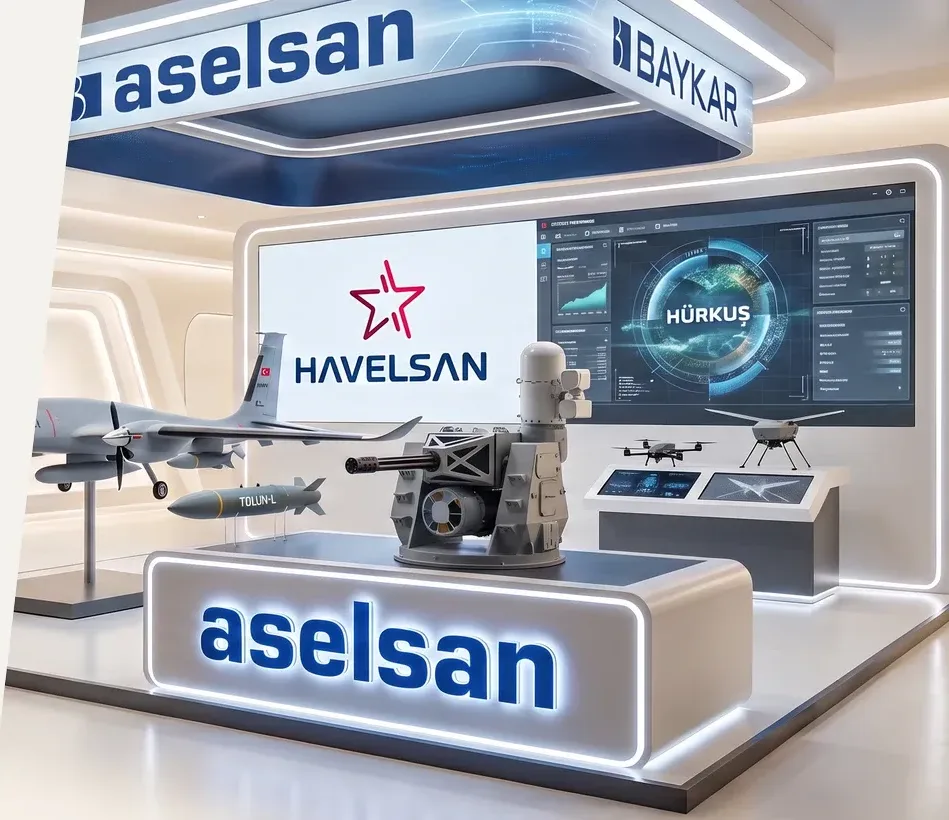
On November 25, Baykar and ASELSAN announced that the 250-pound-class TOLUN-L guided munition completed its first live-firing test from a Bayraktar AKINCI unmanned combat aerial vehicle (UCAV), scoring a direct hit on its first shot.
According to ASELSAN's technical documentation, the 121-kilogram TOLUN-L combines an inertial and satellite navigation suite (INS/GNSS) with a semi-active laser seeker and a fragmentation warhead. Fitted with deployable wings that extend its range beyond 50 kilometers (27 nautical miles) from unmanned aircraft, the munition mounts on single pylons or SADAK-2T and SADAK-4T multiple carriage racks. ASELSAN lists the AKINCI, KIZILELMA, ANKA-III, and Bayraktar TB3 among its carrier platforms.
Autonomous Naval Air Defense
At sea, ASELSAN conducted an international live-fire demonstration of its GÖKDENİZ Close-In Weapon System (CIWS) in the Black Sea, detailed in a company release on November 22 and 23. Selected by the navies of six countries, GÖKDENİZ engaged high-speed, jet-powered target drones simulating low-altitude maneuvering UAVs and cruise missiles approaching from multiple directions and altitudes.
Operating aboard a vessel moving at 5 to 10 knots, the system ran in autonomous mode: it handled target detection, tracking, and engagement sequencing automatically, limiting operator input to single-button firing authorization before destroying the targets. Alongside its fully autonomous setting, ASELSAN noted the containerized, deployable GÖKDENİZ configuration unveiled at EURONAVAL 2026 in early November to protect commercial vessels and maritime infrastructure from aerial threats.
Military-Grade FPV Drones and Aerial Mine-Clearing
In tactical land operations, STM announced on November 23 that its ALKAN FPV kamikaze drone completed acceptance testing and entered the inventory of Turkish security forces with initial deliveries of multiple systems.
STM General Manager Özgür Güleryüz cited two features separating ALKAN FPV from commercial first-person-view drones: a military-standard safety fuze (MIL-STD-331) for transport and operational safety, and computer-vision-assisted autonomous terminal diving after an operator designates a target. Built to resist electronic jamming and optical blinding, ALKAN FPV carries day and night cameras, an adjustable proximity sensor, and interchangeable anti-personnel and armor-piercing warheads shared with STM's KARGU loitering munition.
In counter-mine capabilities, state-owned Machinery and Chemical Industry Corporation (MKE) confirmed that ALPAY-D, the airborne variant of its ALPAY mine-breaching family, completed field trials. Built to clear anti-personnel mines without sending sappers into mined terrain, ALPAY-D uses an unmanned aerial vehicle to lay an explosive line charge from the air over a target zone and detonates it remotely, opening a 25-meter or 50-meter corridor for infantry. MKE stated that two personnel can prepare the system, which joins the ground-based ALPAY and unmanned ALPAY-2 variants.
Digitizing Flight Preparation and Debriefing
On November 22, HAVELSAN announced that acceptance processes concluded for its Mission Planning Software tailored to TUSAŞ's HÜRKUŞ trainer and light attack aircraft.
Adapted from HAVELSAN's Fleet-Level Mission Planning System (FSGP) in service with the Turkish Air Force, the HÜRKUŞ software digitizes route optimization, fuel consumption analysis, weather integration, and emergency scenario planning, alongside post-flight debriefing tools for pilot training. The system integrates directly with the Turkish Air Force Information System (HvBS) for air tasking orders, airspace data, and meteorology, and supports standalone offline operation.
Sources: Official announcements and product documentation from ASELSAN (Nov 3, Nov 22–23, Nov 25, 2026), Baykar Teknoloji (Nov 25, 2026), STM (Nov 23, 2026), MKE (Nov 2026), and HAVELSAN (Nov 22, 2026).