
By Bosphorus News Defense Desk
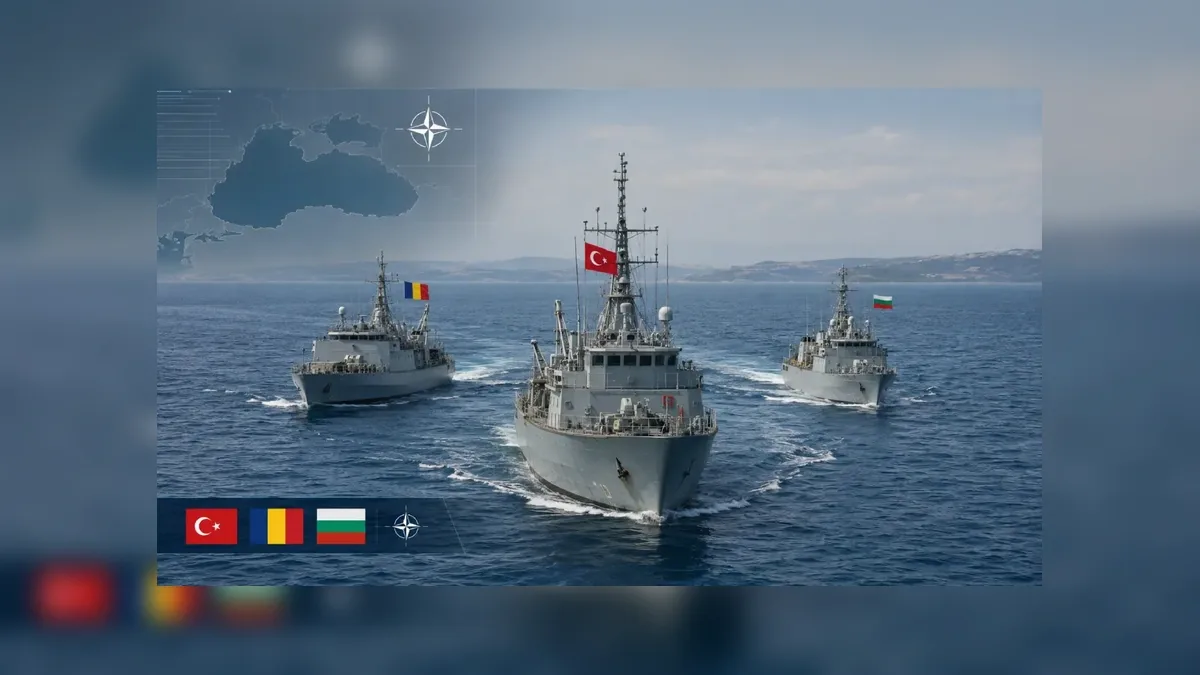
Türkiye, Romania and Bulgaria have expanded their joint Black Sea naval mission from mine clearance and navigation safety to the protection of critical undersea infrastructure, widening the remit of the three-country force beyond its original mission.
Within weeks, drones were destroyed near Romania's Neptun Deep gas project, while Turkish-owned and Turkish-operated merchant vessels came under repeated attack elsewhere in the Black Sea. The task group's declared mandate covers critical seabed infrastructure but does not assign it a standing role in defending commercial ships against drones or missiles.
Three Allies Expand the Mission
Defense ministers Yaşar Güler, Radu-Dinel Miruță and Dimitar Stoyanov signed an amendment to the Black Sea Mine Countermeasures Task Group memorandum in Ankara on July 8, on the margins of the NATO summit.
Türkiye's Ministry of National Defence said the amendment added protection of the three countries' critical undersea infrastructure to the group's responsibilities. Romania used similar language, while Bulgaria described surveillance and reconnaissance as part of the expanded mission.
The July amendment expanded the force beyond its original mine-clearing mission as Bulgaria prepared to take over the rotating command from Türkiye.
The amendment applies to infrastructure belonging to Türkiye, Romania and Bulgaria rather than creating a general Black Sea protection mechanism for every pipeline, cable or commercial vessel.
Mine clearance and navigation safety remain part of the mission.
A Regional Force Built With Limits
The original memorandum establishing the Mine Countermeasures Black Sea Task Group was signed in Istanbul on Jan. 11, 2024.
Its immediate purpose was to counter drifting mines generated by the Russia-Ukraine war, improve maritime situational awareness and reduce hazards to navigation. Search-and-rescue cooperation and related maritime-security tasks were also included.
Güler said at the signing that the naval component would consist of vessels from the three participating Black Sea states. Contributions from other allies could be considered when agreed by the participants and when conditions allowed.
Türkiye has described the task group as a regional initiative outside NATO's formal force structure while continuing to treat the Montreux Convention as the legal framework governing military access to the Black Sea.
The force became operational in July 2024 and rotates command every six months. Türkiye held command during the first half of 2026 before Bulgaria took over in July.
The group's earlier activation cycle shows how the format developed from a mine-countermeasure mechanism into a recurring regional naval deployment.
The July activation included Türkiye's TCG Akçay, Romania's minehunter Căpitan Constantin Dumitrescu and Bulgaria's Captain 1st Rank Dimitar Dobrev and Struma. The ships also took part in Breeze 2026, Bulgaria's multinational naval exercise involving NATO allies and partner countries.
Neptun Deep Put the New Mission Against a Real Threat
The infrastructure amendment was followed within weeks by incidents close to one of the Black Sea's largest new energy projects.
Romanian forces destroyed two drifting drones near the Neptun Deep offshore gas development on Aug. 11. Another maritime drone carrying explosives was destroyed on Aug. 20 only a few hundred metres from infrastructure associated with the project.
Those operations were carried out by Romanian national forces, not by the trilateral mine group.
The incidents showed that the threat to offshore infrastructure was already present. Pipelines and production installations are exposed not only to drifting mines or accidental damage but also to unmanned systems carrying explosives.
Neptun Deep is expected to begin producing gas in 2027 and could make Romania the European Union's largest natural gas producer.
Türkiye is expanding its own seabed energy infrastructure at the opposite end of the western Black Sea. Production from the Sakarya Gas Field stands at about 9.5 million cubic metres per day. Ankara plans to double output to around 20 million cubic metres per day after the Osman Gazi floating production platform enters service in the final quarter of 2026.
Turkish Merchant Ships Face a Different Threat
Commercial shipping has been hit repeatedly during the same period.
Türkiye's Foreign Ministry confirmed on Aug. 4 that the Turkish-owned civilian vessels Yaşar and Nadezhda were struck by drones after leaving Novorossiysk the previous evening. The ministry said personnel, including Turkish nationals, were injured.
The attacks continued later in August.
The Turkish-owned, San Marino-flagged cargo ship Necibe was hit on Aug. 18 while operating off Tuapse. The Turkish-owned, Cameroon-flagged Ural, operated by Kalyoncu Denizcilik, took 18 seafarers off the damaged vessel before Ural itself was attacked near Novorossiysk on Aug. 21. Chief cook İlker Lazoğlu was killed and eight people were injured.
On Aug. 26, the Turkish-operated Lider Bordo Mavi was struck off Tuapse and caught fire. Lider Kocatepe, sent the following day to tow the damaged vessel, was also targeted.
Türkiye subsequently summoned Ukrainian Ambassador Naryman Dzhelialov. Turkish officials said the safety of life, property, navigation and the marine environment in the Black Sea had to be protected.
Ankara also raised the International Ship and Port Facility Security Code level for Turkish-flagged vessels heading to Russian and Ukrainian Black Sea ports and offshore areas to ISPS Level 3, the highest security level.
The ISPS measure applies to commercial shipping and sits outside the trilateral naval mechanism.
Merchant-Ship Defence Remains Outside the Expanded Mandate
The July amendment did not turn the trilateral naval group into an escort or air-defense force for commercial traffic.
Mine clearance, surveillance, navigation safety and critical undersea infrastructure fall inside its declared responsibilities. No public document assigns the group a standing role in escorting merchant vessels, defending them against drones or missiles, or intervening when a commercial ship is attacked.
The trilateral force handles mines and now seabed infrastructure, while attacks on merchant shipping have produced national security measures and a separate diplomatic effort.
Former maritime transport director general Deniz Vank has said close to 50 Turkish vessels have been attacked in the Black Sea over roughly four and a half years. The figure is his assessment rather than an official government count.
Vank has also argued that Türkiye should consider closing the straits under the Montreux Convention if attacks continue. Ankara has not adopted that position.
Ankara Moves From Moratorium Call to a New Black Sea Plan
Foreign Minister Hakan Fidan said on Aug. 8 that Türkiye had proposed a mechanism to both Russia and Ukraine for a moratorium on attacks against commercial shipping.
He said attacks had moved beyond military ports and military vessels and increasingly reached civilian maritime traffic.
Reuters later reported that Ukraine had sent Russia a separate proposal through a third party for a partial ceasefire covering attacks on civilian targets. No evidence has established that the Ukrainian proposal originated from Ankara's initiative.
Russia rejected the suggestion that an agreed mechanism was taking shape. Deputy Foreign Minister Alexander Grushko said Moscow had received no formal proposal, while Foreign Ministry spokeswoman Maria Zakharova said conditions did not exist for a ceasefire or a return to the previous Black Sea Grain Initiative.
By Aug. 31, Fidan was describing a broader Turkish effort. He said Ankara had prepared a new study covering safe navigation and grain movements in the Black Sea and was in contact with both Russia and Ukraine.
Türkiye's wider Black Sea and Caspian security approach has increasingly combined Montreux, merchant-shipping security and regional mechanisms rather than relying on a single naval response.
Ankara has moved from calling for a moratorium to working on a broader navigation arrangement. Russia and Ukraine have not agreed to a mechanism.
Operational Rules for the New Mission Remain Unclear
The July amendment gives the trilateral naval group an additional responsibility but leaves much of its operational framework outside the public record.
Official documents refer to surveillance, reconnaissance and protection of critical undersea infrastructure. They do not specify which pipelines, cables or offshore installations would receive priority, what assets would be assigned to an incident or how the group would respond if infrastructure were deliberately attacked rather than threatened by a drifting mine.
The Neptun Deep incidents already produced the type of threat the amendment is intended to address. Romania responded with national forces.
Bulgaria now holds command of the task group. Its next activations will show whether the July amendment changes deployments and exercises or remains largely a formal mandate expansion of a force still operating around its original mine-clearing mission.
Sources: Türkiye's Ministry of National Defence, Türkiye's Ministry of Foreign Affairs, Türkiye's Directorate General of Maritime Affairs, Romanian Ministry of National Defence, Romanian Naval Forces, Bulgarian government and Ministry of Defence, Türkiye's Ministry of Energy and Natural Resources, Reuters, Anadolu Agency, Bosphorus News review and reporting.