
By Bosphorus News Energy Desk
Turkish Vice President Cevdet Yılmaz said Türkiye will proceed with its planned natural gas pipeline to northern Cyprus despite objections from the Greek Cypriot side.
His September 18 remarks brought the dispute back into focus over a system designed to move gas in both directions.
Yılmaz, speaking in northern Cyprus, referred to the natural gas link and a separate fiber infrastructure project as two large-scale initiatives. Responding to criticism, he said, "It seems we have upset some people," and added that Türkiye would continue supporting projects intended to improve the welfare of the Turkish Cypriot community.
Two Parallel Pipes, Bidirectional Flow
Türkiye and the Turkish Republic of Northern Cyprus (TRNC) signed a memorandum of understanding for the project on July 10.
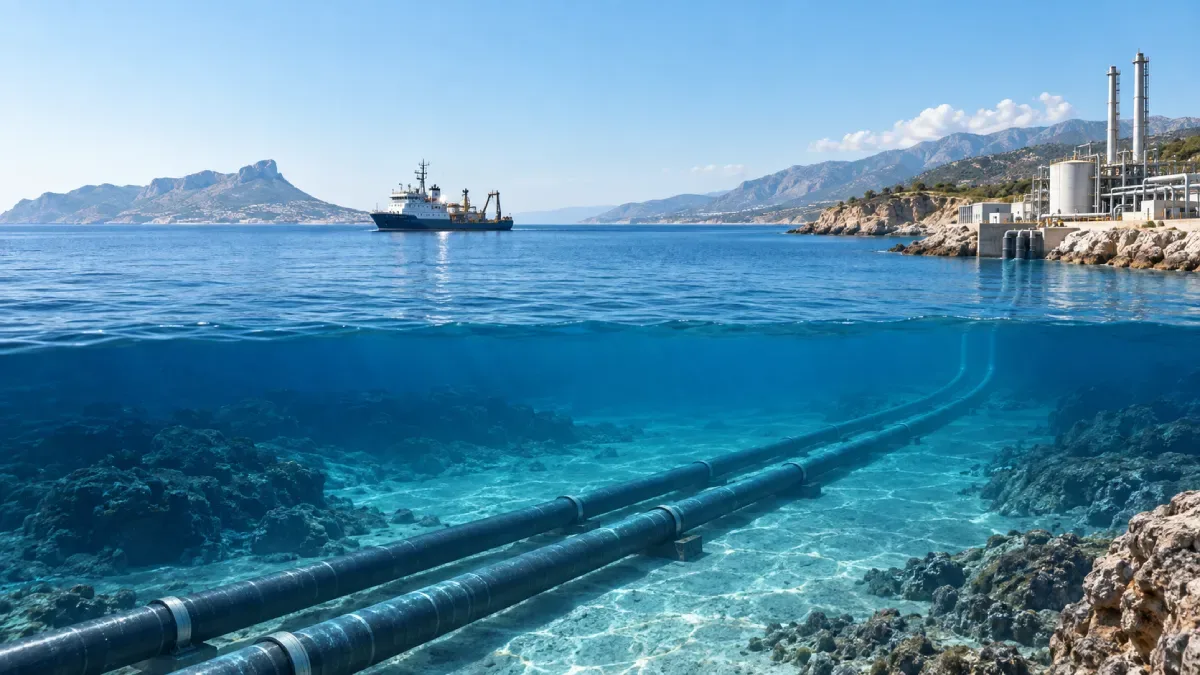
Energy and Natural Resources Minister Alparslan Bayraktar said the planned system would run approximately 101 kilometers from Anamur on Türkiye's Mediterranean coast to Teknecik near Kyrenia. About 97 kilometers would be offshore and four kilometers on land.
The current design calls for two parallel 22-inch pipelines, each about 56 centimeters in diameter.
Bayraktar said the system would be bidirectional. Gas could move from Türkiye to the island, but the same infrastructure could also carry gas from the island back to Türkiye and onward to European markets under a future supply arrangement.
The immediate plan is to supply natural gas for electricity generation in northern Cyprus and reduce reliance on liquid fuels. The project is targeted for operation in 2028 following the engineering phase.
Republic of Cyprus Takes the Dispute to the UN
The Republic of Cyprus submitted an August 7 letter to United Nations Secretary-General António Guterres challenging the Türkiye-TRNC memorandum. The document is registered as A/80/809 in UN Law of the Sea records.
Its objection also covers the reverse-flow capability. The Republic of Cyprus argues that Turkish Cypriot authorities cannot conclude agreements affecting territory or maritime areas over which it claims sovereignty or sovereign rights. It describes the memorandum as legally invalid and objects to infrastructure being developed without its consent.
The letter argues that reverse-flow capacity could eventually be used to transport gas originating from maritime areas over which the Republic of Cyprus claims sovereign rights.
Bosphorus News found no public announcement assigning a specific Cyprus offshore field to the pipeline or setting out a reverse-flow supply contract, capacity agreement or final investment decision. Bosphorus News examined the legal and technical dispute in August.
What the July NAVTEX Notices Confirm
The Republic of Cyprus letter also cites Turkish navigational warnings issued in July as evidence that preparatory activity appeared to have begun.
The NAVTEX notices themselves are more limited.
NAVTEX 0731/26, issued on July 21, states that R/V Oruç Reis, Denar Explorer, Denar Pathfinder and Denar Surveyor would conduct "scientific research and underwater works" between July 20 and August 30 inside a specified area south of Anamur.
A second notice, NAVTEX 0741/26, was issued on July 23. It assigned Denar Explorer, Denar Pathfinder and Denar Surveyor to "scientific research and underwater works" between July 25 and August 30 in a separate area closer to northern Cyprus.
Neither notice mentions a natural gas pipeline, identifies the work as a seismic survey for the pipeline or states that pipeline construction had begun.
Bosphorus News previously reviewed the Oruç Reis NAVTEX and its coordinates, finding that NAVTEX 0731/26 covered a limited survey block near the Turkish end of the proposed connection rather than the full 101-kilometer corridor.
NAVTEX 0741/26 adds a second survey area farther south. It confirms additional scientific research and underwater work by the three Denar vessels, but its wording also stops short of identifying the operation as pipeline construction or explicitly describing it as seismic work.
Reports published when the notices appeared described the operation as seismic work associated with the pipeline. The navigational warnings themselves use the broader wording "scientific research and underwater works."
Yılmaz Says Projects Will Continue
Yılmaz's September 18 remarks do not change the engineering design or the legal positions already on record. They amount to Ankara's clearest recent political response to the objections.
He described the gas and fiber links as lawful infrastructure projects intended to improve conditions for Turkish Cypriots and said Türkiye would continue with them despite criticism.
The Republic of Cyprus maintains that the pipeline raises questions of sovereignty, maritime jurisdiction and authority over infrastructure connected to the island. Its UN letter also includes the possible future use of the two-way system in that dispute.
Türkiye and the Turkish Cypriot side describe the project primarily as energy infrastructure for northern Cyprus. The design preserves the ability to move gas in the opposite direction if a future source and commercial arrangement are established.
Reverse flow remains a design feature. No offshore source, supply contract or commercial route has been announced.
Sources: Türkiye's Presidency, Türkiye's Ministry of Energy and Natural Resources, United Nations, NAVTEX 0731/26 and 0741/26, Anadolu Agency, Cyprus Mail, Bosphorus News review and reporting