
By Bosphorus News Energy Desk
The Republic of Cyprus has taken its objection to the Türkiye-TRNC natural gas pipeline memorandum to the United Nations as survey work continues near the Turkish end of the planned route.
At the centre of the dispute is a specific feature of the project: the pipeline is designed to carry gas in both directions.
Türkiye and the Turkish Republic of Northern Cyprus (TRNC) describe the Anamur-Teknecik connection as an energy security project that would initially deliver natural gas from Türkiye to northern Cyprus and support the conversion of the Teknecik power station.
The Republic of Cyprus argues that the same technical capability creates a future possibility of transporting gas from maritime areas over which it claims sovereign rights.
The dispute is therefore not about whether the system can operate in two directions. Both sides acknowledge that capability. The disagreement concerns what that flexibility could mean for future Eastern Mediterranean gas flows and who would have authority over any future exports.
Two Parallel Lines From Anamur to Teknecik
The planned connection between Anamur on Türkiye's Mediterranean coast and the Teknecik power station near Kyrenia consists of two parallel 22-inch pipelines, each approximately 56 centimetres in diameter.
Energy and Natural Resources Minister Alparslan Bayraktar has described the route as approximately 101 kilometres, including around 97 kilometres offshore and four kilometres on land.
The immediate purpose is energy security. Northern Cyprus currently relies heavily on imported liquid fuels for electricity generation, and gas delivered through the pipeline would allow Teknecik to shift toward gas-based generation.
The project has been targeted for operation in 2028, although key commercial details, including financing structure, supplier selection and final construction arrangements, have not been publicly disclosed.
Bosphorus News previously examined the technical architecture of the 101-kilometre bidirectional Türkiye-TRNC gas pipeline project, including the offshore route, two-pipe configuration and the absence of a confirmed reverse-flow gas source or transportation agreement.
The Second Pipe Becomes the Main Legal Question
The reverse-flow capability was part of the project design before the current legal dispute emerged.
Bayraktar has said the system would allow gas to move from Türkiye to the island and, under a future scenario, from the island through Türkiye toward European markets.
Bosphorus News previously examined whether the two-way Türkiye-TRNC pipeline could eventually carry Cyprus gas toward European markets through Türkiye and how that possibility fits into wider Eastern Mediterranean energy routes.
No Cyprus offshore field has been assigned to the project. No export contract, capacity reservation or final investment decision connecting a specific gas source to the Anamur-Teknecik route has been announced.
For Türkiye, the design provides technical flexibility for future energy scenarios.
For the Republic of Cyprus, the same feature forms part of a legal argument over possible future use of resources in maritime areas where it claims sovereign rights.
Republic of Cyprus Takes Objection to UN
The Republic of Cyprus' Permanent Representative to the United Nations, Maria Michael, has submitted objections to UN Secretary-General António Guterres regarding the Türkiye-TRNC memorandum.
Nicosia argues that Turkish Cypriot authorities do not have the international legal capacity to conclude agreements affecting maritime areas over which the Republic of Cyprus claims sovereignty or sovereign rights.
The argument focuses on three issues: the legal status of the memorandum, authority to approve infrastructure affecting contested maritime areas and the possible future use of offshore resources.
Michael's letter does not argue that gas from a specific Cyprus field is already assigned to the pipeline. Instead, it focuses on what the bidirectional design could allow in the future.
Türkiye maintains a different position on Cyprus maritime jurisdiction and energy rights, while the Turkish Cypriot administration describes the project as an infrastructure step for energy security and economic development.
NAVTEX Shows Activity Near Anamur, Not Full Route Construction
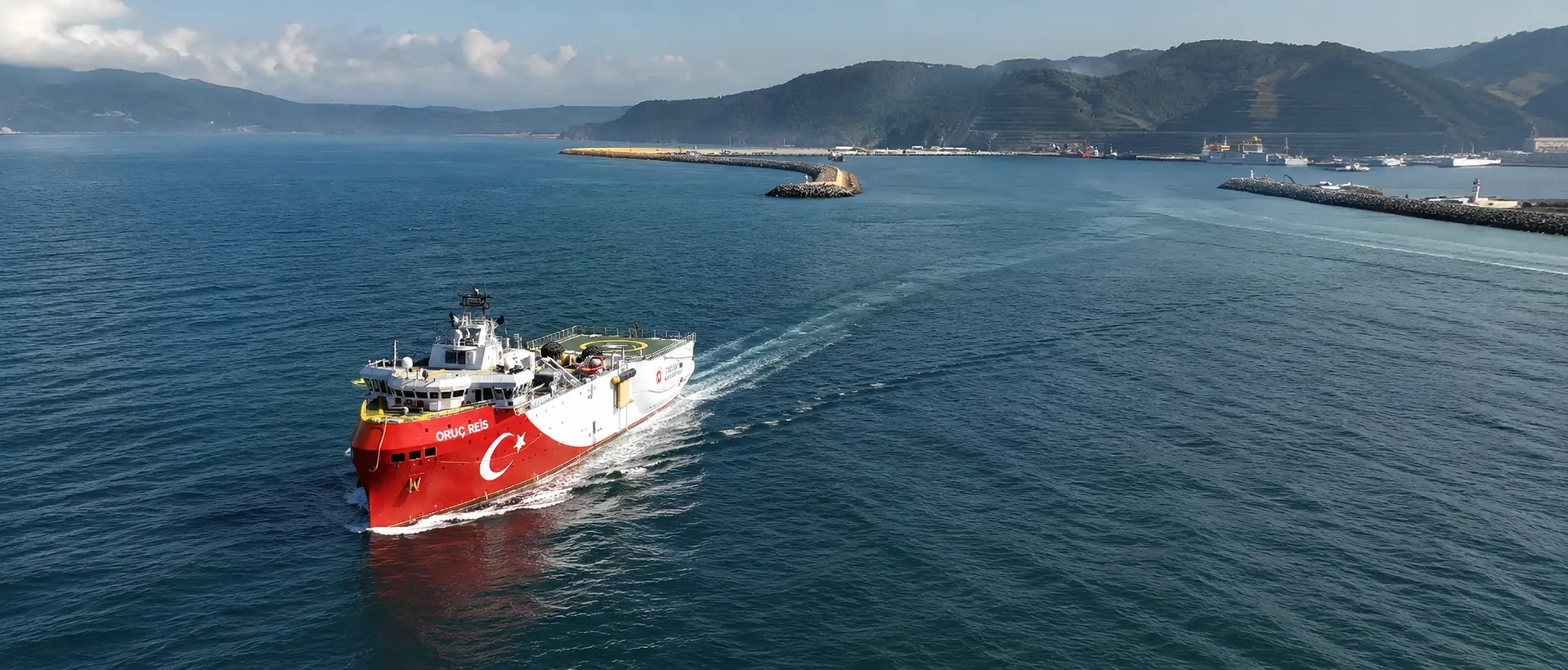
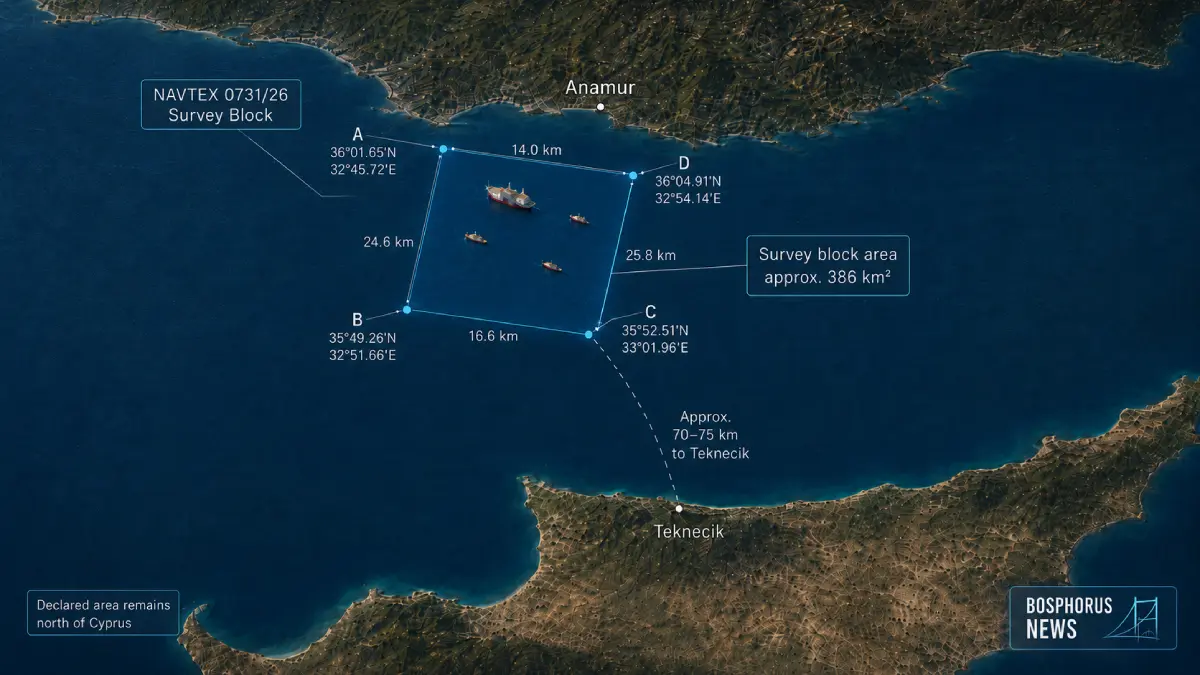
Türkiye issued NAVTEX 0731/26 in July for scientific research and underwater works south of Anamur.
Bosphorus News' Oruç Reis NAVTEX coordinate review found that the notified area covers a limited survey zone near the Turkish side of the proposed route rather than the full 101-kilometre corridor toward Teknecik.
The notice does not state that pipeline construction has begun and does not describe activity along the entire route.
The available evidence confirms survey-related activity near Anamur. It does not confirm construction or surveying across the full proposed connection.
The Water Pipeline Connection
The gas project follows a geography already used for strategic infrastructure.
Türkiye's Northern Cyprus water pipeline project, completed in 2015, demonstrated the engineering possibility of a large subsea connection between the Anamur area and northern Cyprus.
The water project is not a legal precedent for the gas pipeline. The regulatory framework and maritime issues are different.
It is, however, an infrastructure example showing that large-scale utility links between the two shores can be engineered and operated.
The gas pipeline adds a different feature: unlike the water system, it has been designed with the possibility of flow in both directions.
That difference has placed the gas pipeline inside the wider Cyprus dispute before any gas begins to flow.
The EU Dimension
The Republic of Cyprus raised the pipeline issue at a European Union Foreign Affairs Council meeting in July.
EU foreign policy chief Kaja Kallas said the bloc expected Türkiye to respect the sovereignty and sovereign rights of all member states.
The Turkish Cypriot side rejected that response and defended the project as an energy security initiative.
The European dimension could become more significant if the pipeline is eventually linked to a wider Eastern Mediterranean gas route through Türkiye.
For now, that remains a technical possibility rather than a contracted supply chain.
Two Timelines Meet
The pipeline follows a multi-year construction timeline. The Cyprus political process is moving on a much shorter schedule.
The UN-backed meeting between Tufan Erhürman and Nikos Christodoulides comes as both sides discuss confidence-building measures and possible next steps in the negotiation process.
The Republic of Cyprus argues that unilateral infrastructure projects complicate the political environment.
Türkiye and the Turkish Cypriot side argue that long-term infrastructure planning cannot wait indefinitely for a political settlement.
The pipeline remains a future infrastructure project. The legal dispute, however, has already begun over what that infrastructure could eventually enable.
Sources: Türkiye's Ministry of Energy and Natural Resources, Republic of Cyprus Ministry of Foreign Affairs, Permanent Mission of the Republic of Cyprus to the United Nations, TRNC Prime Ministry and Public Information Office, European External Action Service, Türkiye's official navigational warnings, State Hydraulic Works, Bosphorus News review and reporting.