
By Bosphorus News Defense Desk
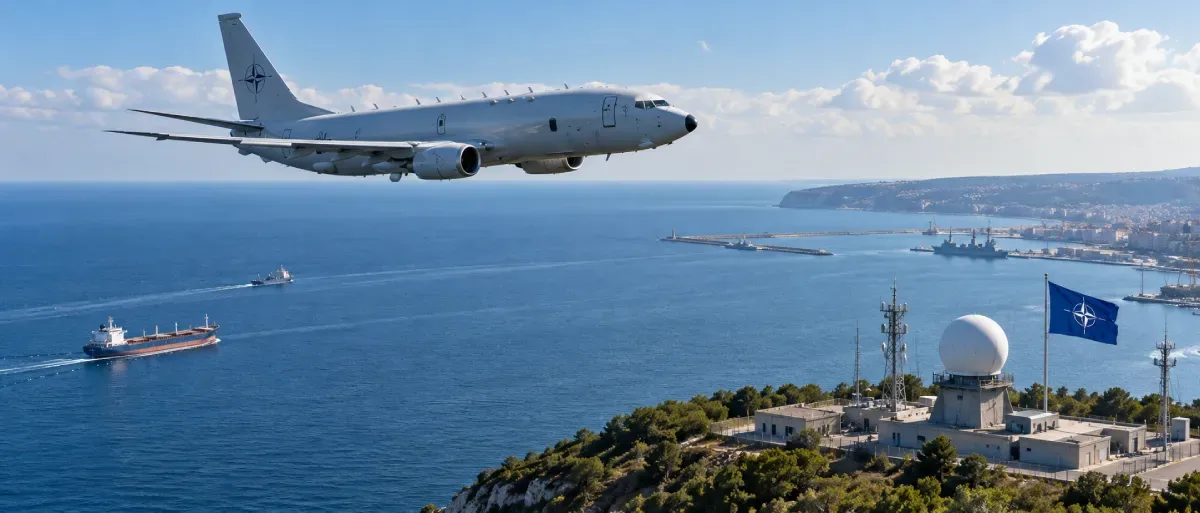
NATO is reinforcing surveillance in the Black Sea with maritime patrol aircraft, drones, radar systems and intelligence specialists after attacks on merchant vessels near Romania and Bulgaria. A US Navy P-8A Poseidon is already flying reconnaissance missions from Bulgaria.
The North Atlantic Council discussed the attacks in Brussels on October 20. Col. Martin O'Donnell, spokesman for NATO's Supreme Headquarters Allied Powers Europe, said allies had sent or would send additional surveillance equipment, intelligence personnel and explosives-analysis teams.
Additional sensors and intelligence sharing would help NATO track threats at sea, O'Donnell said. No naval escort operation for commercial ships has been announced.
US patrols from Varna
Bulgarian Prime Minister Rumen Radev confirmed on October 20 that a US P-8 Poseidon was carrying out reconnaissance flights over the Black Sea. The aircraft arrived in Varna from Sigonella, Italy, on October 18, two days before the council meeting. Bulgarian Defense Minister Dimitar Stoyanov said the deployment was coordinated with the alliance and that its findings would be shared with NATO.
Romanian President Nicușor Dan welcomed the additional support on October 21 and called for more counter-drone, reconnaissance and investigative capabilities. He confirmed that Romanian F-16s had shot down two drones over the country's territorial waters near Sulina on October 17.
The attacks included fires aboard two chemical tankers near Romania on October 14 and 15. Seven crew members of the San Marino-flagged Wine Trader were reported missing. NATO has not publicly assigned responsibility for the attacks.
Türkiye's naval role remains separate
Bulgaria had already asked NATO for help and proposed a moratorium on attacks against civilian shipping. Sofia also consulted Türkiye and Romania, whose navies operate a separate Black Sea mine-countermeasures mission.
The three countries established the Mine Countermeasures Black Sea Task Group (MCM BLACK SEA) in 2024. In July 2026, they expanded its mandate to include critical undersea infrastructure protection. The mission operates under rotating national command, outside NATO's formal command structure.
Bulgarian Navy commander Rear Admiral Kiril Mihaylov welcomed the task group's ships back to Varna on October 20 after their latest deployment. He also reported that Bulgaria had recovered or destroyed parts of more than 100 drones and eliminated six drifting mines during 2026. The drone figure counts recovered objects, not attacks on ships.
The task group's published mandate does not provide for routine merchant-ship escorts or air-defense operations. NATO's latest measures expand surveillance and investigation, not naval escort operations.
Separately, Türkiye has proposed measures to Russia and Ukraine to protect civilian shipping. The two countries have responded, but no agreement has been announced. NATO has announced no protected shipping corridor.
Sources: NATO Spokesperson, Supreme Headquarters Allied Powers Europe, Bulgarian Telegraph Agency, Bulgarian Ministry of Defence, Romanian Presidency, Romanian Ministry of National Defence, Türkiye's Ministry of National Defence, Reuters, EFE, Bosphorus News review and reporting.