
By Bosphorus News Geopolitics Desk
The Kurdistan Regional Government (KRG) declared its long-running Peshmerga unification process complete on September 10. A day later, Iraqi Prime Minister and Commander-in-Chief of the Armed Forces Ali Falih Al-Zaidi said armed factions in Sinjar would begin handing weapons to the state, with eligible fighters offered a route into official security institutions.
The files concern different forces. Erbil is reorganizing Peshmerga formations built around rival Kurdish parties, while Baghdad is trying to bring armed groups in Sinjar more firmly under federal authority.
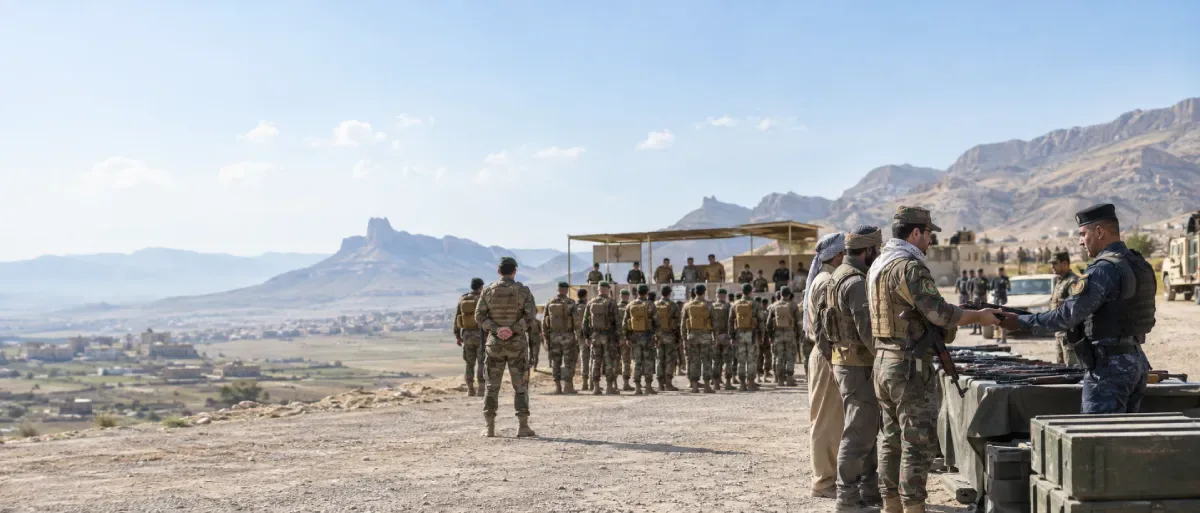
Kurdistan Region Minister of Peshmerga Affairs Shoresh Ismail said forces historically aligned with the Kurdistan Democratic Party (KDP) and the Patriotic Union of Kurdistan (PUK), commonly known as the 80 and 70 forces respectively, had been fully unified and reorganized under the Ministry of Peshmerga Affairs (MoPA). The ministry said brigades and divisions were now operating through a unified command structure and that the two area commands had formally begun their duties.
The declaration comes weeks before the end of a reform framework renewed with the United States (US) Department of Defense in September 2022. The arrangement runs through the end of September 2026 and was intended to move the Peshmerga toward a unified, nonpartisan force under ministry authority.
US oversight reporting put the planned MoPA force at an end strength of 138,000, organized around 11 divisions and two area commands. The KRG's July 2026 reform update gave a lower figure for personnel already organized within the new structure: 88,900 officers and Peshmerga personnel in 38 brigades, nine divisions and two combat-support divisions. The two area commands were still being brought under MoPA authority at that stage.
The difference between 88,900 and 138,000 does not by itself contradict the September declaration. The larger figure is the planned end strength, while the KRG figure described personnel already organized within the structure in July. It does mean that "unification complete" is primarily a claim about command and organization rather than evidence that the planned force has reached full staffing.
Prime Minister Masrour Barzani had prepared part of that structure on February 26 through Order No. 703, which set out the administrative, legal and financial powers of corps and division commands and their coordination with federal forces.
What Completion Still Has to Prove
The KRG says the formal merger is finished, but party influence is harder to measure. A Lead Inspector General report on Operation Inherent Resolve covering April through June 2025 said 72,000 Peshmerga were under MoPA authority by late May, while many more remained under the 70 and 80 structures.
The Defense Intelligence Agency also reported that partisan alignment remained visible during the reform process, including party-linked commanders and units operating in areas associated with their respective political organizations. US oversight reporting covering the second half of 2025 said the two area commands had still not been established because of a partisan impasse.
Those assessments came before the KRG's September 2026 completion declaration, but they provide a benchmark for what follows: whether appointments, budgets, weapons, training and operational orders now remain inside the ministry chain rather than passing through older party networks.
MoPA has not published a division-by-division readiness assessment alongside its announcement or detailed how remaining informal political links were dismantled. Its official claim is narrower: the 70 and 80 forces have been reorganized and the new command structure is operating.
British officials heard the same account during a September 10 meeting in Erbil, when Ismail told a visiting United Kingdom military and diplomatic delegation that brigades and divisions had been brought together under the two area commands and asked Britain to continue supporting the next stage of Peshmerga development.
Baghdad Opens the Sinjar Track
According to the Iraqi Prime Minister's Media Office, Al-Zaidi received a delegation from the Yazidi Issue Coalition Bloc, headed by MP Murad Ismail, together with leaders of the Sinjar Resistance Units (YBŞ).
The government said armed factions in Sinjar would begin handing weapons to the state and that Mount Sinjar would come under federal security and administrative authority. It also said the legal status of YBŞ members and members of the Sinjar Women's Units (YJŞ) would be regularized, with those meeting legal requirements eligible for integration into state security institutions.
Baghdad framed the move around ending multiple centers of security decision-making rather than simply dissolving a local force. Al-Zaidi said weapons should remain under state authority and that no military or security power should operate in Sinjar outside the federal framework.
The September 11 announcement went beyond reports circulating earlier in the month. After a September 1 security meeting in Baghdad, Iraqi officials had discussed integrating roughly 1,500 to 2,000 Iraqi fighters from armed formations in Sinjar. YBŞ then denied reports that 2,200 of its fighters had already joined the Iraqi army and said no agreement had been reached.
The Prime Minister's Office later said YBŞ leaders had attended the September 11 meeting and that the delegation supported measures involving weapons handover and integration. Baghdad has not published an implementation timetable, a final number of fighters to be absorbed or arrangements for collecting and holding the weapons.
Ankara's Iraq Pressure Preceded the Move
Türkiye had already been pressing Baghdad over the presence of the Kurdistan Workers' Party (PKK) in Iraq.
Foreign Minister Hakan Fidan said on February 9 that Türkiye saw an "Iraq leg" following developments in Syria and argued that the Iraqi government would eventually have to assert authority over armed organizations operating on its territory. Asked specifically about Sinjar, he said the situation could not continue indefinitely and also named Makhmour and Qandil when discussing the PKK's presence in Iraq.
During the same interview, Fidan described a hypothetical operation in which Popular Mobilization Forces moved on the ground while Türkiye conducted air operations, arguing that such a military task could be completed quickly if Baghdad had the political will. The Turkish Foreign Ministry said two days later that some Iraqi coverage had taken his remarks out of context and stressed Türkiye's support for Iraqi sovereignty and deeper security cooperation with Baghdad.
The exchange fitted a wider line Ankara had already been developing through Türkiye's PKK disarmament process and the broader Syria-Iraq security agenda.
Coordination was widening by early September. Iraqi military spokesman Sabah al-Numan told Channel 8, according to Rastinews, that Baghdad, Erbil and Ankara had agreed on a security mechanism for areas being vacated by the PKK, with Iraqi Border Guards and Peshmerga expected to move into some positions.
The mechanism was described in relation to northern border areas including Qandil, Zap, Metina and Gara, not Sinjar. It nevertheless shows that Baghdad, Erbil and Ankara were already coordinating on the wider PKK file before Al-Zaidi's September 11 announcement.
Türkiye has also formally described YBŞ as "PKK-affiliated." The Turkish Foreign Ministry used that term on March 20, 2025, after an attack on Iraqi soldiers in Sinjar, saying Ankara would continue working with Iraq against the PKK and its extensions.
Baghdad did not use that terminology in its September 11 statement. Its announcement was framed around weapons control, federal authority and the integration of eligible local fighters. The PKK is designated as a terrorist organization by Türkiye, the United States and the European Union.
A Different Route From the 2020 Sinjar Agreement
The current plan also reaches back to the Sinjar Agreement concluded between Baghdad and the KRG in 2020. Its security provisions envisaged local police and federal security and intelligence institutions assuming responsibility in the district while other armed formations withdrew. United Nations documentation of the agreement also recorded that the PKK and its affiliates were to have no role in Sinjar.
Implementation stalled over security arrangements, local representation and the continued presence of armed groups. Baghdad's current approach differs by offering eligible fighters a route into official Iraqi institutions rather than only requiring armed formations to leave, while still seeking to place weapons and security authority under federal control.
Erbil is further along in its institutional process: the KRG says the former party-aligned Peshmerga structures have been formally merged under MoPA just before the US-backed reform framework reaches its September endpoint, although published staffing figures remain below the force size envisaged in American oversight reporting. Baghdad, by contrast, has announced the direction of travel in Sinjar but has not yet demonstrated the weapons handover or completed the integration of fighters.
In the Kurdistan Region, the next evidence will come from who controls appointments, budgets, weapons and operational orders inside the new Peshmerga structure. In Sinjar, Baghdad will be judged on whether the announced transfer of weapons produces durable federal control without reviving the disputes that have blocked implementation there since 2020.
Sources: Kurdistan Regional Government Ministry of Peshmerga Affairs, Kurdistan Regional Government, US Lead Inspector General reporting on Operation Inherent Resolve, Iraqi Prime Minister's Media Office, Iraqi Council of Representatives, Türkiye Ministry of Foreign Affairs, United Nations Iraq, Rudaw, Rastinews, Bosphorus News review and reporting.