
By Bosphorus News Geopolitics Desk
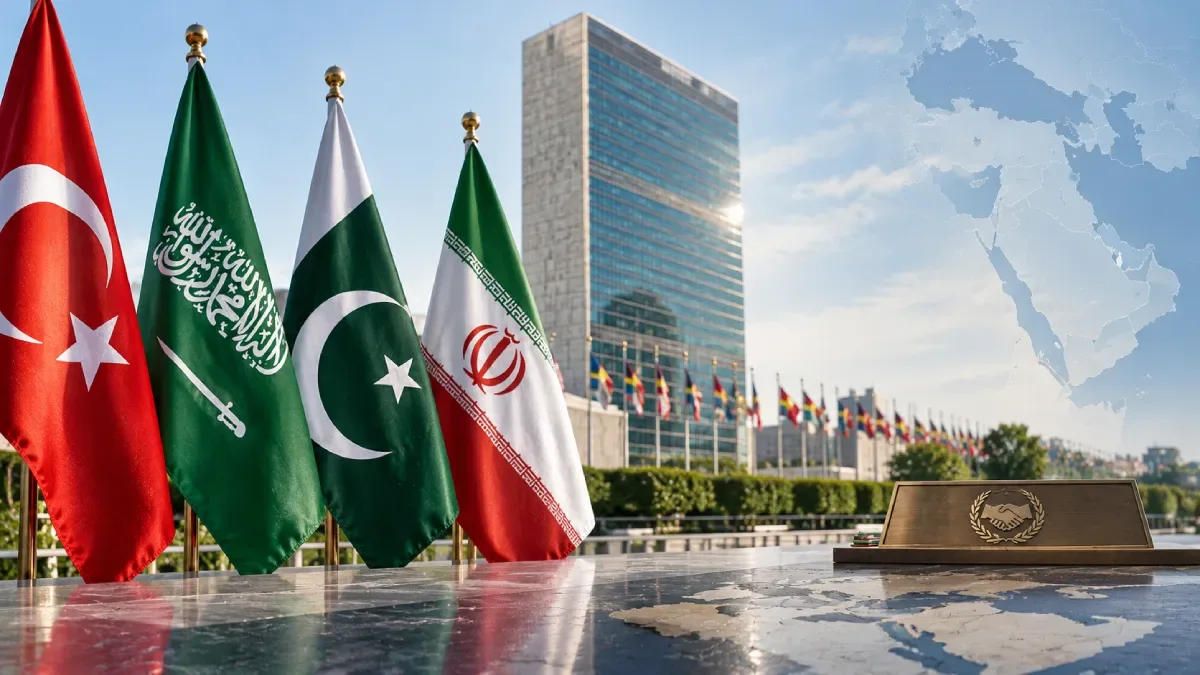
The Mecca Pact moved into a more concrete institutional phase in New York on September 25, as the foreign ministers of Türkiye, Saudi Arabia and Pakistan reviewed progress on establishing the agreement's General Secretariat, committees and working groups. The meeting was held on the margins of the 81st United Nations General Assembly, where Foreign Minister Hakan Fidan also met his Iranian counterpart Abbas Araghchi at the Turkish House.
The institutional work had already advanced before the New York meeting. Pakistan appointed retired Lt. Gen. Nauman Mahmood as the pact's first Secretary-General on September 23. He will lead the General Secretariat being established in Riyadh. Two days later, the three foreign ministers discussed preparations for the Secretariat's work as well as an urgent meeting of the three countries' chiefs of staff to examine ways to assist Saudi Arabia under the agreement.
The military track follows Fidan's September 19 statement that detailed work on the Secretariat and an associated military headquarters was almost complete, with personnel assignment and the headquarters' operation as the next stage. He also said the pact was open to other countries in the region once its institutional structure was in place.
That expansion principle was part of the pact's design from the outset. After the first Strategic Political and Defense Committee meeting in Istanbul on August 31, Fidan said the alliance had been established with expansion in mind, with additional countries able to join if they met conditions and standards agreed by the existing members.
Iran has meanwhile voiced support for wider participation. President Masoud Pezeshkian said on August 31, during a meeting with Pakistani Prime Minister Shehbaz Sharif, that the joint action by Pakistan, Saudi Arabia and Türkiye under the Mecca Agreement was a step toward strengthening unity in the Muslim world. He expressed hope that other regional and Islamic countries would join the process and said cooperation could expand beyond defense into political, economic and cultural fields.
Pezeshkian did not announce an Iranian bid to join the pact. His remarks placed Tehran in favor of a broader participation model while the three founding states were still putting the agreement's institutions into operation.
The enlargement question also extends beyond Iran. Egypt presents a separate case because of its relations with Greece and Cyprus, giving the Egypt expansion question a direct Eastern Mediterranean dimension.
Fidan said on September 19 that Türkiye maintains contact with the parties involved in the Iran-US conflict and rejected treating attacks on Saudi Arabia as part of that confrontation. He said Mecca Pact members were holding consultations that had not been made public and that Türkiye could meet certain technical military needs if required.
President Recep Tayyip Erdoğan addressed the pact's relationship with Iran in a September 25 interview with Newsweek. He said the Mecca Joint Defense Agreement should not be viewed as an alliance established against Iran, Israel or any third country. He also said Türkiye's channels with Iranian counterparts remain open and that Ankara is using its contacts with the parties to reduce tensions.
Erdoğan said the agreement is based on Article 51 of the UN Charter. An armed attack against one of the three states is treated as an attack against all parties, while the form of assistance would depend on the attacked country's needs and decisions taken through the pact's political and military mechanisms. He said no automatic military scenario had been predetermined for possible attacks involving Iran or its partners in Iraq or Yemen.
On September 25, the pact's three foreign ministers were dealing with an institution that already had its first Secretary-General, a Secretariat being established in Riyadh and an associated military headquarters moving toward operation. At the same meeting, they prepared for an urgent chiefs-of-staff session on support for Saudi Arabia, while Iran was publicly calling for wider participation.
Sources: Türkiye's Ministry of Foreign Affairs, Government of Pakistan, Türkiye's Directorate of Communications, Tasnim News Agency, Bosphorus News review and reporting.