
By Bosphorus News Geopolitics Desk
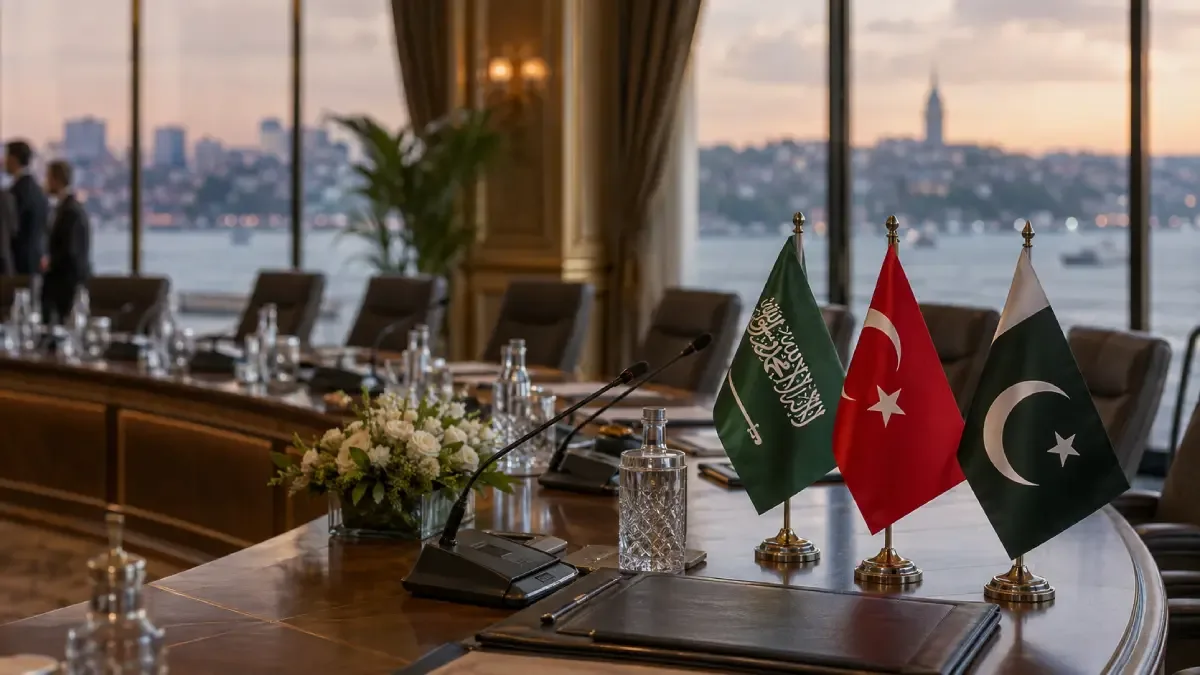
Türkiye, Saudi Arabia and Pakistan intend to expand the Mecca Defense Alliance beyond its three founding states, Turkish Foreign Minister Hakan Fidan said Monday after the alliance held its first high-level committee meeting in Istanbul.
"It is an alliance that has been established to expand but first we have to take care of the institutionalization of the alliance," Fidan told a news conference attended by a Bosphorus News correspondent.
The three countries signed the Mecca Joint Defense Agreement on August 7, committing themselves to regard an armed attack on one as an attack on all. Monday's meeting brought together their foreign and defense ministers and military chiefs for the inaugural session of the Strategic Political and Defence Committee established under the agreement.
Fidan said other countries could join if they met conditions to be set by the alliance.
"The participation of other countries to our alliance is by the nature of the agreement possible under certain conditions and standards," he said.
Riyadh to Host Secretariat
The Istanbul meeting produced the first decisions on the alliance's institutional structure.
Fidan said the three countries had agreed on the name Mecca Defense Alliance and envisaged establishing its secretariat in Riyadh. There was also general agreement that the first secretary-general would be Pakistani.
The committee also began setting the sequence and timetable for the alliance's next steps. Before the meeting, Turkish officials said the agenda would include military interoperability, defense capacity, joint production, research and development, counterterrorism cooperation and the mechanisms needed to implement decisions taken by the three governments.
Fidan described the alliance as defensive and said it was not directed against a particular country. Türkiye has also rejected suggestions that the arrangement is intended as an alternative to NATO, where it remains a member.
The agreement nevertheless creates a separate collective-defense commitment among three states with different existing security relationships. Türkiye belongs to NATO, while Saudi Arabia and Pakistan maintain longstanding defense ties with the United States without belonging to the alliance.
Membership Debate Moves Quickly
Interest from potential new members has emerged before the three founders have finished building the alliance's institutions.
Pakistani Foreign Minister Ishaq Dar said during a visit to Britain over the weekend that six or seven Muslim-majority countries had expressed interest in joining. He did not identify them.
Pakistan's Foreign Ministry had already said the agreement was open to countries willing to share the obligations and security interests of the founding states, adding that any formal request would be considered in consultation with Riyadh and Ankara.
Bangladesh has also entered the public discussion. Bangladeshi officials have said Dhaka is examining the pact positively, although no formal accession has been announced.
The distinction matters because expressions of interest do not amount to applications, and the alliance has yet to publish the standards Fidan said prospective members would have to meet.
Egypt Is the Most Explicit Candidate
Egypt remains the country Türkiye has identified most clearly as a prospective member.
During an August 13 visit to Egypt, Fidan called Cairo a "natural partner" and said he hoped it would become a formal partner. Egyptian officials have said they are studying the agreement while examining the legal, constitutional and technical obligations that membership could create.
Cairo presents a harder case than countries that have only expressed preliminary interest. Egypt already works with Türkiye, Saudi Arabia and Pakistan in the Regional Four consultation mechanism, but it also maintains defense, maritime and energy relationships with Greece and the Republic of Cyprus.
Bosphorus News examined the obstacles facing Egyptian accession on August 29, including the commitments Cairo would have to reconcile if it chose to join.
Fidan's comments in Istanbul remove any ambiguity over whether the founders see the Mecca arrangement as a closed three-state pact. Expansion is part of its design. The immediate work is institutional: establishing the Riyadh secretariat, appointing the first secretary-general and defining the conditions under which additional countries could enter.
Sources: Bosphorus News correspondent in Istanbul, Türkiye's Foreign Ministry, Türkiye's Defense Ministry, Pakistan's Foreign Ministry, Saudi official statements, Bosphorus News review and reporting.