
By Murat Yıldız
November 20, 2026
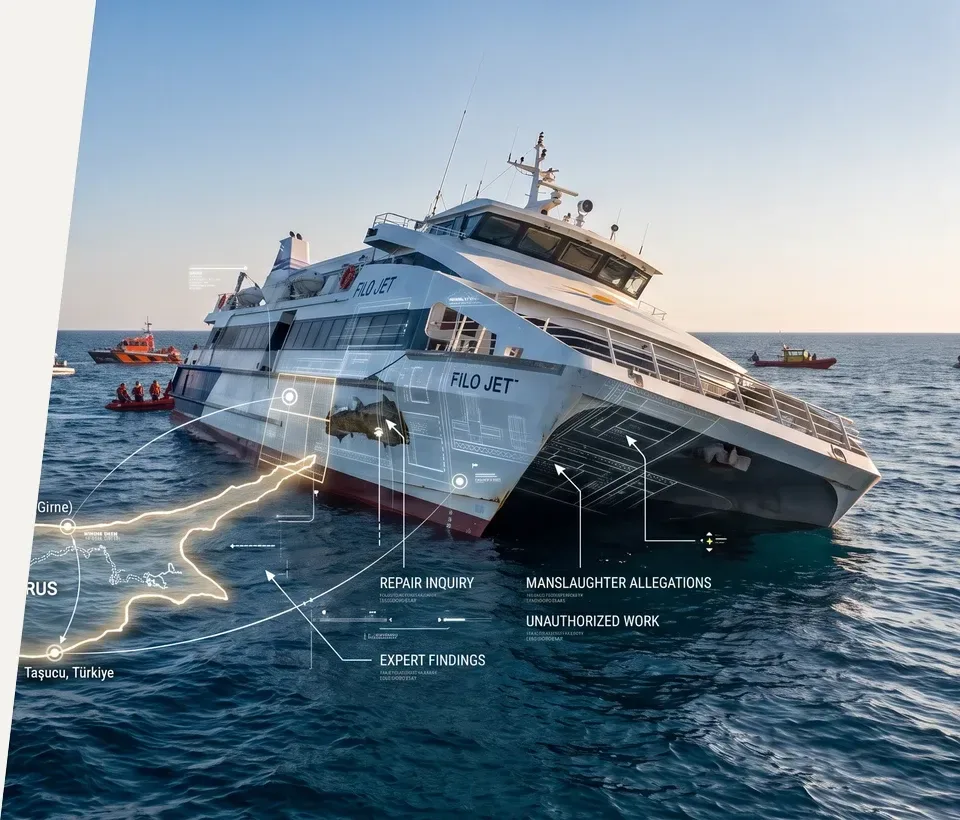
On November 20, 2026, the investigation into the sinking of Filo Jet took a significant turn when police presented expert findings to Kyrenia District Court linking the disaster to damage sustained by the vessel and subsequent repairs carried out by personnel allegedly lacking the necessary authorization. The findings have placed the company's maintenance decisions under closer scrutiny, with nine suspects now being investigated for manslaughter over the August 30 sinking of the passenger catamaran off northern Cyprus.
The court ordered the company's director, two captains, two engineers and four crew members to remain in police custody for another three days. The investigation, previously conducted under Section 210 of the Turkish Cypriot Criminal Code concerning death caused by carelessness or negligence, now involves allegations under Section 205, which covers manslaughter, including criminally negligent omissions. Premeditated murder is addressed separately under Section 203.
The revised allegations follow months of testimony about equipment problems, maintenance work and the crew's conduct during the ferry's final voyage from Kyrenia to Taşucu in Türkiye. The latest expert assessments have brought those issues into a more detailed examination of how the vessel was repaired, who authorized the work and whether the condition of its structure was properly assessed before it continued operating.
Expert findings bring June repairs into focus
Assistant Inspector Mehmet Mannaş told the court that two expert assessments had examined the circumstances of the sinking. According to his testimony, one report attributed the loss of the vessel to damage it had sustained, while the second connected the disaster to repairs performed by personnel who lacked the required authorization.
Mannaş also said the repair involved unsuitable materials and should have been carried out at a shipyard. The experts' findings, presented through police testimony, have given investigators a more specific basis for examining the decisions surrounding the work and the company's knowledge of the vessel's condition.
The complete reports have not been released publicly.
Mannaş said materials used in the repairs had been purchased on June 13. Earlier proceedings had identified WhatsApp photographs dated June 17 showing repair work on damage to the catamaran's left forward section.
The dates help establish part of the maintenance chronology, although the photographs do not establish when the damage first occurred. Investigators are examining the purchases, the work itself and the instructions given to those involved.
Police also alleged that the company's director knew about the repair expenditure, while the first captain and members of the crew serving at the time participated in the work. Their respective roles are being examined alongside the question of whether damage requiring specialist intervention was reported to the competent maritime authorities.
The June chronology also brings Filo Jet's earlier inspections into focus.
Türkiye's Ministry of Transport and Infrastructure confirmed in parliamentary answers that Türk Loydu conducted technical checks on the vessel on June 2, following a shipyard period. That inspection preceded the repair activity now under examination in Kyrenia.
The ministry's parliamentary answers concerning the vessel's inspections and route approvals identified the June 2 control but did not provide the detailed survey findings or records of subsequent repairs.
Whether Türk Loydu or the competent maritime administration was informed of the later damage and repair work has become a central question alongside the expert findings presented in court.
Watertight doors, crew duties and electronic evidence
The investigation also covers the condition of Filo Jet's watertight compartments and the crew's response during the emergency. Mannaş told the court that expert assessments had examined the vessel's watertight doors and the movement of water through its structure during the sinking.
Police are examining allegations that some crew members failed to close watertight doors while others did not carry out their assigned emergency duties. Investigators have reviewed duty schedules, technical documents and witness statements to reconstruct what happened aboard the catamaran and establish the responsibilities of individual officers.
The court also heard that the allocation of duties in the available schedules was not sufficiently clear, requiring police to establish individual responsibilities through statements and other evidence.
Company management faces a related line of inquiry concerning the reporting of damage and the authorization of maintenance work.
Electronic correspondence has become another part of the investigation. According to Mannaş, the second captain had referred to repair photographs exchanged by email, but investigators encountered difficulties retrieving the relevant communications.
Police said one account had been closed and that attempts to access another had been unsuccessful. Defense lawyers questioned how investigators had established the closure of the first account.
The correspondence may help determine when information about the damage reached company officials, who received the photographs and what instructions followed. Defense lawyers have also contested the connection drawn between earlier technical problems and the sinking.
Mersin complaint advances as the inquiry extends into Türkiye
The developments in Kyrenia coincide with progress in the separate legal initiative brought by survivors and victims' relatives in Türkiye. Speaking after Friday's hearing, lawyer Berkan Aydoğan said the criminal complaint filed with the Mersin Chief Public Prosecutor's Office on November 4 had received an investigation number.
The complaint seeks an examination of corporate relationships, maintenance arrangements and regulatory oversight associated with Filo Jet's operations in Türkiye. Aydoğan welcomed the findings presented in Kyrenia, arguing that they supported the families' concerns about the vessel's condition and the decisions taken before its final voyage.
The procedural development comes as police in northern Cyprus continue seeking statements and evidence from individuals in Türkiye. Some statements have already been obtained, while efforts to reach others are ongoing.
The Mersin proceedings and the Kyrenia investigation remain legally separate, although both concern aspects of the vessel's maintenance history and the responsibilities of those involved in its operation.
The new repair evidence also gives added relevance to the documentation held by maritime authorities, particularly the June technical checks and subsequent maintenance records. Establishing what was reported to the relevant institutions, and when, is now an important part of reconstructing the events that preceded the sinking.
Şampiyon Melekler returns to service after engine failure
The operator has also faced renewed scrutiny following a separate incident involving Şampiyon Melekler, another vessel in the Filo Denizcilik fleet. The cargo-passenger ship lost propulsion off the Karpaz peninsula on November 17, less than two months after returning to service following a four-day Türk Loydu inspection in September.
In a statement issued on November 19, Filo Denizcilik said the mechanical problem had been repaired under Türk Loydu supervision and that the vessel had resumed operations that morning.
The company maintained that the failure had no technical or legal connection to the Filo Jet disaster and announced that procedures had begun to rename the ship following a request from the Şampiyon Melekler Association.
The November 17 engine failure and the vessel's earlier inspection history had already drawn attention to the operator's maintenance arrangements. The latest company statement provides an account of the repair and return to service, although the detailed November survey findings and sailing assessment have not been publicly disclosed.
The incidents involve different vessels and technical circumstances. The latest breakdown has nevertheless renewed attention to the operator's inspection and maintenance practices as the Filo Jet inquiry examines how earlier damage was repaired and documented.
The decisions before Filo Jet's final voyage
The August 30 disaster involved 267 people. Twenty-seven bodies have been recovered, while three-year-old Anni Asel Hilaloğlu remains missing. Police told the court on Friday that efforts to locate her were continuing.
The nine suspects are expected to return to court following the three-day extension of their detention, with the expert assessments placing Filo Jet's repair history among the principal issues in the investigation.
The examination now extends across the vessel's damaged structure, watertight compartments, maintenance records and the responsibilities of those who ordered, carried out or supervised the work.
The complete expert reports, purchase records, repair documentation and related correspondence will be particularly important in reconstructing that sequence. They may establish when the damage occurred, how it was addressed and whether information about the vessel's condition reached the authorities responsible for its technical oversight.
The findings presented on November 20 have given the investigation a clearer direction. Alongside the actions taken during the emergency, investigators are now examining the maintenance decisions made weeks before Filo Jet sailed from Kyrenia, the information available to company management and the circumstances in which the vessel continued operating after the disputed repairs.
Sources: Türk Ajansı Kıbrıs, BRTK, MHA Haber, Kıbrıs Postası, Bugün Kıbrıs, Turkish Cypriot Criminal Code (Chapter 154), Filo Denizcilik statement of November 19, Kyrenia District Court proceedings, Türkiye's Ministry of Transport and Infrastructure parliamentary answers, Bosphorus News review and reporting.