
By Murat Yıldız
The European Union (EU) renewed its existing Eastern Mediterranean sanctions framework three days before Parliament called for further measures against the 2019 maritime agreement.
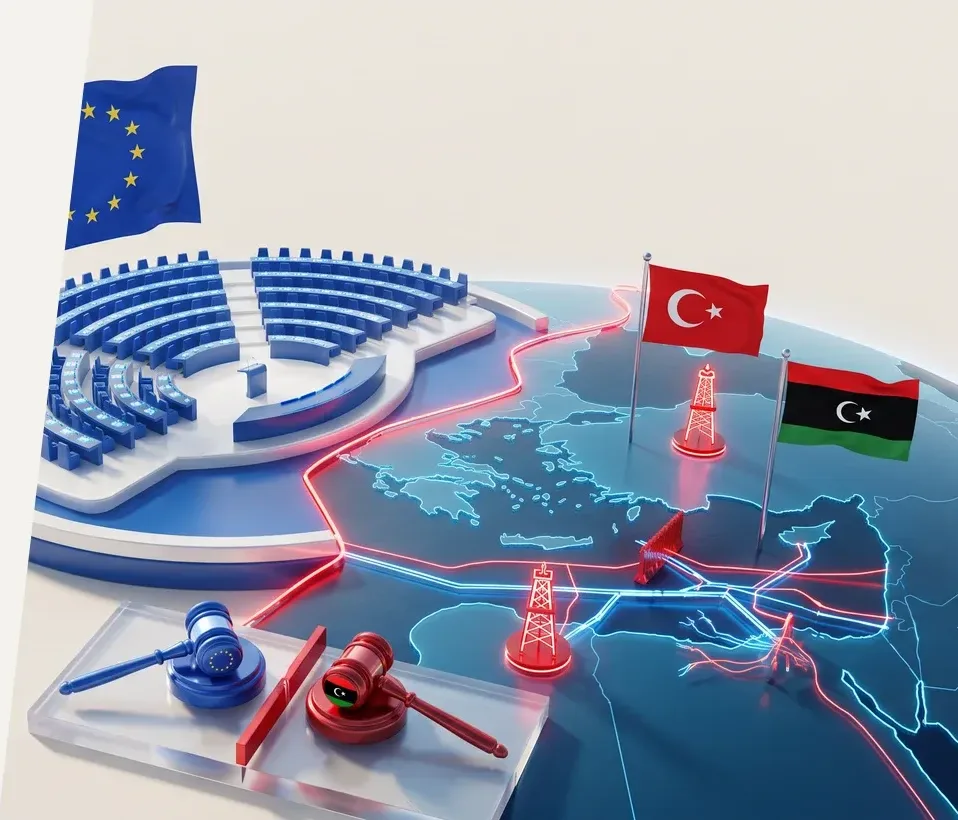
On November 26, 2026, the European Parliament adopted a resolution calling for consideration of targeted EU sanctions, a review of EU funding and maritime defense planning in response to the Türkiye-Libya maritime delimitation agreement. Türkiye's Foreign Ministry rejected the resolution later that day as biased and unfounded, arguing in Statement No. 230 that the EU has no competence to delimit maritime jurisdiction areas.
The eight-page, non-binding resolution, P10_TA(2026)0411, contains 25 operative paragraphs. It does not invalidate the 2019 bilateral agreement, determine maritime boundaries, impose sanctions or activate the EU's mutual assistance clause.
Libya's ratification and wider regional opposition
The European Council first rejected the 2019 memorandum in December 2019 as incompatible with the law of the sea and an infringement of third states' sovereign rights, reaffirming that stance in June 2025. The EU reiterated its objections on October 21, 2026, following the Libyan parliament's ratification vote.
On November 25, eastern Libya's House of Representatives published Law No. 8 of 2026 in Issue 17 of its Official Gazette, accompanied by a map and geographic coordinates. The law followed the parliament's unanimous ratification of the 2019 agreement on October 20 and reversal of its 2020 rejection resolutions. That day in Ankara, President Recep Tayyip Erdoğan received Libyan National Army commander Field Marshal Khalifa Hafter. Erdoğan had met Tripoli-based Prime Minister Abdul Hamid Dbeibeh in Antalya on November 12. Turkish Foreign Minister Hakan Fidan and National Intelligence Organization chief İbrahim Kalın met Dbeibeh in İstanbul on November 21.
The European Parliament considers the memorandum invalid under international law and rejects any legal effect on third states. It expresses full solidarity with Greece and the Republic of Cyprus and maintains that Libya's ratification cannot remedy the alleged violations. The resolution cites a January 27, 2021 judgment by Libya's Al-Bayda Appeals Court against the memorandum. The text does not establish how the 2026 legislation affects that earlier court ruling under Libyan domestic law.
With the publication of the ratification law in eastern Libya, Türkiye now has broader political backing inside Libya for the agreement. The competing maritime claims remain unresolved, and opposition to the pact extends beyond Greece and the Republic of Cyprus. On October 26, 2026, Egypt, Bahrain and the United Arab Emirates joined Greece, the Republic of Cyprus and the EU in a joint statement at the United Nations (UN) rejecting the pact.
Maritime entitlement, consent and delimitation
Maritime entitlement and delimitation are distinct legal questions. A coast may generate entitlements without receiving full effect when a boundary is drawn.
Article 121 of the United Nations Convention on the Law of the Sea (UNCLOS) grants islands the same maritime entitlements as other land territory, subject to Article 121(3), under which rocks incapable of sustaining human habitation or an economic life of their own generate no exclusive economic zone (EEZ) or continental shelf, although such rocks may have a territorial sea. Articles 74 and 83 require the delimitation of EEZs and continental shelves to achieve an equitable solution.
International jurisprudence allows the effect given to islands in delimitation to vary with geography and other relevant circumstances. It provides no general rule for disregarding island coasts.
Paragraph 6 of the European Parliament resolution recognizes the maritime entitlements of Crete and the Dodecanese and separately addresses the delimitation of overlapping entitlements. Paragraph 8 supports Greece's right under UNCLOS to extend its territorial waters to 12 nautical miles. Neither paragraph prescribes a specific boundary or mandates full delimitation effect for every Greek island.
Türkiye has neither signed nor ratified UNCLOS, while Libya has signed but not ratified it. Both remain subject to applicable customary international law. Their bilateral agreement was registered with the UN on December 11, 2019, under registration number 56119. Under Article 102 of the Charter of the United Nations, registration allows an agreement to be invoked before UN organs; it does not confer judicial endorsement of its validity or determine third states' rights.
Paragraph 9 invokes the principle reflected in Article 34 of the 1969 Vienna Convention on the Law of Treaties, under which treaties do not create rights or obligations for third states without their consent. Although Türkiye is not a party to the Vienna Convention, the third-party consent rule reflects customary international law. Turkish officials maintain that Türkiye and Libya lawfully negotiated the agreement as consenting coastal states. They reject maritime boundaries imposed without Türkiye's consent. Greece and Egypt object to a boundary drawn without their participation across waters they claim. Article 34 alone does not settle which state holds the underlying entitlements.
The Aegean and the limits of EU jurisdiction
The resolution also condemns Türkiye's marine parks beyond territorial waters, competing maritime spatial plans, certain navigational notices and its 1995 parliamentary casus belli warning regarding a possible Greek extension of Aegean territorial waters to 12 nautical miles. These disputes engage different rules of international law.
Greece's maritime spatial planning is governed by EU Directive 2014/89/EU. Article 2(4) of that directive expressly excludes any effect on the delineation and delimitation of maritime boundaries by member states under UNCLOS. Neither Greek maritime plans under EU law nor Turkish planning and environmental designations can establish a disputed international boundary unilaterally. International law allows coastal states to exercise environmental jurisdiction in their EEZs. The location of the maritime boundary and the legality of the measures themselves must therefore be considered when assessing marine parks beyond territorial waters.
Türkiye's Foreign Ministry argued on November 26 that the EU has no competence to delimit maritime jurisdiction areas, referring to the case law of the Court of Justice of the European Union. In its January 31, 2020 judgment in Slovenia v Croatia (Case C-457/18), the Grand Chamber declined jurisdiction over an action under Article 259 of the Treaty on the Functioning of the European Union (TFEU) that depended on resolving a boundary dispute between the two member states. Paragraph 107 explains the limits of the court's jurisdiction in that case. The judgment provides legal context for Türkiye's objection to EU competence over maritime delimitation, without ruling on the Türkiye-Libya agreement.
Türkiye's National Security Council called for dialogue and diplomacy in the Aegean and Eastern Mediterranean on November 26, maintaining that Türkiye would not relinquish its rights under international law. Its communiqué also addressed Libya's unity and territorial integrity.
Sanctions, hydrocarbon deals and funding conditions
Paragraph 18 calls on the Council of the EU to consider targeted restrictive measures against individuals or entities responsible for implementing the memorandum in ways that infringe member states' sovereign rights, should such activities occur or persist. The resolution contains no sanctions list and imposes no restrictions. EU foreign policy sanctions generally require a unanimous Council decision under Article 29 of the Treaty on European Union (TEU), followed, where necessary, by implementing regulations adopted by qualified majority under Article 215 TFEU.
On November 23, the Council adopted Decision (CFSP) 2026/2621 under the EU's Common Foreign and Security Policy, extending Decision (CFSP) 2019/1894 concerning unauthorized drilling in the Eastern Mediterranean through November 30, 2027. Published in the Official Journal on November 24, the decision changed only the expiry date and added no names. The Council confirmed in December 2025 that the list was empty.
The existing listing criteria concern hydrocarbon drilling without authorization from the Republic of Cyprus in maritime areas covered by the decision, as well as specified forms of support for such activities. They do not automatically cover every activity under the Türkiye-Libya agreement. Any broader sanctions would require an appropriate legal basis and a separate Council decision.
Paragraphs 10 and 11 call on Türkiye and Libya to rescind the memorandum and related hydrocarbon arrangements and to refrain from issuing or implementing licenses, seismic survey permits and drilling authorizations based on the memorandum in areas overlapping with the maritime entitlements of Greece or other third states. Paragraph 15 requests a review of financial cooperation with Türkiye and Libya. Parliament wants funds that support implementation of the memorandum in breach of member states' sovereign rights suspended or redirected. It explicitly protects humanitarian assistance and support benefiting civilians.
Paragraph 22 calls for compliance with international law, including UNCLOS, respect for member states' sovereign rights and good neighborly relations to become explicit conditions in all future EU agreements with Libya.
Article 42(7), IRINI, ASPIDES and the Great Sea Interconnector
Paragraph 17 asks the Council and the EU's foreign policy chief to develop arrangements for applying Article 42(7) TEU, the EU's mutual assistance clause, including in maritime scenarios. The treaty obliges member states to assist a member subjected to armed aggression on its territory, using all means in their power. Assistance is intergovernmental; the clause establishes no automatic EU military command. The treaty also requires consistency with commitments under the North Atlantic Treaty Organization (NATO), which remains the foundation of collective defense for EU members in the alliance. Greece is a member of both organizations; Türkiye belongs to NATO. Parliament also calls for consequences for the EU's cooperative relations with Türkiye and Libya in the event of such aggression.
France invoked the clause following the November 2015 Paris attacks. An EEZ dispute, navigational notice or seismic survey does not in itself meet the threshold for invoking Article 42(7). Sovereign rights over seabed resources remain distinct from sovereignty over territorial waters.
The resolution names the Great Sea Interconnector, the planned electricity link between Greece and the Republic of Cyprus. Lawmakers criticize Türkiye's actions during the July 2024 seabed survey near Kasos and call on Ankara to refrain from interfering with cable installation in sectors where Türkiye disputes Greek maritime jurisdiction. Paragraph 16 cites the EU Naval Force operation ASPIDES as a model for stronger maritime security capabilities to protect subsea infrastructure, energy routes and navigation. The resolution does not authorize an ASPIDES deployment in the Eastern Mediterranean.
On November 25, EU foreign policy chief Kaja Kallas confirmed in Barcelona that the extended mandate of Operation IRINI covers protection of undersea infrastructure. As examined in the November 25 Eastern Mediterranean Strategic Brief, that mandate does not establish a specific escort arrangement for the interconnector. The resolution also links the maritime agreement to the UN arms embargo on Libya and criticizes Türkiye's cooperation with IRINI. An alleged embargo violation requires evidence of prohibited conduct. The validity of a maritime boundary agreement is a separate legal question.
The February report and maritime negotiations
Paragraph 24 asks the European Commission and Kallas to report to Parliament within three months, around February 26, 2027, on diplomatic action, EU funding safeguards and further proposed measures.
Parliament also supports Greek-Libyan delimitation talks and judicial or arbitral settlement where jurisdiction exists. A binding settlement of the disputed boundaries would require agreement between the relevant coastal states or a decision by a tribunal with jurisdiction.
The requested report is Parliament's mechanism for assessing diplomatic action and funding safeguards. Any new sanctions require a Council decision, and maritime-law conditions for future EU agreements with Libya would have to be incorporated into the agreements themselves. Neither measure was enacted by the November 26 resolution.
Sources: European Parliament resolution P10_TA(2026)0411, Council Decisions (CFSP) 2026/2621 and 2019/1894, Ministry of Foreign Affairs of Türkiye (Statement No. 230), Presidency of the Republic of Türkiye, National Security Council of Türkiye, European Council and Council of the European Union, European Commission, Treaty on European Union, Treaty on the Functioning of the European Union, Directive 2014/89/EU, Charter of the United Nations (Article 102), United Nations Convention on the Law of the Sea, United Nations Treaty Collection, Vienna Convention on the Law of Treaties, Court of Justice of the European Union (Case C-457/18), European External Action Service, Libyan News Agency, Bosphorus News review and reporting.