
By Bosphorus News Geopolitics Desk
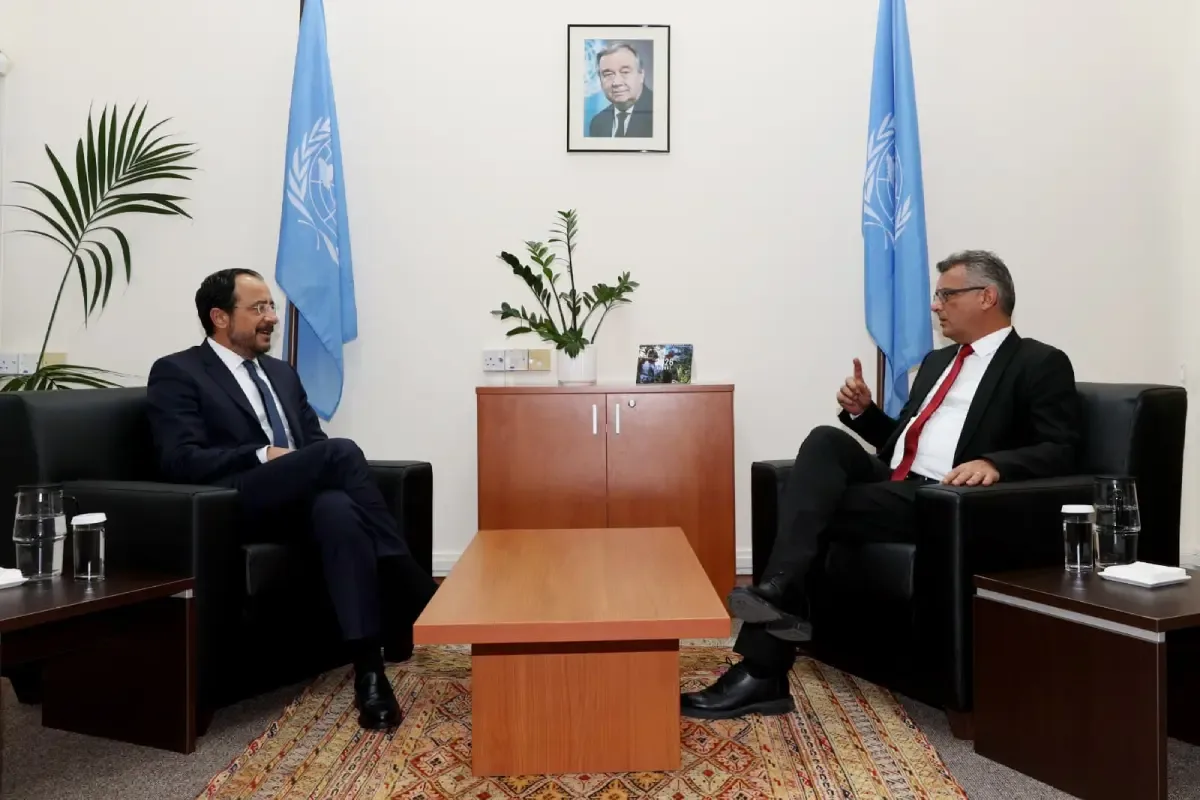
Turkish Cypriot leader Tufan Erhürman and Republic of Cyprus President Nikos Christodoulides agreed Wednesday to meet at least once a week, giving the United Nations process a regular leaders-level schedule while Secretary-General António Guterres keeps another expanded meeting conditional on further preparation.
Their nearly three-hour meeting in the United Nations Protected Area included a one-on-one session but produced no publicly announced agreement on crossing points, demining, negotiating methodology or the substantive settlement file. The joint statement instead recorded the weekly schedule and one further step in an earlier agreement to bring civil society into the process.
Weekly Meetings Give the UN Roadmap a Schedule
The United Nations (UN) said the leaders reviewed progress on the way forward defined during Guterres' July visit and agreed to intensify their meetings, gathering once a week and more frequently when circumstances require.
Guterres set the terms on July 29. Another 5+1 would follow only after adequate preparation on confidence-building measures, methodology and substance, taking account of convergences reached in earlier negotiations.
The format brings together the two Cypriot sides, guarantor powers Türkiye, Greece and the United Kingdom, and the UN.
Guterres said he had the consent of the sides and guarantors to move toward another expanded meeting but left the date open. He made clear that sufficient preparation was needed to avoid another 5+1 ending without results and to give a future gathering a realistic chance of opening the way toward a settlement.
He also said no joint Cyprus meeting was scheduled during the UN General Assembly High-Level Week in September. Christodoulides has since said that he and Erhürman are expected to meet Guterres separately in New York.
Erhürman had already called for weekly leaders' meetings after Guterres' visit, describing confidence-building measures, methodology and substance as the work that had to be completed before the next 5+1.
The August 26 agreement now gives that work a regular timetable.
Erhürman Leaves Without a Separate Public Account
The two leaders handled the end of the meeting differently.
Christodoulides spoke to reporters as he left the UN Good Offices Mission, saying the process had started on a good path. Erhürman left without commenting.
The Turkish Cypriot Presidency later confirmed that the meeting had lasted nearly three hours and that the leaders had also met one-on-one. Its account reproduced the UN statement without adding a separate political assessment from Erhürman.
His silence came after weeks in which he had publicly pressed the case for weekly meetings, a defined methodology and measurable preparation before another formal negotiating round.
Wednesday evening therefore produced a common UN account and a separate interpretation from Christodoulides, but none from Erhürman.
Crossings, Demining and Methodology Stay Outside the Statement
The joint statement does not mention new crossing points, demining, a broader confidence-building package, methodology, substantive settlement questions or a date for another 5+1.
Crossings had been one of the principal files ahead of the meeting. They did not appear in the post-meeting text.
More frequent political contact has been agreed, but formal negotiations have not resumed. That follows the sequence Guterres established in July: preparatory work first, another 5+1 if that work advances far enough, and only then the possibility of moving back into substantive negotiations.
The difficulty is that the next round would begin with more unresolved political, security and regional files surrounding it than earlier Cyprus efforts.
Demining Remains Unfinished
Mine clearance shows how far an agreed confidence measure can remain from implementation.
The UN Secretary-General's January 5 report on the United Nations operation in Cyprus, S/2026/8, records demining among the trust-building initiatives already accepted in principle. The same report says 29 suspected hazardous areas remained uncleared across the island, including four active minefields inside the buffer zone, three under the National Guard and one under Turkish forces.
The dispute now concerns scope.
Erhürman has said the Turkish Cypriot side accepted a UN proposal beginning with clearance inside the buffer zone and extending later to other parts of the island, while Christodoulides rejected the broader approach on security grounds. Neither the UN nor the Republic of Cyprus has publicly confirmed that account.
The disagreement over how far the Cyprus demining plan should extend remains unresolved, and Wednesday's statement contains no new agreement on the file.
Confidence Measures Run Alongside Disputed International Contacts
The UN is asking the two sides to build confidence while a separate dispute is running over Turkish Cypriot access to diplomatic, cultural and sporting contacts.
The Republic of Cyprus Foreign Ministry contacted diplomatic missions before a briefing by Erhürman's undersecretary Mehmet Dânâ at the Home for Cooperation in the UN buffer zone, urging them not to attend. The briefing went ahead.
Days later, Democratic Rally (DISY) member of the European Parliament Loukas Fourlas wrote to Serbian President Aleksandar Vučić over the Nexus electronic music festival planned near Kyrenia Castle. Fourlas chairs the European Parliament's Delegation to the European Union-Serbia Stabilisation and Association Parliamentary Committee and asked Vučić to intervene to prevent the event.
Serbian festival company EXIT formally announced its withdrawal on August 20. It said Nexus was part of its international program and that, after consultations, it had come to understand more fully the historical and political sensitivity surrounding Kyrenia and the castle.
Kyrenia Mayor Murat Şenkul later announced that the event had been cancelled and attributed the outcome to political pressure through Serbia. The National Popular Front (ELAM) separately said its own interventions had contributed to the cancellation.
The same dispute then moved into football.
FC Barcelona's official website still lists a Barça Academy "Lefkosa Camp" at Near East University on September 7-11 and September 16-20, with the location given as "Lefkosa, Northern Cyprus."
Cyprus Football Association (CFA) President Haris Loizides wrote to Royal Spanish Football Federation President Rafael Louzán asking him to intervene. The CFA said it had acted in consultation with the Union of European Football Associations (UEFA) and wanted the camp moved to a location it considers legally compatible or cancelled.
ELAM separately called on the Spanish government to intervene.
Erhürman addressed the Barcelona issue on Wednesday morning. He argued that foreign young people, artists and clubs taking part in events in northern Cyprus does not amount to recognition of the Turkish Republic of Northern Cyprus, just as Greek Cypriot young people attending events in Türkiye does not mean Türkiye recognises the Republic of Cyprus government.
He said cancelling a festival or trying to prevent children from playing football was "not a diplomatic victory" but a defeat for people on both sides.
Days earlier, after the diplomatic briefing and festival disputes, Erhürman had said attempts to "render Turkish Cypriots invisible" harmed efforts toward a settlement rather than helping them.
Christodoulides set out the opposing argument before Wednesday's meeting. Asked about Turkish Cypriot complaints over the cancellation of international festivals, he separated what he described as illegality and unlawful actions from efforts to restart talks and reach a Cyprus settlement.
Republic of Cyprus Government Spokesman Konstantinos Letymbiotis has made a related point on confidence-building measures, arguing that they are not an end in themselves and that the objective remains a return to the substance of the Cyprus problem.
The disagreement reaches beyond individual festivals, briefings or football camps. Erhürman says international participation does not constitute recognition and that restricting such contacts damages confidence between the communities. Christodoulides treats activities his side considers unlawful as separate from negotiations, while the Republic of Cyprus government argues that confidence measures cannot replace substantive talks.
These disputes carry less negotiating weight than crossings, demining or methodology, but they sit inside the political environment in which Guterres is asking the leaders to rebuild trust.
Past Convergences Enter the Preparatory File
The UN is also compiling the record of convergences reached in previous negotiations.
Guterres said another 5+1 should be prepared with those convergences in mind.
Christodoulides said before Wednesday's meeting that the work was at an advanced stage and that María Ángela Holguín Cuéllar, the UN Secretary-General's Personal Envoy on Cyprus, was expected back on the island in early September.
The UN has not announced that the document is complete or formally distributed.
Holguín has argued against reopening years of earlier negotiating work from the beginning. The convergences do not amount to a final agreement, but preserving what has already been negotiated could reduce the ground that would have to be covered again if substantive talks resume.
Her expected return coincides with the leaders beginning their weekly schedule.
Türkiye's 'No Common Ground' Position Has Not Disappeared
The new schedule does not resolve the disagreement over the basis of a settlement.
After Guterres' July visit, Türkiye said there was still no common ground between the two sides and argued that approaches pursued over previous decades had failed to produce an agreement. Ankara supported further engagement and practical cooperation while maintaining its position on the political basis of a future settlement.
That position has remained in place since Guterres began preparing another 5+1 despite Ankara's assessment that no common ground yet exists.
Erhürman has focused heavily on methodology, arguing against another open-ended negotiating exercise and calling instead for conditions capable of producing a result to be settled before a new formal process begins.
Weekly meetings fit that procedural approach. They do not alter the positions over the ultimate negotiating basis.
The EU Remains Inside the UN Framework
The European Union (EU) has increased its involvement without creating a separate negotiating channel.
The European Commission designated Executive Vice-President for Cohesion and Reforms Raffaele Fitto as its Special Representative for Cyprus in July. His mandate places his work within the UN framework and in close cooperation with Holguín.
Fitto met both leaders on July 31.
After their meeting, Erhürman said the EU could not participate as a party at a future negotiating table but could contribute on confidence-building measures connected to EU responsibilities. He raised the Direct Trade Regulation, implementation of the Green Line Regulation and issues involving EU citizenship and property rights of Turkish Cypriots.
The Commission has given Fitto a supporting role: engaging the sides, assisting preparations for renewed negotiations and working alongside the UN.
No new European Commission statement responding specifically to Wednesday's leaders' meeting had been issued by publication.
Civil Society Body Moves to Its Next Stage
The other concrete item in Wednesday's UN statement concerns the Civil Society Consultative Body.
The leaders agreed that members of its Steering Committee would be announced on August 27.
The consultative body predates Wednesday's meeting and forms part of the wider UN effort to involve actors outside the formal negotiating teams. Guterres also met civil society, women and youth representatives during his July visit, alongside the bicommunal technical committees handling practical cooperation across the island.
The Steering Committee announcement moves that earlier agreement closer to operation.
Weekly Meetings Begin, the Conditions Remain
Erhürman secured the weekly leaders' meetings he had sought. Holguín is expected back in early September, the UN is working through previous convergences, and the Civil Society Consultative Body is moving ahead.
The harder files have not shifted publicly. Crossing points remain unresolved, the demining plan is unfinished, no agreement on methodology or substantive settlement questions was announced, and Türkiye has not withdrawn its position that no common ground exists.
Guterres' standard for another 5+1 remains the one he set on July 29: adequate preparation on confidence-building measures, methodology and substance.
The next 5+1 still depends on progress in those files, not on the new meeting schedule alone.
Sources: United Nations Secretary-General and Good Offices Mission in Cyprus, UN Secretary-General report S/2026/8, Turkish Cypriot Presidency, Republic of Cyprus Presidency and government statements, European Commission, Cyprus News Agency, Cyprus Mail, FC Barcelona, Cyprus Football Association, EXIT, Bosphorus News review and reporting.