
By Bosphorus News Geopolitics Desk
On October 29, 2026, the Republic of Cyprus renewed its rejection of the Türkiye–Libya maritime memorandum at the United Nations Security Council. The same day, Defense Minister Vasilis Palmas said he wanted Greek F-16 fighters and naval vessels to remain on the island, but confirmed that the two governments had signed no agreement for their permanent deployment.
Ambassador Maria Michail, the Republic of Cyprus's permanent representative to the United Nations, called the 2019 memorandum "null and void" during a Security Council debate on emerging technologies and maritime security. She argued that it was incompatible with international law and cited Article 121 of the United Nations Convention on the Law of the Sea (UNCLOS) on islands' maritime entitlements. She also said maritime boundaries could not disregard geography or the rights of other coastal states.
Greek Prime Minister Kyriakos Mitsotakis chaired the debate during Greece's October presidency of the Council. Michail was setting out the Republic of Cyprus's legal position; the Council made no ruling on the memorandum.
Türkiye–Libya Dispute Returns to the UN
Libya's eastern-based House of Representatives approved the 2019 memorandum on October 20, reversing its earlier rejection. Türkiye welcomed the vote, while Greece and the Republic of Cyprus objected on the grounds that the agreement disregarded maritime rights they claim for neighbouring coastal states and islands. On October 26, Greece, Egypt, the Republic of Cyprus, Bahrain, the United Arab Emirates and the European Union presented a joint objection at the UN.
Mitsotakis challenged the memorandum again on October 29, displaying a map and arguing that the line ignored Crete and other Greek islands. He also warned against using disputed maritime claims to obstruct energy and communications infrastructure in the Mediterranean.
Türkiye rejects that interpretation. Its Foreign Ministry said on October 20 that the memorandum had been in force since 2019 and protected Turkish and Libyan rights under international law and the principle of equity. At the Security Council, Türkiye's UN ambassador Ahmet Yıldız responded that the Council was not a court for delimiting maritime boundaries and that displaying a map could not settle competing legal claims.
Palmas Wants Greek Aircraft and Ships to Stay
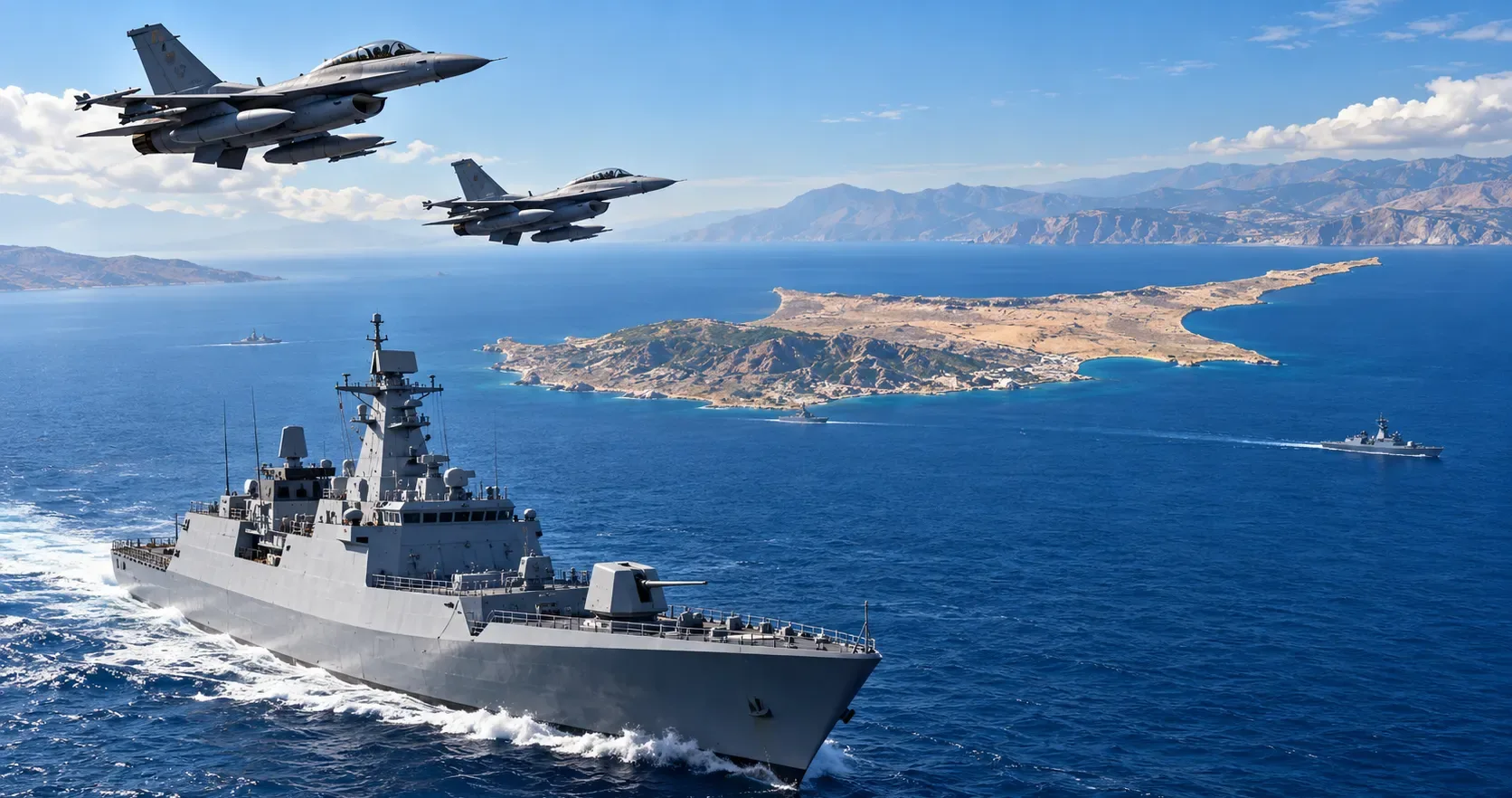
Speaking to Defence ReDEFiNED in Thessaloniki on October 28, Palmas described the Greek F-16s and a Greek Navy vessel as having a "permanent presence" in the Republic of Cyprus. The following day, in an interview with Sigma television, he clarified that Athens and the Republic of Cyprus had not signed any agreement providing for the permanent stationing of Greek fighter aircraft or warships.
Palmas said his government wanted the Greek assets to remain, citing Türkiye's military presence in northern Cyprus and instability in the Eastern Mediterranean. He had taken a different position on June 15, when he described the deployment as temporary and said permanent stationing had not been discussed.
Greece has confirmed the forces currently deployed. In an October 25 interview published by its Defense Ministry, Minister Nikos Dendias said two pairs of F-16 fighters, four aircraft, and a frigate were stationed in the Republic of Cyprus. He gave no permanent basing commitment. Athens had first announced the dispatch of Greek fighters and frigates on March 2 after attacks on the Republic of Cyprus. Dendias and Palmas met in Thessaloniki this week, but neither ministry has announced a change to the deployment's formal status.
Israeli Patrol Vessel and EU Defense Financing
On October 26, the Republic of Cyprus and Israel signed a deal for a second Israeli-built offshore patrol vessel and upgrades to the existing Ioannides (P61). Israel Shipyards will supply the new ship with Rafael naval systems. Palmas told Sigma that delivery could take roughly 12 to 18 months because construction was already advanced; the defense ministries did not publish a delivery date or contract price.
European financing is another part of the Republic of Cyprus's procurement programme. On February 11, the Council of the European Union approved up to €1.1815 billion in long-term loans under Security Action for Europe (SAFE). The European Commission confirmed an initial €177.2 million pre-financing payment on June 18, equal to 15% of the allocation. The larger figure is a loan ceiling, not money already paid out.
Palmas told Sigma that the Republic of Cyprus had signed several bilateral arrangements with European partners, particularly France and Greece, and aimed to use the SAFE allocation by 2030. Asked whether Turkish private companies might participate indirectly in projects, he said he would prefer to exclude them but acknowledged that other European governments maintain their own relations with Türkiye. He identified no Turkish company participating in a Republic of Cyprus SAFE project.
Sources: United Nations Security Council, Office of the Prime Minister of Greece, Republic of Cyprus Defense Ministry, Hellenic Ministry of National Defense, Republic of Türkiye Foreign Ministry, Council of the European Union, European Commission, Cyprus News Agency, Sigma, Kathimerini, Bosphorus News review and reporting.