
By Bosphorus News Geopolitics Desk
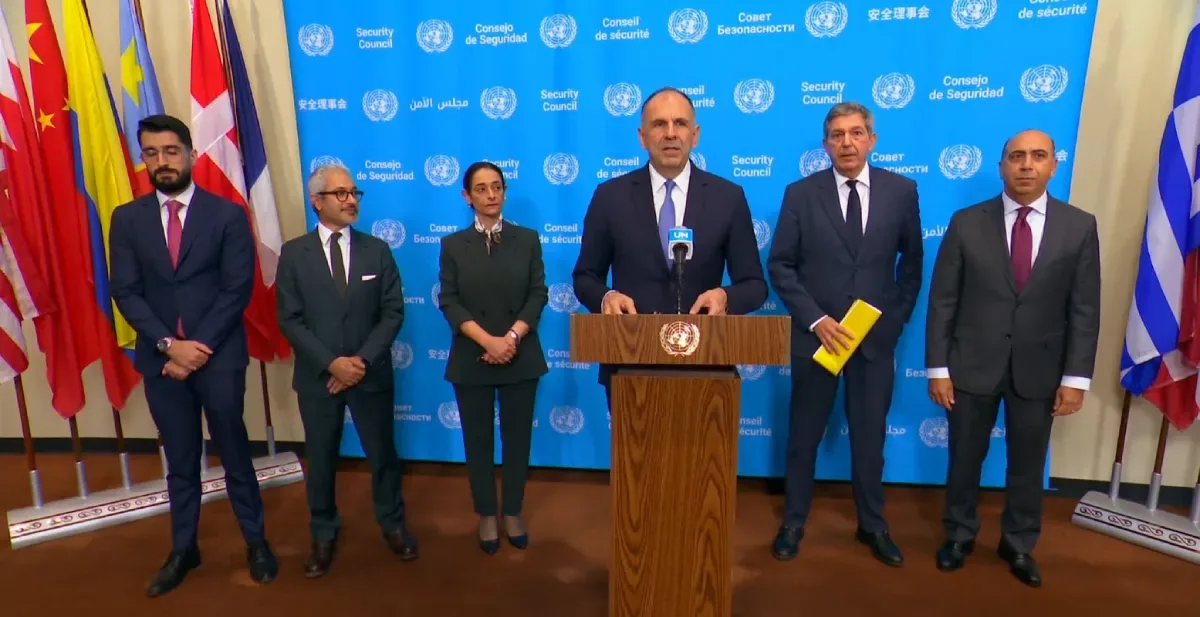
Greece, Egypt, the Republic of Cyprus, Bahrain, the United Arab Emirates and the European Union rejected the 2019 Türkiye–Libya maritime pact on October 26, six days after Libya's eastern parliament approved it. Speaking on their behalf at the UN in New York, Greek Foreign Minister Giorgos Gerapetritis called the agreement "null and void."
Maritime Rights of Islands and Coastal States
The joint statement said the October 20 vote did not change the six parties' legal position. It accused Türkiye and Libya of disregarding other coastal states' maritime rights, including the entitlements of islands under the United Nations Convention on the Law of the Sea (UNCLOS).
Gerapetritis argued that the agreement could not serve as a lawful basis for maritime delimitation or produce legal consequences for third states. The declaration was delivered at UN headquarters, not adopted as a Security Council decision.
The signatories also supported the reunification of Libya's divided institutions. Gerapetritis said Greece remained ready to hold maritime boundary talks with Libya.
Libyan Parliament Reverses Its 2020 Rejection
Libya's eastern-based House of Representatives unanimously approved the pact on October 20. Türkiye and Libya's then Government of National Accord signed it on November 27, 2019.
Lawmakers also overturned two decisions from 2020: one rejecting ratification of memorandums with Türkiye and another calling for political ties with Ankara to be severed.
The parliamentary reversal was welcomed by the Tripoli-based Government of National Unity. Libya's rival political centres now publicly back the same maritime agreement.
The UN Treaty Collection records December 8, 2019, as the agreement's entry-into-force date and December 11 as its registration date. The latest Libyan vote did not establish a new entry-into-force date. Registration with the UN does not resolve disputes over the agreement's legality or its effect on third states.
Erdoğan Defends Pact as Greece and Egypt Press Objections
Türkiye's Foreign Ministry welcomed the Libyan vote, saying the agreement had been in force since 2019 and was consistent with international law and the principle of equity.
After a Cabinet meeting on October 26, President Recep Tayyip Erdoğan said objections to the Libyan vote, particularly from the EU, lacked legitimate grounds. Türkiye sought to protect its maritime rights, he said, and expected other parties to respect the joint will of Ankara and Libya.
Greece had raised the pact in closed UN Security Council consultations on October 21. Egypt separately raised its objections with Turkish Foreign Minister Hakan Fidan during talks in Istanbul on October 23.
Athens and Cairo have also discussed extending their 2020 partial maritime delimitation agreement eastward toward Cyprus. No new boundary agreement has been announced.
Sources: Hellenic Republic Ministry of Foreign Affairs, Libyan House of Representatives, Libyan News Agency, Republic of Türkiye Ministry of Foreign Affairs, United Nations Treaty Collection, Egyptian Ministry of Foreign Affairs, Anadolu Agency, Reuters, Bosphorus News review and reporting.