
By Bosphorus News Geopolitics Desk
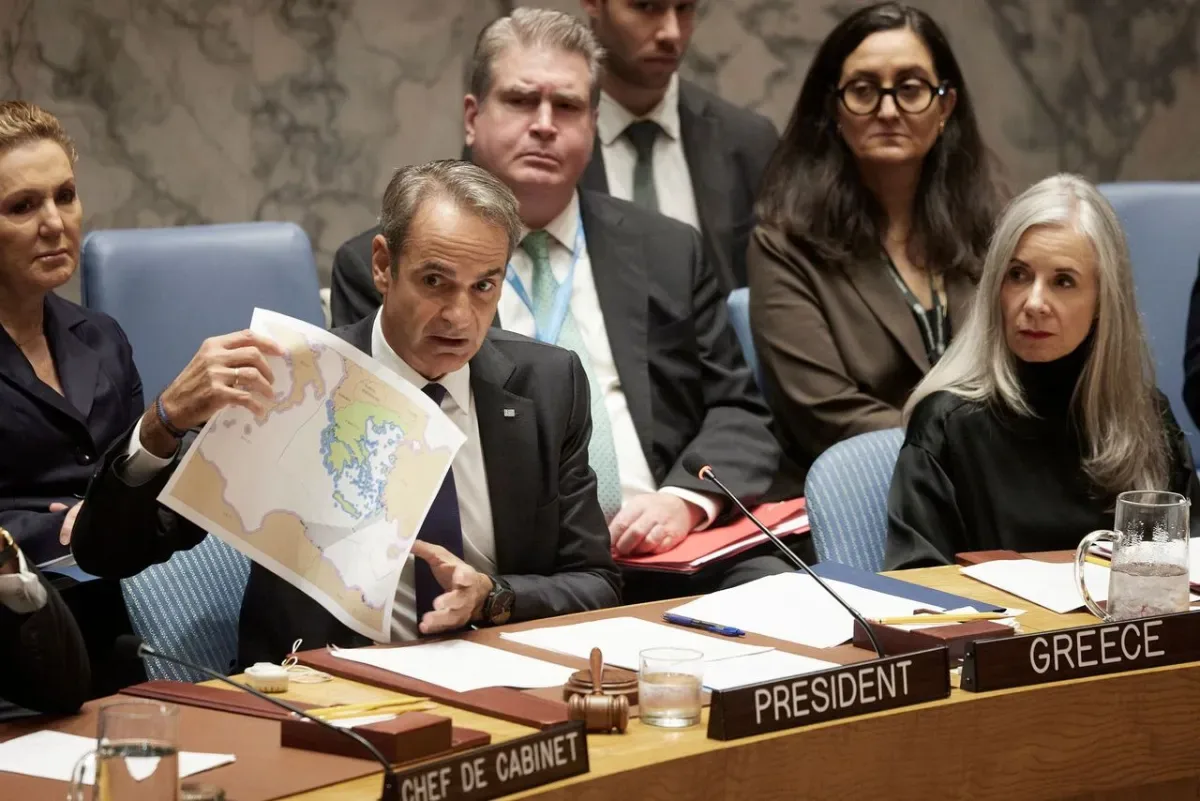
On October 29, 2026, Greek Prime Minister Kyriakos Mitsotakis denounced the 2019 Türkiye–Libya maritime agreement at the United Nations Security Council, calling it illegal and arguing that it cannot affect Greece's sovereign rights. He warned against using disputed maritime claims to obstruct energy and communications infrastructure in the Eastern Mediterranean.
Mitsotakis was chairing a high-level debate on emerging technologies and maritime security during Greece's October presidency of the Security Council. He spoke three days after six parties, including Egypt and the European Union, publicly challenged the agreement, and nine days after Libya's House of Representatives voted to approve it.
Mitsotakis Challenges Libya's Vote
The prime minister called the Türkiye–Libya memorandum a flagrant violation of the law of the sea. "It is illegal, it is arbitrary and it defies geography itself," he said.
Mitsotakis argued that Greece and Libya have opposite coastlines and can negotiate a maritime boundary, whereas Türkiye and Libya lack opposite or adjacent coasts. Using a map, he pointed to Crete, Rhodes, Karpathos and Kasos, accusing Ankara and Tripoli of disregarding their maritime entitlements.
Crete has more than 620,000 residents and Rhodes about 125,000, he said, rejecting the suggestion that the islands could be overlooked in maritime delimitation. He maintained that the Libyan parliament's October 20 vote could not give an agreement Greece considers unlawful any legal effect on Greek sovereign rights.
Mitsotakis invoked the United Nations Convention on the Law of the Sea (UNCLOS) and the maritime entitlements it provides to islands. Türkiye, which is not a party to UNCLOS, disputes the extent of maritime jurisdiction claimed by Greek islands and argues that boundaries should be determined under equitable principles. Both governments cite customary international law in support of their positions.
The remarks formed part of Greece's national statement at the Security Council. The Council did not rule on the memorandum or adopt the Greek legal position as a decision.
Egypt Holds Separate Contacts With Athens and Ankara
Türkiye's Foreign Ministry welcomed the Libyan parliament's October 20 decision, saying the memorandum had been in force since 2019 and was consistent with international law and equity. Ankara rejects Greece's contention that the agreement is invalid.
On October 26, Greece, Egypt, the Republic of Cyprus, Bahrain, the United Arab Emirates and the EU issued a joint declaration opposing the memorandum. Greek Foreign Minister Giorgos Gerapetritis presented their position in New York, arguing that the agreement could not determine the rights of third countries.
After meeting UN Secretary-General António Guterres, Gerapetritis said on October 28 that maritime zones were "not up for auction". Egyptian Foreign Minister Badr Abdelatty spoke separately with Gerapetritis and Turkish Foreign Minister Hakan Fidan the same day. Neither discussion produced an announced maritime delimitation agreement.
Türkiye's Defense Ministry also renewed an offer to negotiate a maritime boundary with Egypt, estimating that Cairo could gain more than 15,000 square kilometres of maritime jurisdiction compared with a potential arrangement with Greece. The figure is Ankara's calculation; Egypt has neither endorsed it nor accepted the Turkish proposal.
Greece and Egypt signed a partial exclusive economic zone delimitation agreement in 2020. Talks on extending it eastward have yet to yield another agreement.
The UN Treaty Collection records that the Türkiye–Libya memorandum entered into force on December 8, 2019, and was registered on December 11. Registration does not resolve the competing claims concerning its effect on third countries' maritime rights.
Cable Surveys and Maritime Jurisdiction
Mitsotakis warned that maritime claims should not be used to obstruct infrastructure projects that would strengthen energy security and data connectivity. He did not identify the Great Sea Interconnector (GSI) or any survey vessel by name.
The warning came as preparations continued for GSI seabed surveys between Crete and the Republic of Cyprus. The French-flagged Abeille Marengo arrived in Heraklion on October 27. Greek reporting on October 29 indicated that the required navigational warning (NAVTEX) for its planned offshore work was still being prepared.
A separate telecommunications cable survey involving the Bahamas-flagged Kobi Ruegg has prompted competing Turkish and Greek maritime notices. The two ships are working on different projects, and the dispute over Kobi Ruegg does not establish that GSI surveys have begun.
Athens maintains that its maritime activities comply with international law. Ankara contests Greek jurisdictional claims in areas it regards as part of its continental shelf and challenges activities undertaken there without Turkish consent.
Black Sea Sinking Prompts Call for Maritime Truce
Mitsotakis also condemned the October 28 attack on the Greek-owned, Liberian-flagged container ship CONTSHIP JET, which sank off Bulgaria after being hit by maritime drones. All 18 crew members were rescued. The perpetrators have not been identified.
He called for a global maritime truce to protect commercial shipping during armed conflicts, warning that attacks on merchant vessels raise freight and insurance costs and disrupt supply chains.
Bulgaria had already called for a moratorium on attacks against civilian shipping earlier in October. Following the CONTSHIP JET sinking, Bulgarian military prosecutors opened an investigation into possible violations of the rules governing warfare at sea.
Mitsotakis also cited disruptions in the Strait of Hormuz and Red Sea, urging European governments to assume a greater role in keeping maritime trade routes open. He pointed to the EU's Operation ASPIDES in the Red Sea and called for improved surveillance, intelligence sharing and operational capabilities.
He said Greece was investing in systems combining satellites, sensors and vessel tracking to improve maritime awareness, and identified maritime security as a priority for Greece's presidency of the Council of the European Union in the second half of 2027.
The Security Council session ended without a new ruling or negotiated settlement on the Türkiye–Libya memorandum. Athens continues to reject the agreement's maritime boundary, while Ankara maintains that the memorandum remains valid.
Sources: Office of the Prime Minister of Greece, October 29, 2026 national statement; Hellenic Ministry of Foreign Affairs; Republic of Türkiye Ministry of Foreign Affairs; United Nations Security Council; United Nations Treaty Collection; European Council; Reuters; Kathimerini; Bosphorus News review and reporting.