
By Bosphorus News Geopolitics Desk
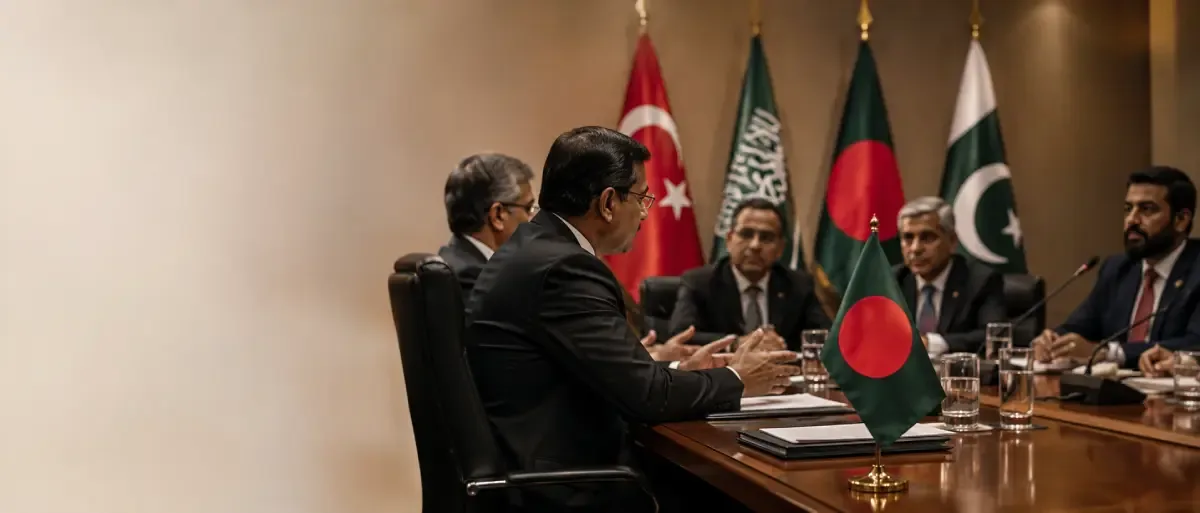
Bangladesh would consider joining the Mecca Joint Defense Agreement if Türkiye, Saudi Arabia and Pakistan asked it to do so, Foreign Minister Khalilur Rahman told parliament on August 27, but said membership had not yet reached the stage of a formal decision.
The statements do not fully match. State Minister for Foreign Affairs Humaiun Kobir said earlier this week that Dhaka had expressed interest in the pact, while Reuters cited an unnamed Bangladesh Foreign Ministry source on August 25 as saying Saudi Arabia had already invited Bangladesh to join. None of the three founding governments has publicly announced such an invitation.
Foreign Minister Says Membership Has Not Yet Come Up
Rahman was answering a supplementary question from independent lawmaker Rumeen Farhana on what Bangladesh stood to gain from joining the agreement and whether the government intended to participate.
"This pact has been made among three countries. We view it positively," he said.
Rahman then separated Dhaka's interest from an accession process.
"If they express an intention to include Bangladesh in this pact, we will certainly consider it positively," he said, adding that it was premature to assess the advantages and disadvantages before the existing members acted.
He described an expanded agreement as a possible self-defense mechanism for the Muslim world and said there was no reason for other countries to be concerned by such an arrangement.
That was more cautious than Kobir's account on August 24. The newly appointed state minister said Bangladesh had expressed interest and that foreign partners were inviting the country's leadership, particularly Prime Minister Tarique Rahman, to participate in regional initiatives.
On August 25, Reuters cited a Bangladesh Foreign Ministry source as saying Saudi Arabia had invited Dhaka to join. The source did not say when the invitation was made, and the Saudi, Turkish and Pakistani embassies in Bangladesh did not respond to Reuters requests for comment.
Rahman's parliamentary answer does not establish whether an informal Saudi approach took place. It does establish that Dhaka is not publicly describing itself as being in a formal accession process.
The Pact Was Designed to Admit More Countries
President Recep Tayyip Erdoğan, Saudi Crown Prince and Prime Minister Mohammed bin Salman and Pakistani Prime Minister Shehbaz Sharif signed the Mecca Joint Defense Agreement at Al-Safa Palace on August 7.
The published commitment says an armed attack against one of the three states will be regarded as an attack against all and calls for stronger collective deterrence and defense cooperation. Erdoğan said after the signing that other friendly countries could participate.
Foreign Minister Hakan Fidan later described Türkiye, Saudi Arabia and Pakistan as the founding core and said Egypt could join after remaining technical issues were resolved. Bosphorus News examined the proposed expansion after Fidan's August 8 remarks.
How a fourth member would formally enter is less clear.
The one-page statement released after the Mecca summit contains the collective-defense commitment but no published accession procedure. Pakistan's ambassador to Türkiye, Yousaf Junaid, later said the released page constituted the agreement in full, although Fidan had referred to an accession article and described political and military mechanisms that do not appear in the public document.
Bangladesh's interest is now testing a procedure the public agreement never explains.
India Is Watching a Pact That Includes Pakistan
India has stopped short of publicly objecting to Bangladesh's possible participation. Its External Affairs Ministry said it was closely following developments surrounding the new agreement, while Reuters cited Indian analysts who expected New Delhi to view Bangladesh joining a security pact with Pakistan unfavorably.
The discussion comes during a difficult period in India-Bangladesh relations.
Tarique Rahman became prime minister on February 17 after the Bangladesh Nationalist Party won the parliamentary election. Six months later, he has yet to decide whether to visit India, while Dhaka continues seeking the extradition of former Prime Minister Sheikh Hasina, who has lived in India since her removal from power in August 2024.
Bangladesh has also accused Indian border forces of forcibly pushing people across the frontier.
Joining a collective-defense pact with Pakistan would put a new military issue directly into Dhaka's already difficult relationship with New Delhi.
Bangladesh and Pakistan Were Already Discussing Defense Ties
Dhaka's interest in the Mecca agreement follows months of renewed military contacts with Islamabad.
The air force chiefs of Bangladesh and Pakistan met in January during talks that covered a possible bilateral defense agreement and potential acquisition of JF-17 Thunder fighter aircraft. Pakistan also offered accelerated delivery of Super Mushshak trainers together with training and support.
Bangladesh is separately moving toward negotiations with China over J-10CE fighters and attack helicopters. China is already Bangladesh's largest defense supplier, while Pakistan is the only confirmed foreign operator of the J-10CE.
The Mecca discussion therefore comes after months of concrete defense contacts with Pakistan and parallel procurement talks with China.
Dhaka is already expanding defense ties with Pakistan while negotiating additional combat-aircraft purchases from China. Neither track establishes that Bangladesh has decided to enter the Mecca agreement, but both give the membership discussion a wider military context.
Dhaka Still Has Several Relationships to Protect
Bangladesh has traditionally maintained defense, economic and diplomatic ties across competing centers of power rather than binding itself to a single security bloc.
Its export economy is heavily connected to the European Union, Britain and the United States. Gulf states are central to employment and remittance flows, China has become the dominant external supplier to the armed forces, and India remains the country's largest neighbor.
Joining the Mecca agreement would be different from buying an aircraft or signing a training accord because the public text contains a collective-defense commitment: an attack on one member is to be treated as an attack on all.
Dhaka has now publicly said it views the agreement positively and would consider membership.
What remains unconfirmed is whether Türkiye, Saudi Arabia and Pakistan have formally asked Bangladesh to take the next step.
Sources: Bangladesh Ministry of Foreign Affairs, Bangladesh Sangbad Sangstha, Türkiye's Directorate of Communications, Reuters, Anadolu Agency, Cumhuriyet, Bosphorus News review and reporting.