
By Bosphorus News Geopolitics Desk
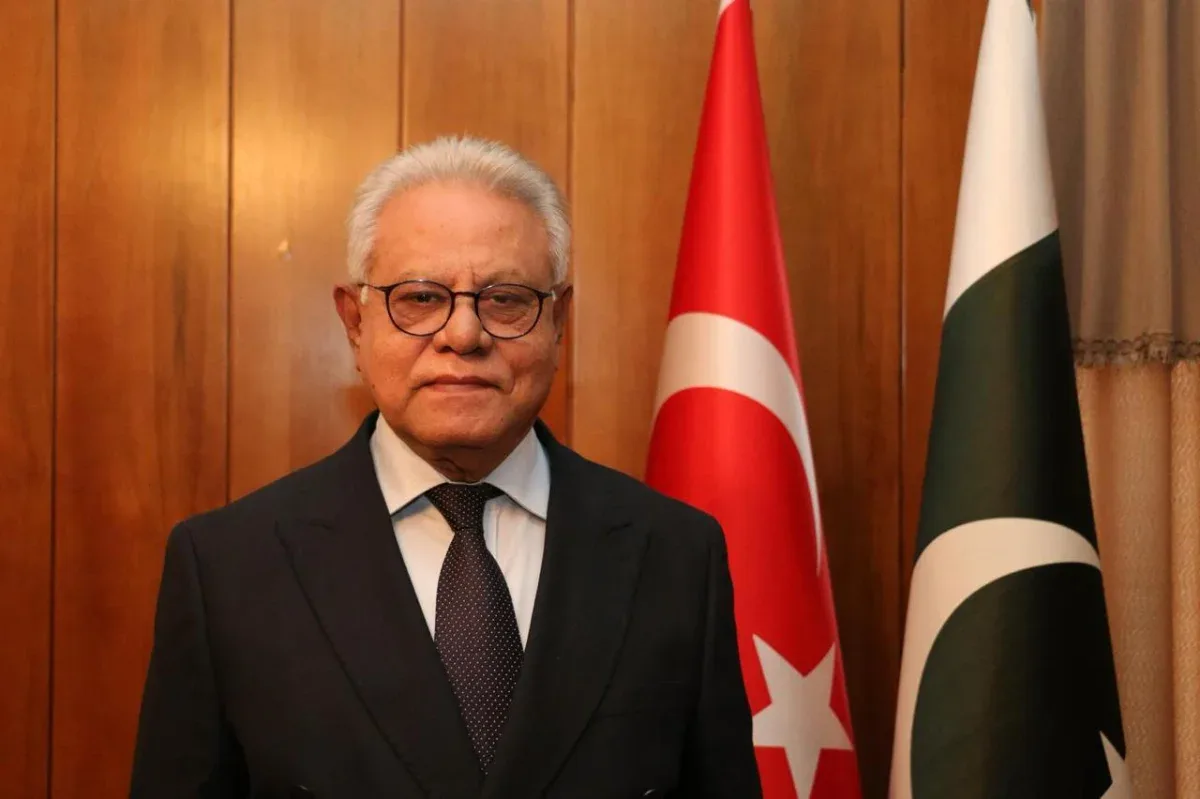
In an interview published on August 15, 2026, Pakistan's ambassador to Ankara said the one-page joint statement issued after Türkiye, Saudi Arabia and Pakistan signed the Mecca Joint Defense Agreement was the pact in full, rejecting expectations that a longer document would follow.
Cumhuriyet asked Ambassador Yousaf Junaid when the complete text would be made public. "It has already been shared," he replied.
The newspaper pointed out that the released material ran to one page. "That is all there is," Junaid said, adding that he did not expect a more extensive version to follow.
Cumhuriyet did not publish an audio recording or complete transcript of the interview. Its account nonetheless provides the clearest indication that Pakistan regards the short statement issued after the signing ceremony as the complete agreement.
What the Public Page Contains
The August 7 statement contains the pact's central promise: an armed attack against any of the three states will be treated as an attack against all. It also commits them to strengthening collective deterrence and expanding defense cooperation.
What it does not provide are the rules needed to interpret that promise. There are no numbered articles, signatures, definitions or provisions governing entry into force, duration and withdrawal. The statement gives no geographic scope and does not explain what each country must do after help is requested.
Nor was a copy of the instrument signed by President Recep Tayyip Erdoğan, Saudi Crown Prince Mohammed bin Salman and Pakistani Prime Minister Shehbaz Sharif attached to the announcement.
The problem is not the document's length, but what the published page omits. The government page does not identify itself as a facsimile or complete reproduction of the signed instrument, and it contains none of the institutional arrangements Turkish officials later described.
Fidan Referred to Provisions Missing From the Page
Foreign Minister Hakan Fidan outlined a structure on August 8 that cannot be found in the released statement.
An attacked member would first submit a request. The three governments would then determine the nature and degree of assistance through consultations. Support could range from intelligence, logistics and ammunition to the deployment of military units.
Fidan also announced a political and military committee bringing together the three countries' foreign ministers, defense ministers and armed forces chiefs. A general secretariat would be based in Saudi Arabia, with its structure and operating rules to be settled at the first committee meeting.
He referred directly to the agreement's contents while explaining these arrangements, saying the text contained general commitments. When discussing future membership, he said the three founding states would approve new entrants, "as expressed in the relevant article in the agreement."
The public statement contains no accession article and no numbered articles at all.
The Turkish Ministry of National Defense supplied further detail. It outlined exercises on land, at sea and in the air, along with cooperation in air defense, unmanned systems, electronic warfare and artificial intelligence. Joint weapons development, production, technology transfer, maintenance and logistics are also planned.
Türkiye has therefore described political and military mechanisms extending far beyond the sentence published on August 7.
The public record leaves several possibilities open. The signed instrument may contain additional provisions, some rules may be reserved for implementing arrangements, or officials may be describing structures not yet formally adopted. Nothing released so far distinguishes among them.
CFR and Foreign Policy Treated the Full Text as Unpublished
International analysts had already treated the complete document as unpublished before Junaid spoke.
Steven A. Cook wrote in an August 13 analysis for the Council on Foreign Relations (CFR) that the parties had not released an official text. Michael Kugelman's August 12 Foreign Policy analysis proceeded from the same premise.
Neither assessment proves that a longer treaty or secret annex exists. They show that independent readers examining the available record understood the government page as a summary rather than the legal instrument itself.
Junaid's account now conflicts not only with those assessments but also with Fidan's reference to an article the public page does not contain.
A Houthi Strike Raised the First Activation Question
Two days after the signing ceremony, Ansar Allah, commonly known as the Houthis, claimed a drone attack on Saudi Aramco's refinery in Jazan. Saudi authorities extinguished the resulting fire and reported no casualties.
Riyadh gave no public indication that it had requested help from Türkiye or Pakistan. The new pact was not publicly invoked.
Cook described the strike as the agreement's first test. He argued that Saudi leaders may have doubted whether their new partners wanted to enter another conflict on the Arabian Peninsula.
That is Cook's interpretation, not an established explanation of Riyadh's decision. Saudi Arabia may have considered the incident too limited to trigger collective defense or may distinguish between attacks by states and those carried out by armed groups.
The released statement offers no guidance. It does not say whether an attack by a non-state actor is covered, whether casualties or a particular level of damage are required, or whether a strike on energy infrastructure crosses the threshold.
The episode therefore leaves a practical question unanswered: what type and scale of attack activates the pact?
Pakistan Has Made This Distinction Before
Pakistan's conduct during the Yemen war explains why the threshold matters.
In April 2015, the Pakistani Parliament unanimously urged the government to remain neutral after Saudi Arabia requested warplanes, warships and troops for its campaign against the Houthis.
The same resolution promised unequivocal support for Saudi territorial integrity and said Pakistan would stand beside the kingdom if its territory or Islam's holy sites came under threat.
Islamabad distinguished between defending Saudi Arabia and joining a Saudi intervention inside another country. The Mecca pact is supposed to turn political solidarity into a standing commitment, yet the published wording does not show where that boundary now lies.
A similar lack of clarity followed the bilateral Saudi-Pakistani Strategic Mutual Defense Agreement signed in September 2025.
Pakistani Defense Minister Khawaja Asif initially said his country's established capabilities would be available to Saudi Arabia under that pact, prompting interpretations that the commitment included Pakistan's nuclear arsenal. He later told Reuters that nuclear weapons were "not on the radar."
The bilateral and trilateral agreements are separate instruments. Asif's statements do not establish a nuclear guarantee under the Mecca pact. They show how sweeping defense language can produce incompatible readings when the operative terms are unavailable.
Türkiye's Ratification Process Has Yet to Appear in Public Records
Article 90 of the Constitution provides, as a general rule, that international agreements require approval by the Grand National Assembly of Türkiye (TBMM) through legislation. Narrow exceptions apply to some economic, commercial, technical and administrative agreements.
AK Party parliamentary group deputy chair Özlem Zengin said the Mecca agreement would be submitted to Parliament and considered under Article 90.
As of August 15, however, Bosphorus News could not locate an approval bill or ratification decision for the agreement in publicly accessible TBMM and Official Gazette records. Eight days is not an unusual interval after an international signing, and the absence of such a record does not indicate an irregularity. It means the pact's ratification process has not yet become visible in the public record.
Any later commitment involving the deployment of Turkish forces could also bring Article 92 into view. That provision reserves to Parliament the authority to permit Turkish forces to deploy abroad or foreign forces to be stationed in Türkiye, except where an existing international agreement or international courtesy requires otherwise.
The legal implications therefore depend on language the released page lacks, including the pact's entry-into-force procedure, ratification requirements and the effect of an assistance request.
The NATO Comparison Shows What Is Missing
Turkish officials have compared the pact's central promise with Article 5 of the North Atlantic Treaty Organization (NATO). That comparison makes the difference in disclosure more conspicuous.
The North Atlantic Treaty is public and contains 14 articles. It allows each member to choose the action it considers necessary, which may or may not involve armed force. It also defines the alliance's geographic reach and establishes rules covering its governing body, accession, ratification and withdrawal.
Ankara says the Mecca pact complements Türkiye's NATO obligations rather than competing with them. Nothing published so far contradicts that position, but the available material does not show how the two commitments would interact during a crisis.
Junaid's answer leaves a basic inconsistency. The public page contains no accession article, yet Fidan referred to one. It provides no rules for a committee or secretariat, although Turkish officials have described both.
Those mechanisms may derive from the signed instrument, implementing arrangements or later political decisions. The three governments have not said which.
Until they do, citizens and lawmakers cannot determine who decides that an attack activates the pact, what assistance follows or when each country becomes legally bound to act.
Sources: Cumhuriyet, Türkiye's Directorate of Communications, Turkish Ministry of Foreign Affairs, Turkish Ministry of National Defense, Grand National Assembly of Türkiye, Constitutional Court of Türkiye, Council on Foreign Relations, Foreign Policy, Reuters, Associated Press, NATO, Dawn, Bosphorus News review and reporting.