
By Bosphorus News Geopolitics Desk
The United States and Greece announced $4 billion in Foreign Military Sales (FMS) and the provision of Stryker vehicles after the sixth Greece-U.S. Strategic Dialogue in Athens, adding new military, energy and economic-security commitments to a relationship both governments described as deepening across multiple sectors.
The October 7 joint statement, issued after U.S. Secretary of State Marco Rubio and Greek Foreign Minister Giorgos Gerapetritis chaired the dialogue, said the FMS would support Greece's long-term defense plan and deepen interoperability. Washington and Athens also agreed to explore future defense-industrial cooperation, including innovative technologies.
The statement does not identify the systems covered by the $4 billion figure, the individual contracts behind it or a delivery timetable. It separately records the provision of Stryker vehicles to Greece without giving a number, variant or schedule, and does not say whether the vehicles are included in the $4 billion total.
The two countries also finalized Greece's participation in the U.S. National Guard Bureau's State Partnership Program (SPP) with Florida. Chief of the Hellenic National Defence General Staff Gen. Dimitrios Choupis and Florida National Guard commander Maj. Gen. John Haas signed the partnership agreement in Athens in the presence of Rubio and Greek Defense Minister Nikos Dendias.
The U.S. Army said the partnership establishes a long-term framework focused on military readiness, interoperability and regional security. Greece's Defense Ministry has listed joint exercises, command and control, joint fires and tactical maneuvers, logistics, air defense and air operations, disaster response, space and cyber operations among the areas for cooperation.
Law-enforcement ties were expanded at the same time. The two governments announced a new memorandum of understanding on the Joint Security Program, strengthening counterterrorism information sharing between U.S. and Greek agencies while building on earlier cooperation at Athens International Airport. The joint statement also reaffirmed cooperation against illegal migration.
The economic-security section went beyond trade. Washington and Athens said they would work together on investment screening and the protection of critical-infrastructure procurement. With Greece participating in the Pax Silica initiative, the statement also listed high-performance computing, cybersecurity, advanced technologies and what it called "super intelligence" as areas for closer cooperation.
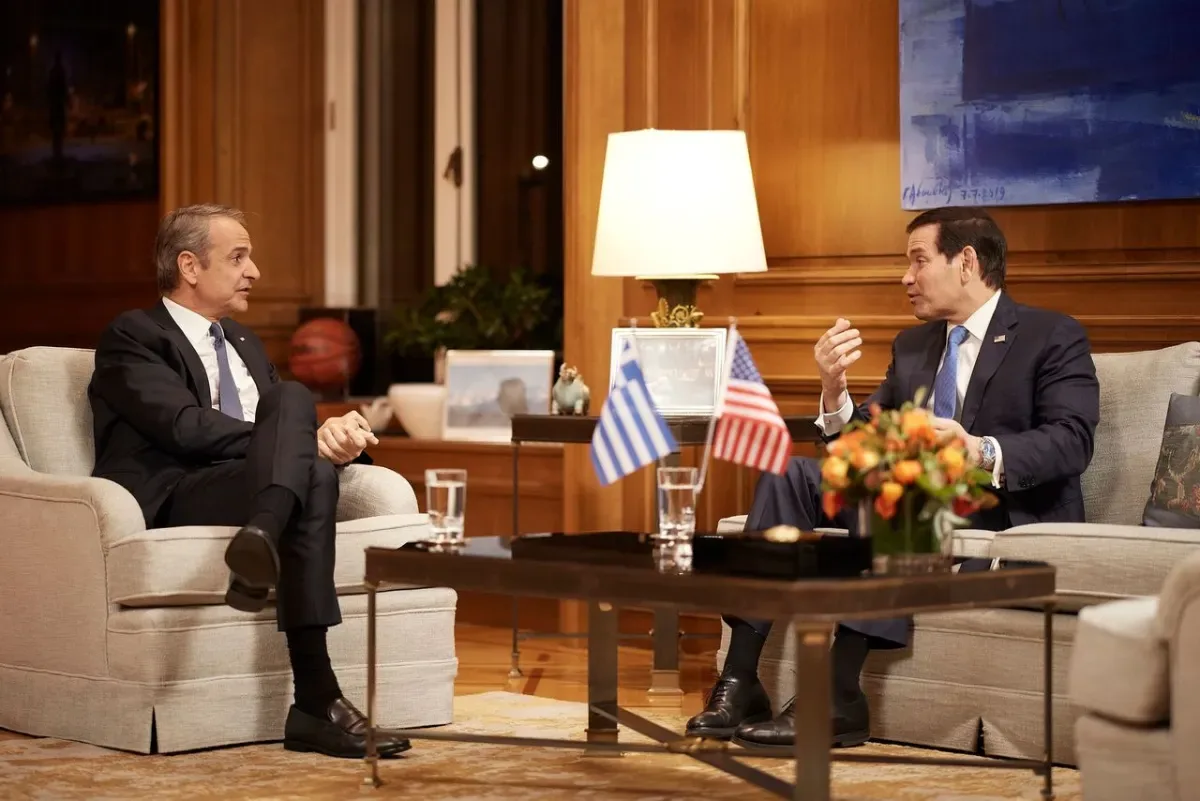
Energy remained a second pillar of the talks. The joint statement cited the November 2025 Partnership for Transatlantic Energy Cooperation ministerial, the Vertical Gas Corridor and hydrocarbon exploration. Prime Minister Kyriakos Mitsotakis, who later met Rubio at Maximos Mansion, said Greece had invested heavily to become an entry point for U.S. liquefied natural gas (LNG) into Europe and was now providing energy security to its northern neighbors.
Rubio was more cautious when asked publicly about electricity interconnectors involving Greece, the Republic of Cyprus, Israel and Egypt. He said the United States was committed to energy corridors and diversification but acknowledged that some projects involve delicate situations with other countries and said those issues were better handled through private diplomacy. He did not name Türkiye.
That answer is relevant to the Great Sea Interconnector (GSI), the Greece-Cyprus electricity link planned to extend to Israel. Survey work east of Kasos has repeatedly intersected with competing Greek and Turkish maritime claims. Bosphorus News has tracked the unresolved question of how Athens and Paris notify Türkiye before renewed cable surveys. Rubio backed the energy projects without publicly entering the underlying Greek-Turkish maritime dispute.
Maritime security also featured prominently. Mitsotakis said Greece had stood with its Gulf partners and remained committed to freedom of navigation, pointing to Greek naval participation in the European Union (EU) operation EUNAVFOR ASPIDES in the Red Sea. Gerapetritis said Greece could cooperate with the United States and provide naval assistance in the Strait of Hormuz if required, provided conditions allowed and a viable peace process was in place. No deployment decision was announced, and Gerapetritis did not identify a specific U.S. request.
Athens also pressed its wider Eastern Mediterranean agenda. Gerapetritis said the Greece-Republic of Cyprus-Israel-United States 3+1 format had developed from an energy framework into a broader geopolitical mechanism. He placed the Republic of Cyprus within the Eastern Mediterranean security architecture and repeated Greece's position on reunification under United Nations Security Council resolutions, using language on occupation and revisionist threats that Rubio did not repeat publicly.
Shipping and technology produced additional agreements. The two governments signed an arrangement on certification for U.S. seafarers serving on Greek vessels, while Mitsotakis emphasized the role of Greek shipping in global trade and the importance of connectivity projects linking Europe, the United States, the Middle East and the Gulf.
The October 7 package leaves the U.S.-Greece relationship with a broader operational footprint: $4 billion in announced FMS, Stryker vehicles, a formal Florida National Guard partnership, expanded counterterrorism cooperation, tighter screening around strategic investment and infrastructure, and deeper energy and maritime coordination. On the most sensitive Eastern Mediterranean energy disputes, however, Rubio kept the U.S. public position anchored in private diplomacy rather than taking a side on competing maritime claims.
Sources: U.S. Department of State, Hellenic Republic Ministry of Foreign Affairs, Hellenic Republic Ministry of National Defence, Office of the Prime Minister of the Hellenic Republic, U.S. Army, Bosphorus News review and reporting.