
By Bosphorus News Economy Desk
Türkiye said its land transit corridor through Syria, Jordan and Saudi Arabia has become a vital route after recent Gulf tensions again exposed the risks surrounding the Strait of Hormuz.
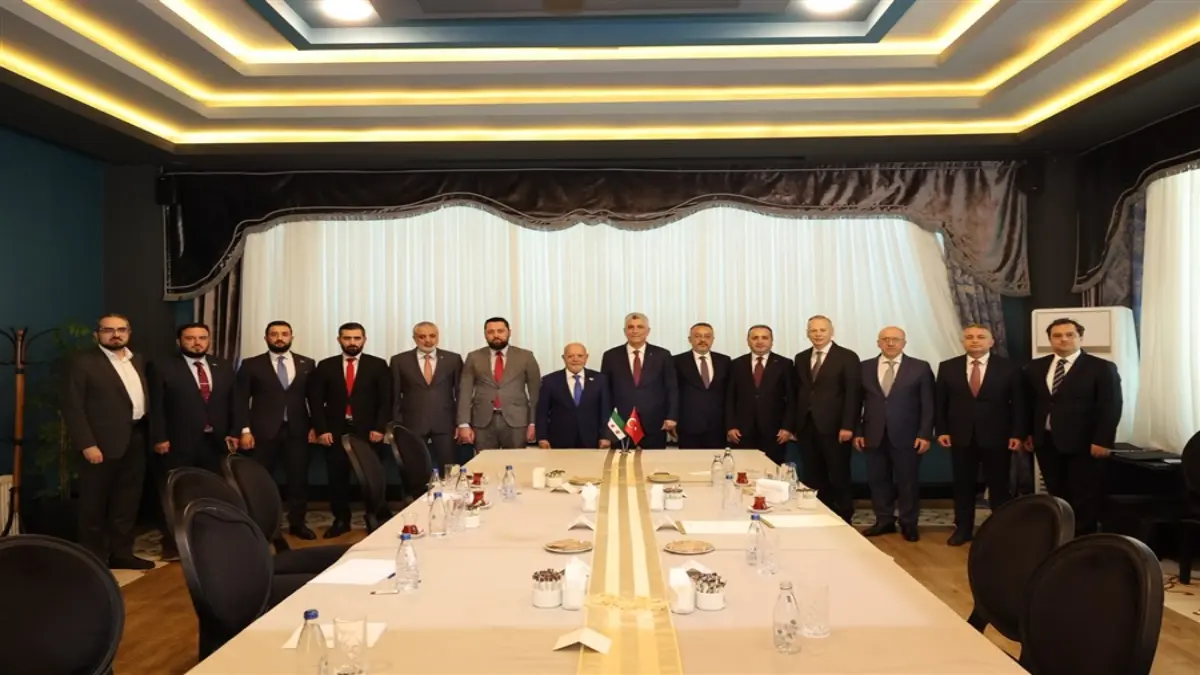
Trade Minister Ömer Bolat made the remarks after meeting Syrian Economy and Industry Minister Mohammed Nidal al-Sha'ar on the sidelines of the AA City Economies Summit in Gaziantep, where the two ministers reviewed trade, transport, customs and investment files between Türkiye and Syria.
Bolat said the Türkiye-Syria-Jordan-Saudi Arabia transit corridor has been operating successfully since April 15 and had gained new importance during the recent Gulf war.
"The recent Gulf war also showed that the Türkiye-Syria-Jordan-Saudi Arabia transit corridor is of vital importance, and since April 15 this corridor has continued to operate successfully," Bolat said.
He added that when the Strait of Hormuz is closed, the route becomes a lifeline for the Middle East and Gulf countries.
Customs gates return to the agenda
Bolat said Türkiye and Syria discussed the reopening of the İslahiye and Nusaybin customs gates, as Ankara and Damascus work to rebuild trade flows after years of war and border disruption.
The discussion fits the wider reopening of Türkiye-Syria trade routes. Bosphorus News previously reported that Akçakale border gate was being prepared for reopening, showing how the Syria trade reset has been moving through multiple crossing points rather than a single customs file.
Bolat said Türkiye had supported Syria after what he called the December 8 revolution, with work focused on economic activity, trade, investment and the freedom of transport. He said major progress had been made in trade since then.
He also pointed to the April meeting of the Türkiye-Syria Joint Economic and Trade Committee, known as JETCO. Bolat said the two sides had made progress on standards, technical harmonization, customs cooperation, joint investments, customs modernization, increased trade, participation in fairs and the liberalization of transit trade.
Free zones and joint industry areas
Bolat said investment confidence was rising as stability increased in Syria, adding that the two sides were discussing joint investments, free zones and joint industrial areas.
The Gaziantep-Halep economic line was also present in the meeting's wider setting. Bolat said the AA City Economies Summit would contribute to accelerating economic integration between Gaziantep and Halep, two cities whose trade, production and logistics links were broken by years of conflict.
That track has already been visible in private-sector diplomacy. Bosphorus News previously covered the Türkiye-Syria business forum in Aleppo, where reconstruction cooperation, trade channels and business engagement were moving back onto the agenda.
Bolat also said Turkish banks opening branches in Syria was one of the most important topics discussed with al-Sha'ar. A banking presence would be central to trade finance, payments, investment activity and the normalization of commercial links between the two countries.
Corridor politics widens the file
Bolat's remarks connected the Syria trade reset to the Gulf-Europe corridor debate. Bosphorus News recently reported that Türkiye and Saudi Arabia signed railway MoUs linked to a possible Gulf-Europe land corridor, a route that becomes more important whenever Hormuz risk raises questions over sea-based trade and energy flows.
The corridor logic also shows why Syria now sits inside a wider economic map. Border gates, customs modernization, banking, free zones and joint industrial areas are no longer only bilateral reconstruction issues. They are becoming part of a land-route discussion that stretches from Türkiye to the Gulf.
The economic opening is not limited to road and rail. Bosphorus News has also reported on Türkiye-Syria offshore energy plans, another file showing how economic normalization is moving beyond simple cross-border trade.
Trade target rises
Bolat said Türkiye and Syria are also in contact over signing a new free trade agreement. He said bilateral trade had reached $3.7 billion last year and that the two countries were working toward a $5 billion target within two years.
He added that the target for the beginning of the 2030s was $10 billion.
The figures show the scale of Ankara's Syria economic reset. The immediate questions are practical: which gates reopen, when banking channels begin, how customs cooperation is modernized and whether transit routes can remain stable through Syria and Jordan toward Saudi Arabia.
The larger question is strategic. If the Syria-Gulf land corridor keeps operating, Türkiye's southern trade map will no longer depend only on border recovery. It will also become part of a wider search for routes that can bypass maritime disruption when the Gulf becomes unstable.
***Source: Republic of Türkiye Ministry of Trade, June 9, 2026