

By Bosphorus News Economy Desk
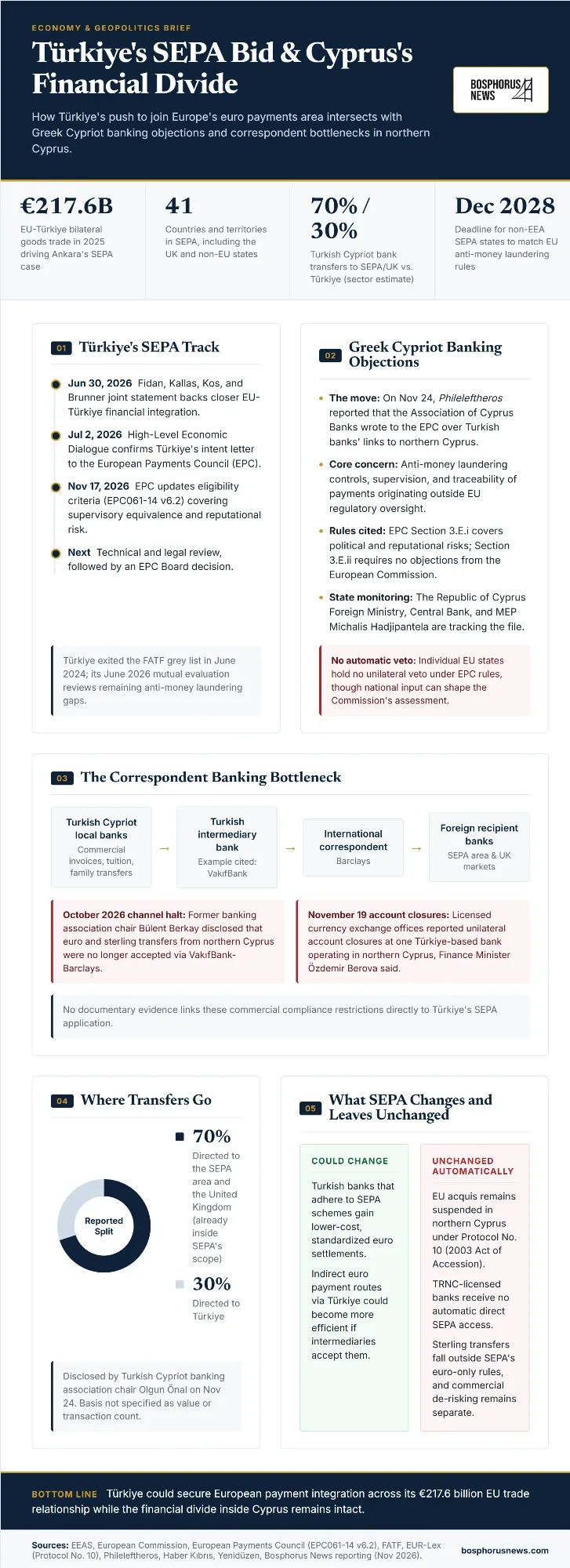
On November 24, 2026, Phileleftheros reported that the Association of Cyprus Banks had written to the European Payments Council (EPC) over Türkiye's bid to join the Single Euro Payments Area (SEPA), raising concerns about the relationship between Turkish financial institutions and banks operating in northern Cyprus.
The intervention coincides with growing difficulties in the Turkish Cypriot banking sector, where local banks have been seeking alternative channels for international euro and sterling transfers since October. Licensed currency exchange businesses have also reported the closure of bank accounts, adding to concerns over the continuity of financial services linking northern Cyprus with international markets.
The Greek Cypriot banking sector is questioning the same correspondent banking relationships on which Turkish Cypriot businesses and households rely to pay suppliers, finance university education abroad and move money between countries.
Although no causal relationship between the recent banking restrictions and Türkiye's SEPA initiative has been established, their convergence offers an unusually clear picture of the financial dependencies created by the division of Cyprus.
Türkiye's €217.6 Billion European Trade Relationship
With bilateral trade in goods reaching €217.6 billion in 2025, Türkiye has a considerable economic interest in joining SEPA. The system standardizes euro payments across 41 countries and territories, allowing participating financial institutions to operate under common technical and operational rules.
Its geographical coverage extends beyond the European Union (EU), encompassing countries such as Switzerland, the United Kingdom, Albania, Serbia and Moldova. Turkish businesses trading with European partners could benefit from lower payment costs and simpler settlement procedures, particularly those handling frequent cross-border transactions.
Türkiye's interest in SEPA was formally acknowledged in the June 30 joint statement issued by Foreign Minister Hakan Fidan, EU foreign policy chief Kaja Kallas and European Commissioners Marta Kos and Magnus Brunner, who agreed that Türkiye's participation would be beneficial.
Two days later, the EU-Türkiye High-Level Economic Dialogue confirmed that Türkiye had submitted a letter of intent to the EPC. European Commissioner for Economy Valdis Dombrovskis welcomed the initiative, while Treasury and Finance Minister Mehmet Şimşek emphasized its potential contribution to commercial competitiveness through more efficient international payments.
The letter of intent marks an initial step in a process requiring an assessment of Türkiye's financial legislation, supervisory framework and operational compatibility with European payment standards. Whether Türkiye has submitted its complete technical and legal application remains unconfirmed, a point made particularly relevant by the recent revision of the EPC's eligibility criteria and forthcoming changes to European anti-money laundering legislation.
The Greek Cypriot Intervention
According to Phileleftheros, the Association of Cyprus Banks has raised concerns with the EPC over the implications of Türkiye's admission for transactions originating in northern Cyprus. The Foreign Ministry and Central Bank of the Republic of Cyprus are also following the process, while Cypriot Member of the European Parliament Michalis Hadjipantela has raised the issue with the European Commission, as covered in the November 21 Eastern Mediterranean Strategic Brief.
The Greek Cypriot concern centers on whether Turkish banks participating in SEPA could extend the benefits of the European payments system to their existing banking partners in northern Cyprus, where EU financial legislation does not apply directly. The objections focus on anti-money laundering controls, regulatory supervision and the traceability of transactions originating outside the EU's supervisory framework.
There is scope within the EPC's admission criteria for these arguments to be considered. Alongside requirements concerning banking supervision, payment services, financial sanctions and regulatory equivalence, Section 3.E.i of the criteria published on November 17 specifically addresses political, social and reciprocity issues that could expose the EPC to reputational risks.
Section 3.E.ii also requires the absence of objections from the European Commission and the relevant regulatory authorities in the applicant jurisdiction before the EPC Board reaches its decision.
The banking association's intervention does not constitute a formal veto by the Republic of Cyprus. Individual EU member states have no explicit unilateral veto under the published EPC admission criteria, although concerns raised through national institutions could influence the European Commission's assessment.
The EPC's framework also distinguishes between institutions operating inside and outside the European Economic Area (EEA). Certain exemptions concerning the transmission of payer information available to EEA-based institutions would not extend to Turkish banks simply through SEPA participation. Admission would therefore leave additional transaction information requirements applicable to Turkish financial institutions.
The original letter from the Association of Cyprus Banks was unavailable for independent examination, and the association's precise regulatory demands remain unclear.
The Correspondent Banking Bottleneck
Northern Cyprus' limited access to international financial networks has made correspondent banking an essential part of its economic infrastructure. A payment initiated by a Turkish Cypriot company may pass through a bank in Türkiye and another international intermediary before reaching a supplier's account abroad, with each institution applying its own compliance requirements and risk policies.
Bülent Berkay, former chairman of the Turkish Cypriot banking association and general manager of NovaBank, disclosed in November that local banks had been informed in October that euro and sterling transfers originating in northern Cyprus would no longer be accepted through VakıfBank's correspondent banking channel with Barclays.
The reported restriction illustrates how a decision affecting a single correspondent banking relationship can disrupt transactions across several otherwise operational banks. Neither Barclays nor VakıfBank has publicly clarified the reasons for the reported restriction in the sources reviewed by Bosphorus News.
The currency exchange sector encountered a separate problem on November 19, when representatives of the Turkish Cypriot Currency Exchange Offices Association reported that bank accounts belonging to licensed operators had been closed without prior notification.
Turkish Cypriot Finance Minister Özdemir Berova subsequently clarified that the closures concerned one Türkiye-based bank operating in northern Cyprus, as reported in the November 25 Eastern Mediterranean Strategic Brief.
Currency exchange representatives have warned that restricting licensed businesses' access to banking services could encourage informal transactions, potentially undermining the financial transparency that international compliance requirements seek to reinforce.
No documentary evidence has emerged linking either development to Türkiye's SEPA initiative.
Where Turkish Cypriot Money Goes
Figures disclosed on November 24 by Olgun Önal, chairman of the Turkish Cypriot banking association, offer an insight into the geographical distribution of northern Cyprus' international payments.
According to Önal, 70 percent of international transfers conducted by local banks are directed toward the SEPA area and the United Kingdom, with the remaining 30 percent going to Türkiye. Although Önal referred separately to the United Kingdom, the country is already within SEPA's geographical scope. He did not specify whether the percentages were calculated by transaction value or number.
The distribution helps explain the significance of Türkiye's intermediary role in the Turkish Cypriot financial system. While the figures do not establish what proportion of these payments passes through Turkish banks, they indicate that most international transfers reported by the sector are destined for European markets.
Önal said the transactions predominantly involved commercial invoices, university payments, transfers between personal accounts and financial support among family members, maintaining that they were documented and subjected to compliance checks by both local and intermediary banks.
Some Turkish Cypriot banks have already resumed international transfers through alternative arrangements, according to Önal, although efforts to establish a lasting solution across the sector continue.
The availability of those alternatives depends on the willingness of foreign financial institutions to establish and maintain correspondent relationships. Their decisions are governed by regulatory obligations, commercial considerations and institutional risk policies over which Turkish Cypriot banks and authorities have limited influence.
A change in those policies can consequently disrupt ordinary commercial and personal transactions, even where customers have fulfilled the applicable documentation and compliance requirements.
What SEPA Can Change
Türkiye enters the SEPA process from a stronger regulatory position than it occupied several years ago. The Financial Action Task Force (FATF) removed the country from its list of jurisdictions under increased monitoring in June 2024, while its latest mutual evaluation, adopted in June 2026, examines further progress and remaining deficiencies in combating financial crime.
The EPC's revised eligibility criteria also require existing and prospective SEPA jurisdictions outside the EEA to demonstrate substantial equivalence with the EU's new anti-money laundering framework, with corresponding domestic legislation taking effect by December 31, 2028, at the latest.
These requirements apply beyond Türkiye's prospective admission and form part of a wider effort to maintain regulatory compatibility across the expanding European payments area.
Northern Cyprus remains subject to a separate legal arrangement. Under Protocol No. 10 of the 2003 Act of Accession, the application of the EU acquis is suspended in areas where the government of the Republic of Cyprus does not exercise effective control.
Türkiye's admission to SEPA would leave that arrangement unchanged and confer no automatic right on banks licensed by the Turkish Republic of Northern Cyprus (TRNC) to participate directly in European payment schemes. Eligible Turkish financial institutions would themselves have to complete the relevant scheme adherence procedures.
Any indirect benefits for Turkish Cypriot customers would depend on how eligible euro payments were handled through existing correspondent banking arrangements and whether intermediary institutions remained willing to process transactions originating in northern Cyprus.
Nor would SEPA offer a direct solution to the reported restrictions on sterling transfers, which fall outside its euro-denominated payment schemes.
Türkiye could therefore complete the admission process without resolving the immediate banking difficulties facing the Turkish Cypriot economy.
Cyprus in Türkiye's European Economic Agenda
The banking association's intervention comes amid renewed disagreement over the relationship between Türkiye's economic integration with Europe and the Cyprus settlement process.
During his November 20 discussions with European Commission Executive Vice-President Raffaele Fitto, Fidan reiterated Ankara's position that modernization of the EU-Türkiye Customs Union should remain separate from the Cyprus negotiations.
Although the Customs Union and SEPA operate under different legal frameworks and decision-making mechanisms, the emergence of Cyprus-related concerns in both discussions demonstrates the reach of the unresolved dispute into Türkiye's European economic agenda.
The SEPA debate extends that relationship into an area where commercial banks, through their correspondent banking decisions, already exercise considerable influence over the ability of Turkish Cypriot businesses and individuals to participate in international economic activity.
The 70–30 distribution disclosed by the Turkish Cypriot banking sector illustrates the economic exposure. Türkiye remains an important financial intermediary, while European markets account for the majority of the sector's reported international transfer destinations.
Türkiye's admission to SEPA could lower payment costs across a substantial trading relationship with the EU. Preserving and improving the banking channels connecting the Turkish Cypriot economy to those same markets will require a separate institutional and regulatory response.
Without that response, Türkiye could secure the economic benefits of European payment integration while the financial divide within Cyprus remains intact.
Sources: EEAS, June 30 joint statement; EU-Türkiye High-Level Economic Dialogue; European Commission, EU-Türkiye trade relations; European Payments Council, Criteria for the Extension of the SEPA Geographical Scope, EPC061-14 v6.2; European Payments Council, SEPA; Phileleftheros, November 21; Phileleftheros, November 24; Haber Kıbrıs, Bülent Berkay; Yenidüzen, Olgun Önal; Yenidüzen, currency exchange offices; Haber Kıbrıs, Özdemir Berova; FATF, Outcomes of the June 2024 Plenary; FATF, Türkiye Mutual Evaluation 2026; EUR-Lex, Protocol No. 10 on Cyprus.