
By Bosphorus News Defense Desk
Türkiye on August 7, 2026, confirmed the relocation of the South-Eastern Europe Brigade headquarters to Istanbul for a new six-year hosting period, alongside the acceptance of TAYFUN system vehicles and deliveries of SOM-B1T cruise missiles and precision-guidance kits to the Turkish Armed Forces.
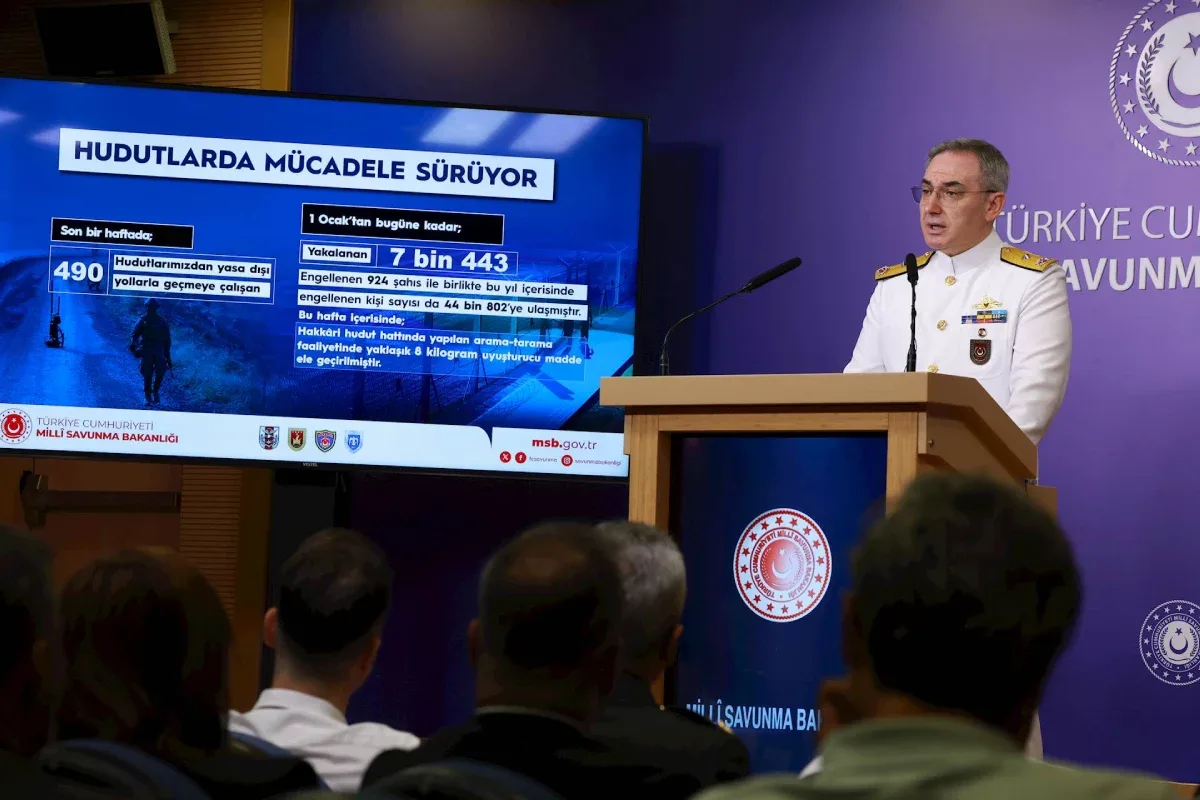
Rear Admiral Zeki Aktürk, spokesperson and press and public relations adviser at the Ministry of National Defense (Milli Savunma Bakanlığı, MSB), said during the ministry's weekly briefing that the South-Eastern Europe Brigade (SEEBRIG) headquarters reached operational capability in Istanbul on August 3 after personnel and equipment were transferred from Kumanovo, North Macedonia. The briefing also covered Türkiye's NATO air-policing deployment in Estonia, allied naval activity in Turkish ports and the military's position on the government's "Terror-Free Türkiye" process.
SEEBRIG headquarters moves back to Istanbul
Türkiye will host the SEEBRIG headquarters from 2026 through 2032, bringing the multinational formation back to Istanbul after its previous deployment in the city between 2007 and 2011.
The relocation from Kumanovo began in July, with equipment transferred between July 19 and 21 before multinational personnel arrived in stages. The headquarters reached operational capability on August 3 at the Gen. Muharrem Mazlum İskora Barracks, home to Türkiye's 3rd Corps Command, and is due to become formally active at its new location on August 31 following an activation, command handover and 27th anniversary ceremony scheduled for August 27.
The headquarters has 28 core personnel from Türkiye, Albania, Bulgaria, Greece, Romania and North Macedonia, including 12 Turkish personnel and 16 from the other participating countries.
SEEBRIG was established in 1999 under the Multinational Peace Force South-Eastern Europe framework to strengthen military cooperation among participating states and provide a formation that can support peace operations. Its forces remain under national command unless participating governments agree on their employment, and the brigade can be made available for missions conducted under United Nations or Organization for Security and Co-operation in Europe mandates and led by NATO or the European Union.
The Istanbul move was planned before the current round of regional tensions and follows the end of the headquarters' six-year rotation in North Macedonia. It gives Türkiye another turn hosting a multinational Balkan military command at a time when southeastern European allies are placing greater emphasis on readiness, military mobility and interoperability.
Turkish Land Forces accept TAYFUN system vehicles
The MSB said inspection and acceptance procedures had been completed for TAYFUN launch vehicles, transport-loading vehicles and command-and-control vehicles for the Turkish Land Forces, together with additional MPT-76 infantry rifles and other equipment. The ministry did not disclose the quantities involved.
The announcement concerns the mobile ground components needed to operate the TAYFUN weapon system rather than a newly announced delivery of missiles. Launch, reload and command vehicles form the field architecture that allows the system to be moved, prepared and controlled during operations.
TAYFUN is one of the principal domestically developed systems in Türkiye's expanding missile inventory, and the acceptance of additional support vehicles increases the infrastructure available to military units assigned to the weapon.
SOM-B1T missiles and guidance kits delivered to Air Force
The Turkish Air Force also received a new batch of precision-guided weapons, with ASELSAN delivering HGK-84 precision-guidance kits and LGK-82/84 laser-guidance kits while ROKETSAN supplied SOM-B1T cruise missiles.
The MSB had previously announced acceptance work for SOM-B1T munitions at ROKETSAN facilities in July. Friday's briefing confirmed that the process had been completed and the weapons delivered to the Air Force, although the number of missiles and guidance kits was not disclosed.
SOM-B1T belongs to Türkiye's air-launched Stand-Off Missile family and uses the domestically developed KTJ-3200 turbojet engine. The missile provides combat aircraft with a precision stand-off strike capability, while the latest deliveries come as Türkiye continues to increase domestic content across propulsion, guidance and mission systems used in its air-launched weapons.
Turkish F-16s begin four-month NATO mission in Estonia
Five Turkish F-16 fighters assigned to NATO's Enhanced Air Policing mission arrived in Estonia on July 31 and began operational duty on August 1, the ministry said, with the deployment scheduled to continue through November 30.
As Bosphorus News previously reported, the aircraft are operating from Ämari Air Base as part of NATO's rotating air-defense presence in the Baltic region, where Turkish pilots and ground crews are available for quick-reaction alert missions involving unidentified aircraft and potential violations of allied airspace.
Türkiye has contributed fighters to NATO air-policing missions in the region before, but the current deployment comes as the alliance continues to reinforce air-defense readiness along its eastern and northeastern flanks.
Greek and Italian naval units call at Aksaz
The weekly briefing also recorded several NATO-linked naval movements involving Turkish, Greek and Italian forces.
The Greek Navy frigate Kountouriotis and the Italian Navy vessel Montecuccoli visited the Aksaz naval facility between August 4 and 6 as part of NATO Standing Maritime Group 2, while the Italian Navy's San Marco visited Antalya between August 2 and 6.
TCG Osmangazi called at Livorno between August 5 and 7 during open-sea training for Turkish Naval Academy cadets, and TCG Oruçreis, after completing duties with NATO Standing Maritime Group 1 and visiting Lisbon, was scheduled to call at Civitavecchia between August 7 and 11.
The movements placed Turkish, Greek and Italian naval units in overlapping NATO activity during the same week, with Aksaz again serving as a port for allied maritime forces operating in the Mediterranean.
MSB says armed forces will protect gains in PKK process
The ministry also addressed the government's "Terror-Free Türkiye" initiative as the Grand National Assembly of Türkiye considers legislation governing the PKK disarmament process.
The Kurdistan Workers' Party (PKK) is designated as a terrorist organization by Türkiye, the United States and the European Union.
The MSB said permanently removing terrorism from Türkiye's agenda would contribute to security and stability beyond the country's borders and described the objective as part of a national and regional security approach. It added that the Turkish Armed Forces would continue carrying out their responsibilities and taking the measures necessary to preserve gains achieved through counterterrorism operations.
The remarks followed the National Security Council's August 6 assessment, which considered the process alongside Türkiye's cooperation with Syria and Iraq and other regional security issues. The Defense Ministry did not announce a separate military timetable or new operational mechanism linked to the parliamentary legislation.
Sources: Türkiye's Ministry of National Defense, South-Eastern Europe Brigade, Bosphorus News review and reporting.