
By Bosphorus News Defense Desk
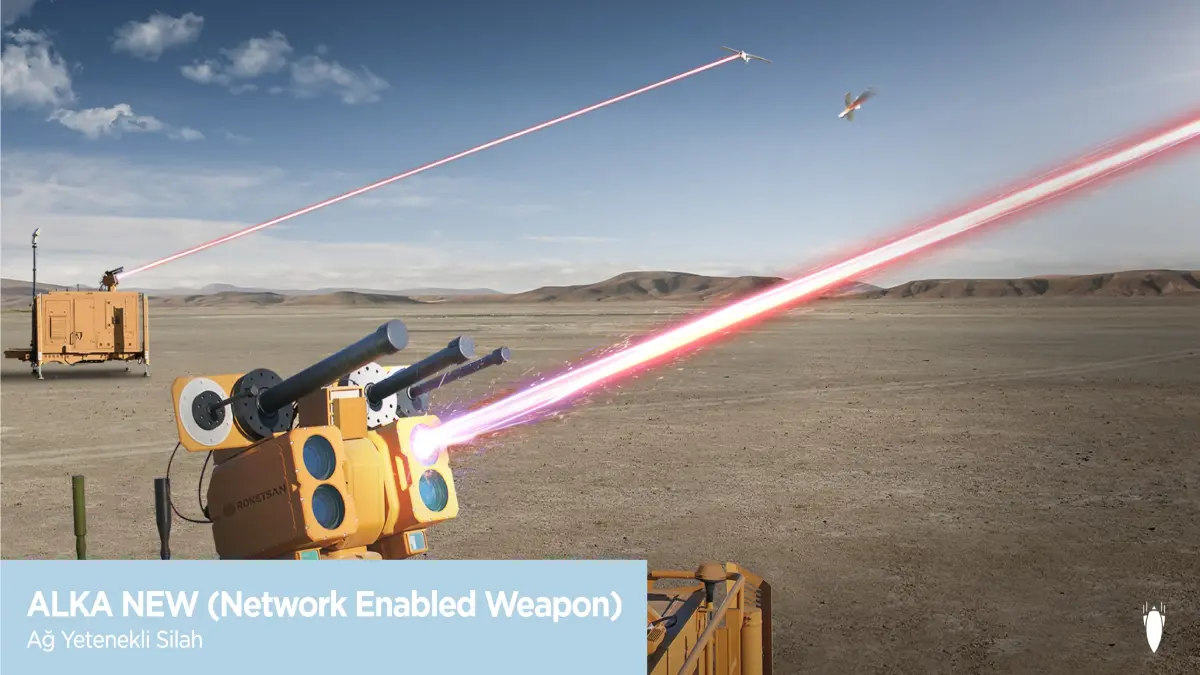
Türkiye is adding Roketsan's ALKA laser weapon system to its Steel Dome air defense shield, placing directed energy inside the country's growing response to drones, loitering munitions and low-cost aerial threats.
Roketsan Weapons Systems and Integration Director Koray Dayanç told Anadolu Agency that ALKA is being positioned as the laser component of Steel Dome, Türkiye's multi-layered air defense project. The system is designed to counter drones, mini and micro unmanned aerial vehicles, improvised explosive devices and other asymmetric battlefield threats.
The most important update is power. Dayanç said ALKA has been upgraded from 2.5 kilowatts to above 10 kilowatts, giving the system a stronger role against small, fast-moving targets that can strain conventional air defense networks.
Roketsan's official product page describes ALKA as a directed-energy weapon system and a very-short-range hybrid air defense system using electromagnetic and laser technologies. The company says the system uses a two-layer defense model, disrupting threats through electromagnetic jamming before destroying them with laser engagement.
The official ALKA catalogue lists a 750-meter effective destruction range for the 2.5-kilowatt laser configuration and 1,500 meters for the 5-kilowatt configuration. It also lists drone-detection radar, tracking capacity for up to 100 targets, day-and-night operation, and mobile, portable or fixed-use concepts.
That catalogue baseline makes Dayanç's latest statement more significant. Roketsan's earlier public material listed 2.5-kilowatt and 5-kilowatt configurations. The new statement places ALKA above 10 kilowatts, marking a capability increase beyond the previously published configurations.
Roketsan lists fixed-wing and rotary-wing mini and micro unmanned aerial vehicles, loitering munitions, improvised explosive devices and unexploded ordnance among ALKA's target set. The catalogue also refers to swarm drone threats, placing the system directly inside the saturation problem now reshaping modern air defense.
Türkiye's Steel Dome is designed as a layered air defense shield bringing together radar, missiles, sensors, command-and-control systems and artificial intelligence-supported decision tools. The project expanded through a $6.5 billion defense package aimed at strengthening Türkiye's integrated air shield, as Bosphorus News previously detailed.
ALKA's role answers a growing operational need. Air defense is no longer built only around aircraft and missile interceptors. Cheap drones, loitering munitions and small unmanned systems force militaries to combine radar coverage, electronic warfare, rapid command decisions and lower-cost kill options.
A missile may be the right answer against an aircraft or cruise missile, but it can be an expensive answer against a small drone. Directed-energy systems change that cost equation, especially when the threat is repetitive, low-cost and close to protected assets such as military bases, airports, energy facilities and public buildings.
The ALKA development also fits a broader Turkish defense pattern. Steel Dome is emerging as an integrated system that connects multiple capabilities across the air defense chain. Türkiye has been expanding the non-kinetic side of that chain through electronic warfare, including the appearance of its HAVA SOJ electronic warfare aircraft, as Bosphorus News reported.
The missile side is moving in parallel. Türkiye has also advanced Gökdoğan and Bozdoğan air-to-air missiles into serial production, strengthening the domestic missile ecosystem around the same defense-industrial base, as Bosphorus News reported.
ALKA therefore adds a specific layer to Steel Dome rather than standing apart from it. HAVA SOJ expands electronic warfare and battlefield disruption. Gökdoğan and Bozdoğan strengthen the missile base. ALKA addresses the closer, cheaper and more repetitive drone threat that many air defense systems now struggle to handle efficiently.
The latest ALKA step does not mean Steel Dome is complete. It shows Türkiye moving to fill one of the most urgent gaps in modern air defense: defeating small drones and saturation attempts without relying only on high-value interceptors.
The test for Steel Dome will be whether these layers can work together under pressure. ALKA gives Türkiye a tool for the closer and cheaper end of the threat spectrum, where small drones and repeated attacks can create problems out of proportion to their cost.