
Bosphorus News Defense Desk
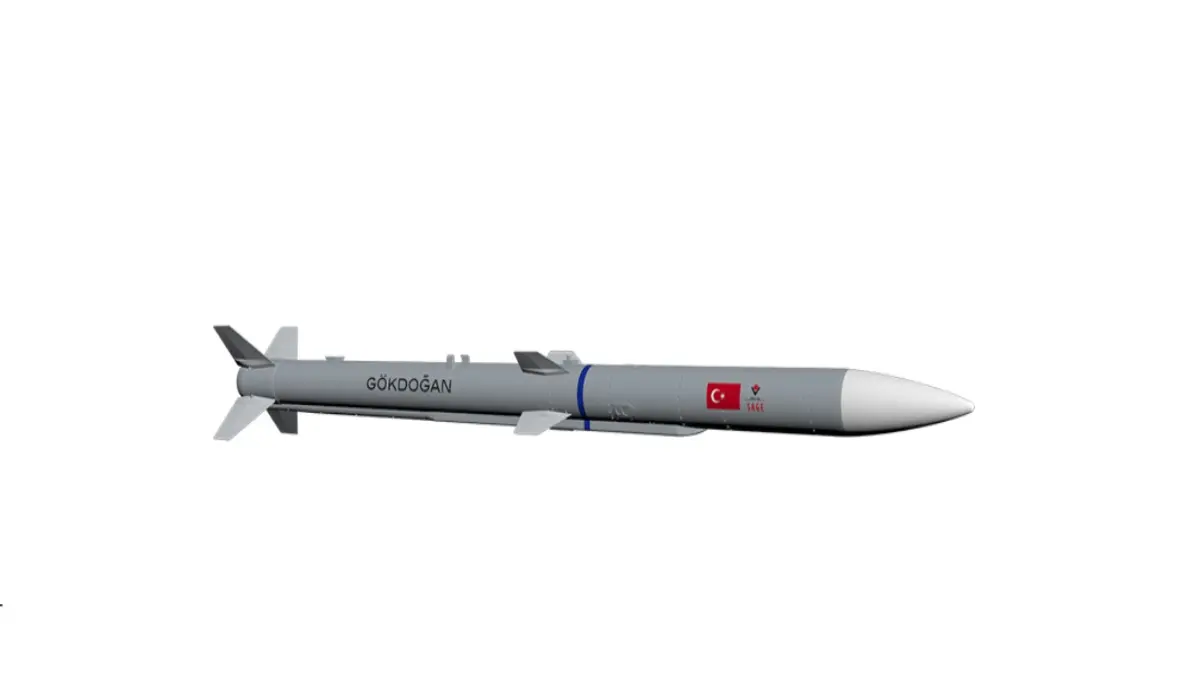
Türkiye has completed live-warhead validation tests for its domestically developed GÖKDOĞAN beyond-visual-range and BOZDOĞAN within-visual-range air-to-air missiles, with serial production processes now underway, Industry and Technology Minister Mehmet Fatih Kacır announced.
Kacır said both missiles hit their targets with full precision in their latest tests using live warheads, completed their validation processes and entered serial production. He described the result as more than a test, calling it a concrete sign of Türkiye's deterrence, engineering capacity and determination in the sky.
The tests were conducted by TÜBİTAK SAGE, Türkiye's defense research institute for guided munitions and missile systems, in coordination with the Turkish Air Force. The announcement gives the GÖKTUĞ air-to-air missile family a clear production threshold after years of development, test firing and platform integration work.
Two Missiles, Two Roles
GÖKDOĞAN is Türkiye's indigenous beyond-visual-range air-to-air missile. TÜBİTAK SAGE describes it as a high-maneuverability missile system equipped with advanced counter-countermeasure capabilities for engagements beyond visual range. Its role is to reduce Türkiye's reliance on imported medium-range air-to-air missiles in one of the most sensitive areas of air combat.
BOZDOĞAN is the short-range counterpart. TÜBİTAK SAGE defines it as a within-visual-range air-to-air missile with high maneuverability, advanced counter-countermeasure features and a solid-fuel rocket motor. It is designed for close-range combat, where reaction time, seeker performance and maneuverability decide the engagement.
The two missiles address different parts of the same dependency problem. Türkiye's fighter force has long relied on foreign-supplied air-to-air missiles for both beyond-visual-range and close-combat missions. Serial production of GÖKDOĞAN and BOZDOĞAN does not make the wider airpower ecosystem fully independent, but it gives Ankara more control over a weapons category that can be shaped by export approvals, political pressure and wartime supply limits.
From F-16s to KAAN
The immediate platform context is Türkiye's F-16 fleet, which remains the backbone of the Turkish Air Force. The latest tests were carried out inside the existing air force test architecture, making the F-16 the first practical bridge between the development program and operational use.
The longer horizon is KAAN, Türkiye's fifth-generation fighter developed by Turkish Aerospace Industries. The latest official announcement did not say that GÖKDOĞAN or BOZDOĞAN had completed KAAN integration. The point is broader. A domestic air-to-air missile family gives the KAAN program a weapons base that can move with the aircraft as it advances through testing, early production and future block development.
A national fighter still needs national weapons to carry strategic weight. Without them, even an indigenous aircraft can remain exposed to foreign export decisions in one of its core combat functions. GÖKDOĞAN and BOZDOĞAN reduce that exposure before KAAN reaches operational maturity.
The Unmanned Air Combat Layer
The missile family has already moved into Türkiye's unmanned air combat planning. TÜBİTAK SAGE has published official material on the GÖKDOĞAN launch from Bayraktar KIZILELMA, Türkiye's unmanned combat aircraft. That test connected an unmanned platform, a national radar architecture and a national beyond-visual-range missile in a single firing sequence.
Baykar and specialist defense outlets described the KIZILELMA firing as a world-first beyond-visual-range air-to-air engagement by an unmanned combat aircraft. The claim is notable, but the larger point is operational. Türkiye is testing whether its future air force can pair manned fighters, unmanned combat aircraft, national radars and domestic air-to-air missiles in the same combat architecture.
That is where the GÖKTUĞ program gains weight beyond the F-16 fleet. Airpower is moving toward mixed formations in which manned aircraft, loyal-wingman systems, drones, sensors and missiles operate as one network. GÖKDOĞAN's use on KIZILELMA gives Ankara an early test case for that model.
Strategic Autonomy After the F-35 Break
The production milestone also belongs to Türkiye's post-F-35 defense trajectory. Türkiye was removed from the F-35 Joint Strike Fighter program after its acquisition of the Russian S-400 air defense system, cutting Ankara off from the Western fifth-generation fighter path it had expected to join.
That break pushed Ankara to deepen its own combat-air ecosystem. KAAN became the future fighter track. KIZILELMA and other unmanned systems became the unmanned layer. MURAD AESA radar entered the sensor architecture. GÖKDOĞAN and BOZDOĞAN now give the weapons side of that structure a stronger production footing.
The Eurofighter file adds a separate but related layer. Türkiye is still weighing foreign platforms to manage the transition before KAAN matures, including the Eurofighter Typhoon. The missile announcement does not answer the platform question. It does show that Ankara is trying to avoid a future in which aircraft procurement, missile supply and combat readiness all depend on the same external gatekeepers.
NATO and the Airpower Debate
The announcement comes weeks before Türkiye hosts the NATO summit in Ankara on July 7 and 8. Ukraine, allied readiness, defense industry capacity and the southern flank are expected to dominate the agenda. Türkiye will host that summit while also presenting itself as a defense producer with expanding air, naval, drone and missile capabilities.
GÖKDOĞAN and BOZDOĞAN are not summit bargaining chips in a narrow sense. Their relevance is more durable. They support Türkiye's argument that its defense industry is moving beyond platform assembly and toward a fuller weapons ecosystem, one that includes missiles, radars, drones, aircraft and production capacity.
The next layer is already visible in TÜBİTAK SAGE's portfolio. GÖKHAN, a national ramjet-powered air-to-air missile, is listed alongside BOZDOĞAN and GÖKDOĞAN as part of the same air-to-air missile family. It remains a development project rather than today's production story, but it shows where the portfolio is heading.
Türkiye's airpower debate has moved beyond the question of which aircraft it can buy. The harder question now is how much of the combat system around those aircraft Ankara can build, produce and sustain on its own. GÖKDOĞAN and BOZDOĞAN do not settle that question, but their move into serial production gives Türkiye a stronger answer than it had before.
***Sources: Anadolu Agency; TÜBİTAK SAGE; Presidency of Defence Industries; Baykar; TurDef; The Aviationist.