
By Bosphorus News Geopolitics Desk
Officials cited by Anadolu Agency said on August 7 that Türkiye's new mutual-defense agreement with Saudi Arabia and Pakistan does not mean Turkish troops will be sent into every regional crisis, and that decisions involving the use of force and military operations will continue to be taken within Türkiye's constitutional order and national decision-making mechanisms.
That qualification does not appear in the joint statement released after the Mecca signing, which says an armed attack against any one of the three countries will be regarded as an attack against all three. With the full agreement still unpublished, the central question is what Türkiye would actually be required to do if Saudi Arabia or Pakistan came under attack.
One month earlier, at NATO's Ankara summit on July 8, Türkiye and its allies reaffirmed Article 5 with similarly direct language: an attack on one is an attack on all. The wording invites comparison. The legal systems behind it are very different.
The commitment is public; the mechanism is not
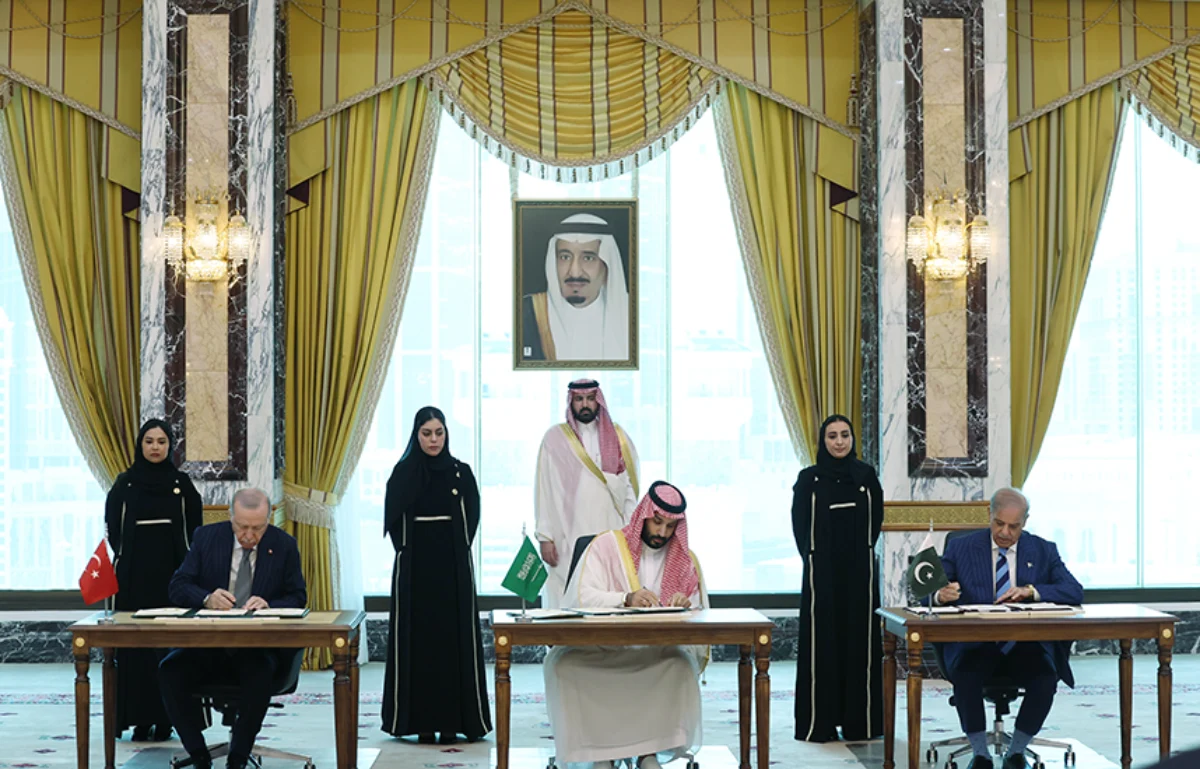
Türkiye, Saudi Arabia and Pakistan issued matching joint statements after President Recep Tayyip Erdoğan, Saudi Crown Prince and Prime Minister Mohammed bin Salman and Pakistani Prime Minister Shehbaz Sharif signed the Mecca Joint Defense Agreement.
The statement says the pact is intended to strengthen collective deterrence against aggression and expand defense cooperation. It then sets out the mutual-defense clause without describing what military action would follow an attack.
Pakistan's Foreign Ministry published the declaration as press release 204/2026. Türkiye and Saudi Arabia released the same operative language through their official channels.
None of the three governments has published the full agreement, leaving the military procedures behind the clause outside the public record. There is no available text showing whether assistance would be automatic, what form it could take, whether consultations must precede action or whether the pact establishes a standing command or deployment structure.
Bosphorus News made that distinction in its August 8 Eastern Mediterranean Strategic Brief: the mutual-defense commitment is explicit, while the military machinery behind it remains undisclosed.
Officials cited by Anadolu Agency added a qualification
The clearest explanation from Türkiye of how the clause would affect military deployments came separately from the joint statement.
Anadolu Agency reported, citing officials familiar with the agreement, that participation does not mean Turkish troops would be sent into every regional crisis. Decisions involving the use of force and military operations would continue to be taken through Türkiye's constitutional order and national decision-making mechanisms, the officials said.
Their account also referred to deeper defense-industry cooperation, greater interoperability among the three militaries and cooperation connected to Ankara's Terror-Free Region policy.
The deployment language shows that the mutual-defense clause is not being presented in Türkiye as an automatic instruction to send forces abroad. An attack could engage Türkiye's commitment under the agreement without, by itself, determining the military response.
The constitutional route cannot yet be stated with certainty. Article 92 of Türkiye's Constitution normally gives parliament authority to approve the deployment of Turkish armed forces abroad, while expressly excluding cases required by international treaties to which Türkiye is a party. Without the full Mecca agreement and the provisions governing its implementation, it is not possible to establish how that exception would apply to a future deployment.
The clearest Turkish qualification of the agreement therefore came not in the joint statement, but through officials cited by Anadolu Agency.
Ankara also addressed the NATO question
Türkiye separately rejected claims that the Mecca agreement conflicts with Article 5 of the North Atlantic Treaty or creates a parallel alliance structure.
The Directorate of Communications said the agreement does not conflict with Türkiye's existing international alliance commitments, including NATO, and described it as a complementary mechanism supporting regional security. It also said Türkiye's development of regional partnerships is not an alternative to NATO membership.
Article 5 itself does not require every NATO member to provide an identical military response. An ally must assist a member subjected to an armed attack, but each state determines the action it considers necessary, including whether that assistance involves armed force.
At the July 8 Ankara summit, NATO leaders reaffirmed their commitment to Article 5 and repeated the attack-on-one formula. Thirty days later, the Mecca statement used closely comparable language for Türkiye, Saudi Arabia and Pakistan.
The comparison cannot be taken much further from the documents available today. NATO's founding treaty, institutions and procedures are public. The rules governing military action under the Mecca agreement are not.
Claims that the two arrangements are legally equivalent, or necessarily incompatible, run ahead of the evidence.
Riyadh also set limits; Islamabad did not
Saudi Arabia also moved to narrow interpretations of the agreement after the signing.
Rayed Krimly, Saudi deputy minister for public diplomacy, said the pact was not an effort to establish a military axis or sectarian bloc and was not linked to nuclear ambitions or an arms race. Saudi messaging also said the agreement would not come at the expense of the kingdom's strategic relations with Gulf, Arab and international partners.
Riyadh was defining what the new arrangement was not intended to become, rather than adding detail about how its mutual-defense obligation would operate.
Pakistan's official statement stopped with the mutual-defense clause and the pledge to expand defense cooperation. It offered no comparable public explanation concerning constitutional procedures, existing alliances or the conditions under which military assistance would be provided.
That does not prove Islamabad interprets the agreement more broadly. It means only that Pakistan chose not to define those limits publicly on August 7.
Reactions depend on who is speaking
The first responses outside the three signatories also showed why the institutional source behind each reaction matters.
India said it was closely following the agreement. Israel was approached for comment, but Prime Minister Benjamin Netanyahu's office declined to respond. Reuters reported that Tehran had not immediately issued an official reaction.
The sharp Iranian criticism that followed came from Ebrahim Rezaei, a member of the Iranian parliament's National Security and Foreign Policy Commission. He argued that the agreement would not provide Saudi Arabia with security and criticized Riyadh's reliance on outside security partners.
Rezaei's committee role gives his comments political relevance. It does not make them a statement by the Iranian government.
A joint declaration issued by three governments, information supplied by officials to a news agency, an official government clarification and a lawmaker's social-media post carry different institutional weight. That distinction becomes more important when the document that would settle many of the underlying questions remains unavailable.
What the Pact Still Does Not Say
The public record leaves little doubt about the mutual-defense promise: an armed attack against one signatory is to be treated as an attack against all three. The missing part is what each government must do next.
Ankara has supplied part of its answer. Officials cited by Anadolu Agency say the clause does not automatically send Turkish troops into a regional conflict and that decisions involving military force remain within Türkiye's constitutional and national decision-making system. Those words are absent from the joint statement released after the signing.
Türkiye had a particular reason to address the issue. It is the only signatory already operating inside NATO's collective-defense system, and the similarity between the two attack-on-one formulations made comparisons unavoidable. Saudi Arabia also moved quickly to define what the pact was not intended to become. Pakistan published the commitment and left its operational limits unstated.
None of those explanations can substitute for the full agreement.
For now, two points are firmly on the record: an attack against one of the three countries is to be treated as an attack against all three, and Türkiye says that provision does not mean its forces will automatically be sent into a regional conflict.
The rules connecting those two propositions remain unpublished.
Sources: Türkiye's Directorate of Communications, Anadolu Agency reporting based on information from officials familiar with the agreement, Constitution of the Republic of Türkiye, Pakistan's Ministry of Foreign Affairs, Saudi official statements, NATO, Reuters, Associated Press, Bosphorus News review and reporting.