
By Bosphorus News Geopolitics Desk
The United States is trying to establish a deconfliction mechanism among Türkiye, Israel and Syria after an Israeli airstrike near the Turkish border exposed the risk of their competing military activity inside Syria producing direct contact.
The effort comes as Israeli Prime Minister Benjamin Netanyahu's election campaign makes President Recep Tayyip Erdoğan part of its domestic security argument. Likud has placed Erdoğan on campaign billboards alongside foreign figures portrayed as wanting Netanyahu defeated on October 27, following earlier Israeli allegations that Türkiye was trying to influence the election through social media.
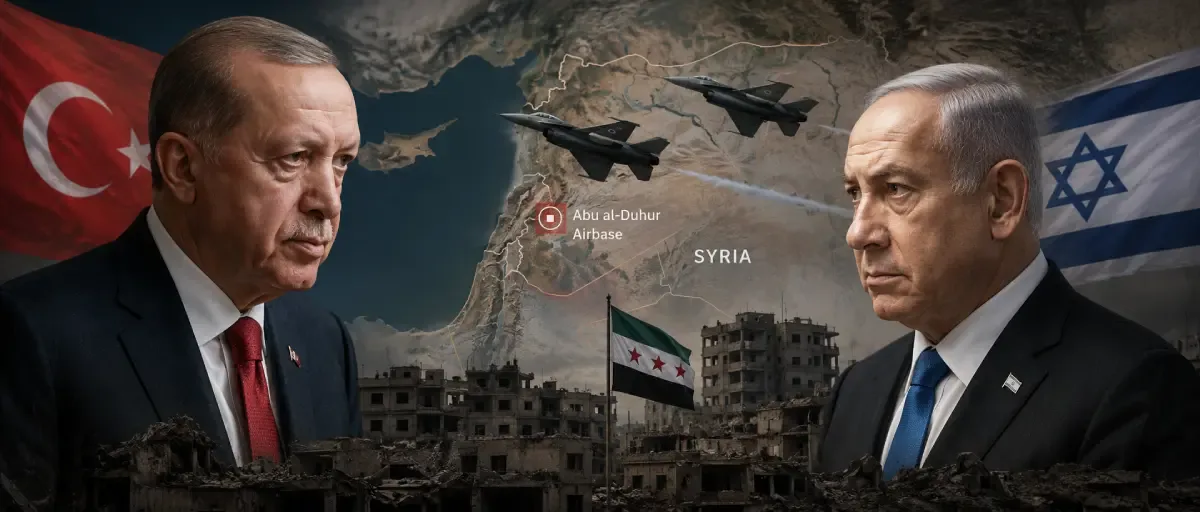
The military risk became concrete on August 18, when Israel struck Syria's Abu al-Duhur airbase without informing Ankara in advance. US Ambassador to Türkiye and Special Envoy for Syria Tom Barrack said Türkiye could have prepared a response after detecting Israeli aircraft heading toward the Turkish frontier. He disclosed the same day that Washington was working on communications intended to prevent such an encounter from escalating.
Washington Is Managing a Military Risk
Israeli aircraft struck Abu al-Duhur at least eight times, hitting runways and storage facilities at the base in Syria's Idlib province. Syrian authorities reported damage but no casualties.
Israel said it acted because Syria was preparing to allow a Turkish military deployment that would alter an existing security understanding. Türkiye said no Turkish military delegation was at Abu al-Duhur immediately before or during the attack. Syrian Foreign Minister Asaad al-Shaibani later acknowledged that Turkish officers had visited the base but described their presence as training and expertise-sharing rather than preparation for a permanent deployment.
The Israeli argument also depends on an understanding whose exact terms have never been published. Israel has described a Syria security "freeze" under which Türkiye was not expected to move farther south while Israel would refrain from changing its own military positions. No public text establishes Türkiye as a party to such an arrangement, and US officials have not confirmed the terms described by Israel.
Barrack's account of August 18 focused on a more immediate problem. Ankara had received no warning, he said, and could reasonably have prepared a response after seeing Israeli aircraft moving north toward the Turkish border.
Israeli Defense Minister Israel Katz later disputed parts of Barrack's description. Katz said Israel had warned senior Syrian officials, shared relevant intelligence with US authorities and approved the attack only after Damascus failed to respond. Israel has not said that Türkiye itself received advance notice.
The disagreement explains part of Washington's urgency. An Israeli decision based on intelligence about a possible Turkish deployment was carried out close enough to Türkiye for Ankara to detect the aircraft without knowing their mission.
Türkiye Was Already Inside Israel's Election Debate
Erdoğan's appearance on a Likud billboard was not the beginning of the election dispute.
In late July, Israeli security officials accused Türkiye of trying to influence the October vote through social media. Likud lawmaker Amit Halevi separately alleged that Türkiye and Iran were involved in a broader effort to remove Netanyahu's government.
No accounts, organizations or evidence connecting the alleged activity to the Turkish government were made public. Israel's State Comptroller had released a report that month identifying Iran as the leading source of detected hostile foreign influence activity in the country's digital sphere, but it did not name Türkiye.
The campaign language became more explicit on August 16. A Likud billboard in Tel Aviv showed Erdoğan alongside Mojtaba Khamenei, Hezbollah Secretary-General Naim Qassem and New York Mayor Zohran Mamdani beneath a message saying they wanted Netanyahu to lose.
Two days later Israel struck Abu al-Duhur.
There is no evidence that the airstrike was ordered for electoral reasons. Barrack nevertheless brought Israeli domestic politics into the discussion when he publicly questioned whether the timing could have been connected to Netanyahu's campaign. He also raised the possibility that the operation had been intended to provoke Türkiye, without presenting either explanation as an established US finding.
Ankara has made the election argument more directly. Presidential Communications Director Burhanettin Duran linked Netanyahu's recent language on Türkiye and Syria to domestic political calculations and accused the Israeli government of manufacturing external threats.
Those are political assessments. The chronology itself is established: allegations of Turkish election interference appeared in July, Erdoğan entered Likud campaign imagery in August, Israel then struck a Syrian base over an alleged future Turkish military presence, and Washington publicly moved to reduce the possibility of Israeli and Turkish forces confronting each other.
Security Contacts Began Before Abu al-Duhur
Senior contacts over Türkiye's military role in Syria were already underway before the strike.
Mossad Director Roman Gofman spoke by telephone with al-Shaibani on August 14. Türkiye's military role in Syria, including arms and drone support and possible deployments, was among the issues discussed.
Israel struck Abu al-Duhur four days later.
On August 23, al-Shaibani and an Israeli delegation met in Jordan under US mediation. Sources familiar with the meeting said Gofman attended and that the talks covered a possible special operations room under US supervision to prevent confrontations inside Syria, including incidents involving Türkiye.
Damascus also made clear that it intended to decide how the Syrian armed forces would be rebuilt and which countries it would choose as security partners.
The Jordan meeting sits alongside a quieter direct channel between Israel and Türkiye aimed at reducing military miscalculation in Syria. A senior Israeli security official told public broadcaster KAN that closed communications were being used to prevent the two countries from reaching a military confrontation.
The official said Israel did not want Türkiye to become an enemy, but also maintained that Israel would act when communications failed to resolve what it considered a security threat.
That description closely resembles Netanyahu's own explanation of Abu al-Duhur: Israel warned first and struck when it concluded that the warning had not worked.
Several Channels, No Three-Way Agreement
No formal Türkiye-Israel-Syria mechanism has been announced.
Washington is instead working through overlapping contacts: renewed Syria-Israel negotiations, discussions in Jordan over operational coordination, a closed Israel-Türkiye line and the broader three-party deconfliction arrangement described by Barrack.
The underlying disputes remain intact. Israel opposes Turkish military infrastructure in areas of Syria that it believes could restrict Israeli operations or threaten its security. Türkiye intends to continue defense cooperation with the government of Syrian President Ahmed al-Sharaa. Damascus rejects Israeli efforts to determine how it rebuilds its armed forces or chooses its partners.
Israel's election campaign now runs alongside those unresolved military questions. Türkiye is being used in Likud campaign material as an external adversary while Israeli officials are simultaneously discussing Turkish deployments, intelligence assessments and red lines inside Syria.
Washington is trying to keep those two arenas separate.
Barrack's account of August 18 explains why the task has become operational rather than rhetorical: Türkiye saw Israeli aircraft moving toward its frontier without advance warning and, in his assessment, could reasonably have begun preparing a response before learning what Israel intended to strike.
Sources: Reuters, Associated Press, AFP, SANA, KAN, Israel State Comptroller, Republic of Türkiye Directorate of Communications, Israeli government statements, Bosphorus News review and reporting.