
By Bosphorus News Defense Desk
Türkiye has formally confirmed it will join the Canada-led Defence, Security and Resilience Bank as a founding member, ending three days of conflicting public messages over its commitment.
Canada named Türkiye among the bank's founders on July 7. Three days later, Turkish outlets citing defense sources reported that an interagency review had concluded Türkiye would not make a commitment "at this stage." By July 11, the public wording had changed, with Turkish defense sources saying participation remained under evaluation.
A Turkish official then said Türkiye formally notified Canada on July 13 that it would join as a founding member.
The decision places Türkiye inside a non-European Union financing structure as it challenges restrictions on Turkish access to European defense programs.
The sequence showed that Canada announced Türkiye's role before the Turkish government had publicly completed its own approval process.
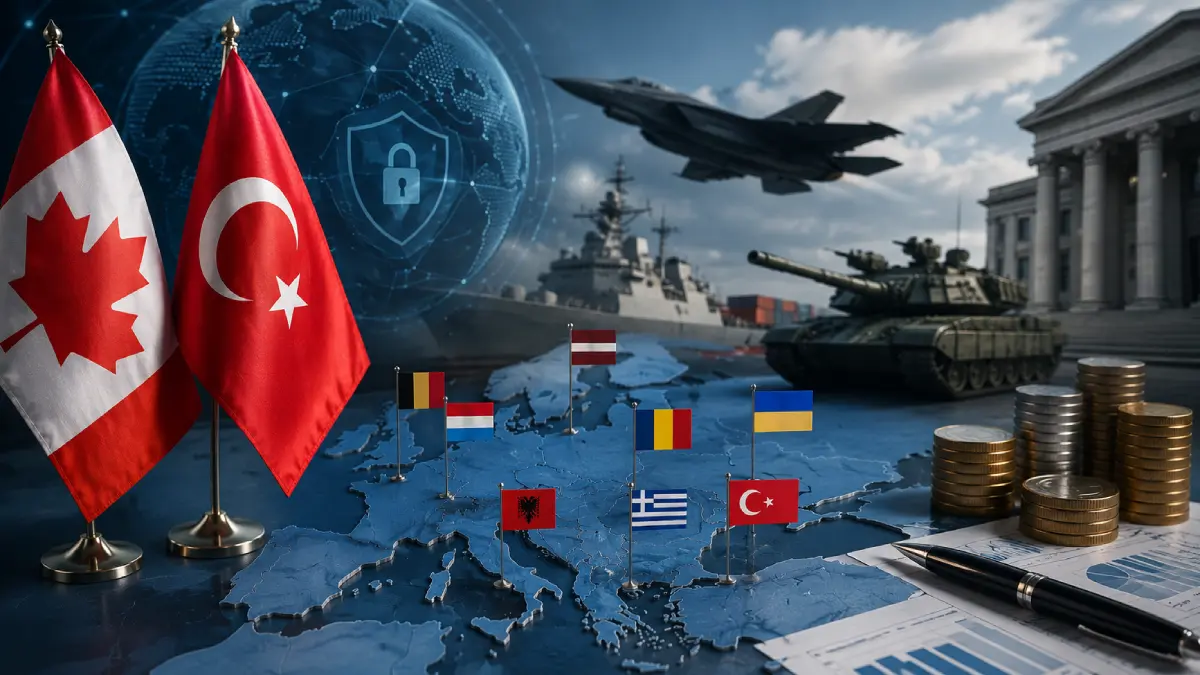
Canada listed Türkiye alongside Albania, Belgium, Greece, Latvia, Luxembourg, Romania and Ukraine in a declaration issued during the NATO summit in Ankara. The document expressed the nine leaders' shared intention to establish the bank.
Canada said the participating countries would define the institution's initial policies and operating directives, including how projects are financed and how economic benefits are distributed among members.
Turkish reports published three days later said representatives of the Defense Ministry, Foreign Ministry, Treasury and Finance Ministry, and the Presidency of Defence Industries had reviewed the proposal and decided against making an immediate commitment.
Reuters reported on July 11 that Türkiye remained involved in the process but was still evaluating participation. The July 13 confirmation brought the public uncertainty to an end.
No public record explains why Türkiye's position changed, and there is no verified evidence of Canadian pressure or an internal dispute among Turkish institutions.
The available timeline indicates that Ottawa announced a political commitment before Türkiye had completed, or publicly acknowledged the completion of, its domestic approval process.
Türkiye was involved before the Ankara summit
Türkiye's involvement began months before the July announcement.
Canadian Prime Minister Mark Carney and President Recep Tayyip Erdoğan discussed the Defence, Security and Resilience Bank during an April 15 call covering trade, energy and defense cooperation. The Canadian readout described the bank as a possible channel for new defense procurement opportunities between the two countries.
Türkiye also participated in negotiations in Montreal, where talks on the bank's founding charter concluded on April 29. Canada described the agreement as an initial step toward establishing the institution and locating its headquarters in the country.
The earlier talks rule out the idea that Canada simply added Türkiye to the founding list by mistake. Both governments had been involved in the process, but Türkiye's final commitment was not settled when the Canadian announcement was published.
An alternative to EU-centered defense finance
The bank is intended to provide long-term, lower-cost loans and guarantees for governments and companies operating in defense, security and related supply chains.
Canada says the institution will use sovereign backing to mobilize private capital and reduce financing constraints faced by small and medium-sized defense suppliers. The bank is expected to begin operations in 2027.
Reuters reported that the institution is targeting up to £100 billion, about $134 billion, in financing capacity. That figure is not an existing fund or an allocation available to Türkiye. It is a projected lending capacity dependent on member capital, guarantees, credit ratings and the bank's ability to borrow in financial markets.
The bank offers Türkiye a potential financing route that is not tied to EU membership.
Erdoğan used the NATO summit to call for the removal of restrictions affecting defense trade and to oppose mechanisms that exclude non-EU NATO members. Türkiye has sought access to European defense programs, including the Security Action for Europe instrument, but disagreements involving Greece and the Republic of Cyprus have complicated its position.
The new bank will not replace EU programs. Its structure could allow Türkiye to finance production capacity, supply-chain expansion and joint projects as a founding participant rather than an external applicant.
Türkiye is seeking a larger role in Europe's rearmament while its return to advanced Western weapons programs remains contested. Bosphorus News previously examined how pressure involving the F-35, KAAN, Greece and Israel is shaping Türkiye's defense relationship with Washington.
Türkiye and Greece join the same structure
Türkiye and Greece are entering the bank at the same stage despite Athens' objections to Türkiye's access to some European defense instruments.
Their participation does not resolve those disputes. It places both countries inside a separate institution whose entry terms are not based on EU membership and whose rules will be shaped by its founding states.
Ukraine is also part of the initial group. Türkiye and Ukraine already cooperate on unmanned aircraft, naval platforms, engines and defense production, creating a possible industrial link if the bank finances Ukrainian procurement or longer-term security projects.
The Ankara summit declaration preserved allied support for Ukraine while avoiding an explicit return to earlier NATO membership language. Bosphorus News reported that the wording reflected the political limits surrounding the alliance's support for Kyiv.
Capital and governance questions remain open
Türkiye's confirmation secures its position in the formation process, but the practical value of membership remains unclear.
The governments have not disclosed Türkiye's capital contribution, voting weight or access to the bank's lending facilities. Final rules for eligible companies, national content, cross-border procurement and project selection have also not been published.
Canada is currently the only G7 member in the founding group. The absence of the United States, Germany, France, the United Kingdom, Italy and Japan raises questions about how quickly the bank can build the capital base and credit strength needed to reach its financing target.
Britain, the Netherlands, Finland and Poland are developing a separate Multilateral Defence Mechanism focused on joint procurement and equipment stockpiles. British Chancellor Rachel Reeves has argued that the two initiatives should eventually be brought together rather than compete for government capital.
Türkiye is now inside the institution's founding group, but its capital contribution, voting power and the eligibility of Turkish companies remain unresolved.
Sources: Canada's Prime Minister's Office, Canada's Department of Finance, Reuters, Bosphorus News review and reporting.