
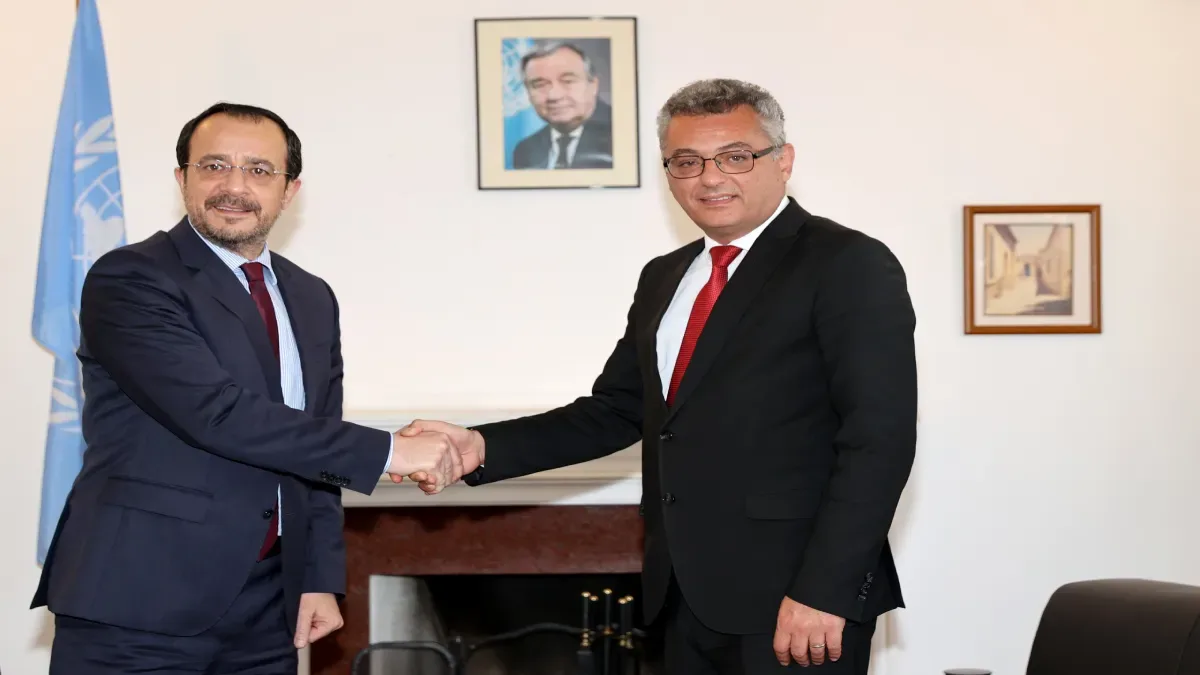
By Bosphorus News Geopolitics Desk
United Nations efforts to prepare another enlarged meeting on Cyprus are moving toward a more structured phase, with the UN Secretary-General's personal envoy saying confidence-building measures must produce results before the wider format is convened and that earlier negotiating convergences should not be reopened line by line.
María Ángela Holguín Cuéllar, Personal Envoy of the Secretary-General on Cyprus, described confidence-building measures as an "indispensable condition" ahead of a possible enlarged meeting, arguing that practical cooperation between the two communities should be tested before negotiations return to the core settlement issues.
Her comments come as Greek Cypriot negotiator Menelaos Menelaou accused the Turkish side of slowing preparations for the next meeting and called for negotiations to resume on the basis of a federal settlement and the convergences accumulated during previous rounds.
Holguín rejected attempts to reduce the current difficulties to a question of blame, saying that presenting confidence-measure talks simply as one side accepting proposals and the other rejecting them was not entirely accurate.
Holguín puts confidence measures before enlarged meeting
Holguín said confidence-building measures should produce practical results rather than serve only as political gestures.
UN Secretary-General António Guterres had already linked another enlarged meeting to sufficient preparation during his late-July contacts with Greek Cypriot leader Nikos Christodoulides and Turkish Cypriot leader Tufan Erhürman.
Holguín went further in her August 9 remarks, arguing that any renewed process should operate under agreed rules, with a defined sequence and clearer accountability instead of returning to an open-ended negotiating format.
She said Christodoulides and Erhürman had indicated a willingness to discuss the principal settlement files, including governance, property, territory, security, guarantees and the role of the European Union.
Her description of confidence-building measures goes further than the position recently expressed by the Republic of Cyprus presidency, which has said such steps could improve the atmosphere but should not become a prerequisite for convening another enlarged meeting.
UN compiles earlier negotiating convergences
Another part of the UN preparations concerns the agreements and partial understandings accumulated during previous rounds of negotiations.
Holguín said the United Nations has spent months compiling a document from its records covering earlier convergences between the two sides. She argued that those points should be preserved rather than negotiated again individually when substantive talks resume.
A convergence does not constitute a final settlement under the long-standing principle that nothing is agreed until everything is agreed. Holguín's position is that reopening each point already negotiated would consume time before the parties reach the issues that remain unresolved.
Menelaou said the Greek Cypriot side expects the document to be circulated to the two sides on the internal aspects of the Cyprus issue and to the guarantor powers on external questions.
Türkiye, Greece and the United Kingdom are the three guarantor powers under the 1960 Treaty of Guarantee.
Menelaou said the Greek Cypriot position remains that the convergences reached through the end of the 2017 Crans-Montana conference should be retained, allowing future negotiations to concentrate on outstanding disagreements.
Menelaou accuses Turkish side of slowing preparations
Menelaou said an enlarged meeting had previously been discussed for earlier dates and accused the Turkish side of delaying preparations.
He also said negotiations should remain within a federal framework with political equality and a single state, contrasting that position with Türkiye's continued support for a two-state settlement.
Holguín offered a different reading of the immediate obstacle. She said broad agreement had been reached in principle on several confidence-building measures, including crossing points and cooperation inside the United Nations buffer zone, but difficulties emerged when discussions moved from general agreement to implementation.
Crossing points remain one of the outstanding practical files, with differences over how proposed openings should be handled and whether individual locations can be separated from a wider package.
Türkiye maintains two-state position
The disagreement over preparations sits alongside the deeper dispute over the basis of a settlement.
Türkiye continues to support a two-state model, while the Greek Cypriot side is seeking a return to negotiations under the federal framework used in previous UN-led talks.
Foreign Minister Hakan Fidan reaffirmed Türkiye's two-state position on August 8 while arguing that practical cooperation in areas including energy, electricity, water and tourism should proceed even without agreement on the island's final political status.
Holguín's latest comments indicate that the immediate UN effort is concentrated on producing results from confidence-building measures, defining the negotiating method and compiling earlier convergences before another enlarged meeting is convened.
Christodoulides and Erhürman are scheduled to meet under UN auspices on August 26, with preparations for a new enlarged meeting and the resumption of substantive negotiations on the agenda.
Sources: United Nations, Cyprus Mail, Anadolu Agency, Bosphorus News review and reporting.