
By Murat Yıldız
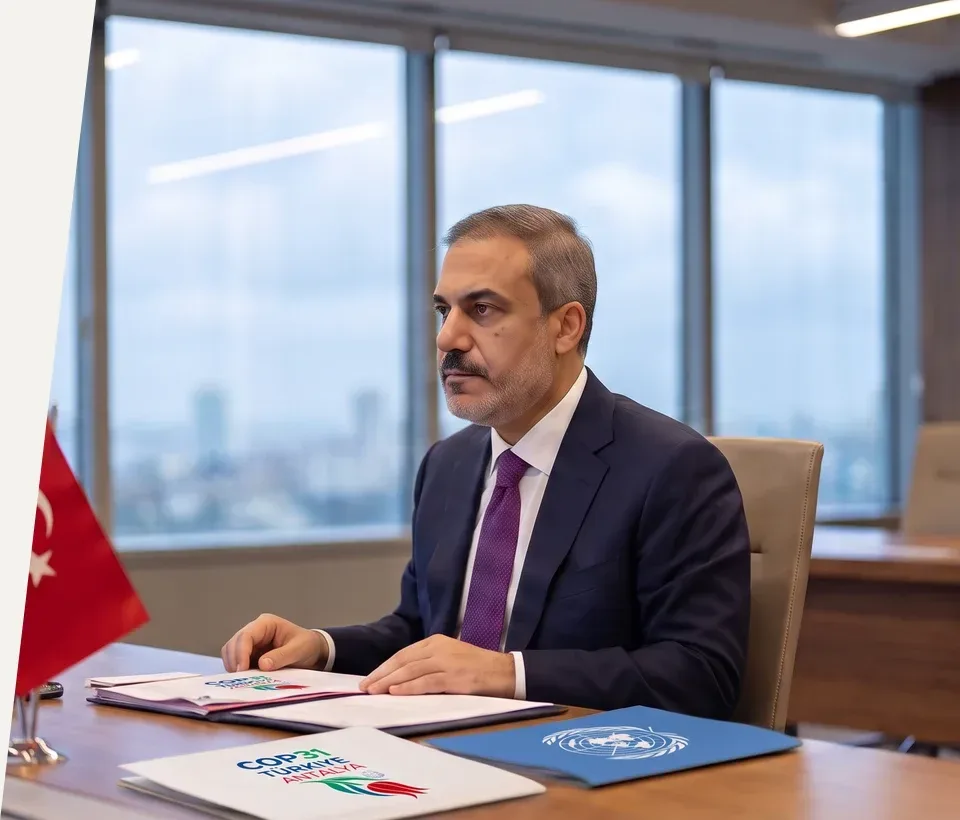
On November 19, 2026, Foreign Minister Hakan Fidan told Parliament's Plan and Budget Committee that hosting the United Nations climate summit in Antalya had shown that "we have a voice and influence in this field, too." He then confirmed his ministry's continued support for Feridun Sinirlioğlu's bid for United Nations secretary-general. I judge both efforts by the work his ministry did ahead of time to win over governments that could block the pact or the appointment.
On October 12, four weeks before the summit opened, the Council of the European Union published the bloc's negotiating position. It called for implementing the 2023 Dubai commitments, including the transition away from fossil fuels. The following week, Fidan met European Commission President Ursula von der Leyen and European Union foreign policy chief Kaja Kallas in Brussels. He returned on November 16, the day the first draft appeared. The European Union's position was already public when Fidan met its senior officials in Brussels.
The COP31 presidency's November 13 summary of consultations had already recorded the split. Some delegations wanted to reaffirm the transition away from fossil fuels, while others opposed singling out particular energy sources. The November 16 draft called for moving away from fossil fuels and phasing out inefficient fossil fuel subsidies. The November 19 revision dropped that language and a proposed minimum of $120 billion in adaptation finance. Saudi Arabia pressed for language on carbon capture and resisted naming fossil fuels. The final draft for the parties to the Paris Agreement recalled the United Arab Emirates Consensus reached in Dubai and omitted its explicit call to move away from fossil fuels in energy systems.
Presidential Circular No. 2025/20 designated Environment Minister Murat Kurum for the COP31 presidency and put his ministry in charge of coordinating the conference. Delegates elected him president at the opening meeting on November 9. The agreement with Australia gave its climate change and energy minister, Chris Bowen, exclusive authority over the formal negotiations. Ankara and Canberra had to keep consulting until they resolved any differences. A stalemate could force Kurum and Bowen to settle differences between their own governments while trying to bring the delegations together.
Under Article 128 of Presidential Decree No. 1, the Foreign Ministry coordinates foreign policy and handles contacts with foreign governments in cooperation with the relevant institutions. Kurum and Bowen needed to know whether Brussels would settle for a reference to Dubai alone and whether Riyadh would accept explicit fossil fuel language alongside provisions on carbon capture. Fidan's team needed to brief both men before the November 19 draft went to delegates. Parliament's published summary of his budget presentation that day gives no details of any efforts by the ministry to test those positions.
With the conference already in overtime, Kurum was still consulting with the European Union, Australia and Saudi Arabia. TRT Haber reported that Kurum brought the European Union and the Arab Group together after meeting them separately and that the COP31 presidency prepared three compromise texts. Bowen said his team was still trying to broker a deal on the final night.
"Only a few minor issues remain," Kurum told reporters shortly before the November 22 plenary. After the Antalya Pact failed to secure consensus, he ruled out another draft and blamed some countries for getting stuck on "a word or a phrase" and bringing up issues unrelated to climate. Kurum left the countries and issues unnamed. The plenary record shows objections over fossil fuels and adaptation finance. Ireland's climate minister, Darragh O'Brien, objected on behalf of all 27 members of the European Union to a climate agreement that left out fossil fuels. The African Group was prepared to accept the pact even as it questioned how adaptation finance could be tripled without a clear baseline.
Delegates agreed separately to complete the Adaptation Fund's transition to serve only the Paris Agreement. Türkiye owed them an explanation of where its efforts to reach a deal on the pact had broken down. Kurum chose to blame the countries he was supposed to bring together.
The Directorate of Communications' English-language site and the multilingual outlets of the Turkish Radio and Television Corporation (TRT) and Anadolu Agency gave Türkiye a way to explain its diplomacy abroad. In his message on Türkiye's bilateral meetings at the leaders' summit, Communications Director Burhanettin Duran praised Türkiye's role in seeking solutions and left its goals for the climate talks unexplained.
In Brussels on November 16, Fidan met his German and Greek counterparts, Johann Wadephul and Giorgos Gerapetritis. Germany went on to convene governments that wanted the Antalya Pact to name fossil fuels. Gerapetritis had already said on November 4 that Greece, which holds a Security Council seat, would withhold support for Sinirlioğlu.
The Republic of Cyprus had reason to challenge the nomination. At the November 6 General Assembly dialogue, its representative cited a 2022 letter disputing the republic's legal status. Sinirlioğlu sent the letter as Türkiye's permanent representative to the United Nations and stated that he was acting on his government's instructions. The representative asked whether he would work to implement the Security Council's Cyprus resolutions. Sinirlioğlu said the United Nations Charter would guide him on Cyprus.
Fidan and his diplomats deserve credit for the deal they struck with Athens in 2024. Türkiye and Greece agreed to back each other's candidates before the appointments came up in Valletta. Sinirlioğlu became secretary-general of the Organization for Security and Co-operation in Europe, and Greek diplomat Maria Telalian was named to lead its Office for Democratic Institutions and Human Rights. All 57 participating states, including the Republic of Cyprus, backed all four appointments.
To secure a Security Council recommendation, Ankara needed at least nine votes and no veto. Türkiye submitted the nomination on October 30, and the United Nations circulated it on November 1. In Atlanta, Fidan spoke of informal contacts ahead of the nomination and left Ankara's prospective supporters unnamed.
In Sinirlioğlu's first straw poll, on November 5, Security Council Report reported three ballots to encourage his candidacy, eight to discourage it and four expressing no opinion. PassBlue reported five votes in support and ten against in the November 20 straw poll. Four of the five permanent members cast ballots to discourage his candidacy. The race remains open. Even the front-runner, Costa Rica's Rebeca Grynspan, faced opposition from two permanent members.
Fidan owes Parliament and the Turkish public an account of the compromises his diplomats tested before the COP31 presidency dropped the fossil fuel language and the votes Ankara counted on before it nominated Sinirlioğlu.